

The idea of the “broke college student” is nothing new. In fact, it is often the expectation. But in reality, students are not sacrificing luxuries like a night out or midday coffees to get by. For the 40 percent of college students in this country who face food insecurity, the real sacrifice for their education is often their next meal.
“In theory, these students have done everything right,” says Jaime Lechner, a Class of 2025 graduate from Niagara University in upstate New York. “You know what we were told growing up: go to college, after college you get a job, start your life, that type of thing. But a lot of people now—current students [and] recent graduates—realize that the way things are, that’s not going to be what’s happening for us.”
Lechner, a political science and international studies student, first heard about college student hunger in early 2023 while on a lobbying trip to Washington, D.C. for her campus’ social work department. During this trip, she learned about the Opportunity to Address College Hunger Act, proposed federal legislation to ensure that college students nationwide know when and how they qualify for the federal Supplemental Nutrition Assistance Program (SNAP). The bill was introduced by Representative Suzanne Bonamici of Oregon and is currently with the House Committee on Education and the Workforce.
“Navigating SNAP eligibility is complicated and confusing, and leaves college students struggling to figure out what kind of support they can access.”
“It grabbed my attention because [it] was so simple in nature . . . something that you would think would already be occurring,” Lechner said. “It was leveraging information that the government already possessed in order to help people in a meaningful way, with little to no fiscal impact. . . . When I was reading the bill, I knew that I could not affect anything at the federal level, but I could do a smaller-scale version of the bill back home, on my campus.”
That summer, she decided to create a SNAP eligibility fact sheet for her peers experiencing food insecurity at her school. She quickly ran into a large problem, the same one students across the country face: Navigating SNAP eligibility is complicated and confusing, and leaves college students struggling to figure out what kind of support they can access.
“The information was not accessible or easy to understand,” she said. “Thankfully, I was able to sit down with my phone and my laptop for three hours and make a bunch of phone calls, but even after three hours, I did not have any information on what student eligibility would be like in New York.”
The federal government’s complex, ever-changing student eligibility requirements for SNAP makes it difficult for college students to access food. Adding to this complexity is the fact that states interpret these rules differently. For example, in Massachusetts, students who receive a MASSGrant financial aid award are eligible for SNAP, but the grant is only available to state residents.
Thankfully, Lechner and others across the country are stepping up to fill the gaps. Their state-level legislative actions—and the students they would benefit—deserve our full support.
The SNAP for Students Act
Even when they qualify based on income, college students are ineligible for SNAP benefits unless they meet specific conditions (“exemptions”), such as working over 20 hours a week, holding a federal work-study job, or caring for young children.
But even many eligible students don’t apply to SNAP because the process is so time consuming. While the initial application can take under an hour, students need to prove that they are eligible for an exemption by collecting myriad documents, including those related to their expenses, college enrollment, and financial aid status. Collecting all of this information—both initially and when students need to reapply for benefits—can be a significant barrier.
This is especially true given that, according to one study, roughly two-thirds of college students reported working while in school, and of this group, almost half were working full-time. Additionally, roughly 20 percent of college students are parents or legal guardians, further limiting available time to chase down SNAP paperwork.
Nationwide, 1.1 million college students currently receive SNAP. An estimated 3 million additional students would qualify based on their income and exemptions, but are not enrolled. According to the College SNAP Project, over 350,000 students in New York are eligible for SNAP, representing a third of all New York college students. However, more than half of these students are not enrolled.
“A lot of the issue is that people do not know where to go for help,” says Lechner. “[And] students are unaware that the benefits are out there [and] that they may be eligible.”
“A lot of the issue is that people do not know where to go for help.”
Lechner’s SNAP for Students Act (A08757 / S08347) would require New York higher education institutions to use existing information channels to notify college students about SNAP benefits, eligibility, how to apply, and where to get more information.
To draft her bill, Lechner studied the Opportunity to Address College Hunger Act and other New York State laws to ensure the bill had the right pieces and language. “I already knew what I wanted to accomplish . . . and I kept that in mind throughout the whole process,” she said.
In May 2025, Lechner shared the bill with State Senator Robert Jackson’s office. That evening, she received an email notifying her that Senator Jackson would introduce the bill the following day. Similarly, Member Phara Souffrant Forrest with the New York State Assembly became a quick supporter.
“I figured I’d have to pitch the idea Shark Tank–style,” Lechner joked. “But they were like, ‘Hey, we love the idea. Is there any other information you want to tell us?’”
The bill has a ways to go. It is currently in the Social Services Committee in both the New York State Assembly and Senate, waiting to be put on the committee agenda for a vote. Lechner is hopeful that it will be voted on this session, which ends in June.
If passed, the bill would come at a critical moment. Lechner describes a palpable feeling of panic among today’s college students and recent graduates as they try to juggle continuing their education and staying afloat in today’s economy.
“I think for students right now, what they’re probably feeling is uncertain about their future,” she says. “Uncertain about their health care, uncertain if they’re going to have food tomorrow to eat, uncertain about how all this is going to affect their schoolwork or their professional work stuff, or even their families.”
More State-Level Solutions
That uncertainty is widespread. More than 6 million college students face food insecurity across the United States. When students constantly have to choose between their education and their next meal, many pick the latter; about 41 percent of students who left college did so for financial reasons, and food-insecure students are significantly less likely to graduate compared with food-secure students. Food insecurity derives from a number of factors, such as the cost of food, not having transportation to food sources, or school schedules clashing with grocery-store and dining-hall hours.
States are increasingly recognizing the significant and growing issue of college food insecurity. California has been a longstanding leader in this space, including with the Plan Against College Hunger Act (PACHA). This plan provided grant awards to eligible college students equal to the cost of a meal plan covering 10 meals a week. The award aimed to support college students who were ineligible for CalFresh, California’s version of SNAP.
“More than 6 million college students face food insecurity across the United States. When students constantly have to choose between their education and their next meal, many pick the latter.”
While PACHA ended in 2022, California prepared other actions to improve food access on college campuses. The state started setting aside annual funds in 2021 for public colleges and universities to establish and operate basic needs centers, which often include food pantries, toiletries, diapers and other childcare essentials, and additional health resources. The California State University and University of California systems each receive $15 million, and California Community Colleges receive $30 million annually. As of 2023, every public higher education campus in the state has a basic needs center and food pantry.
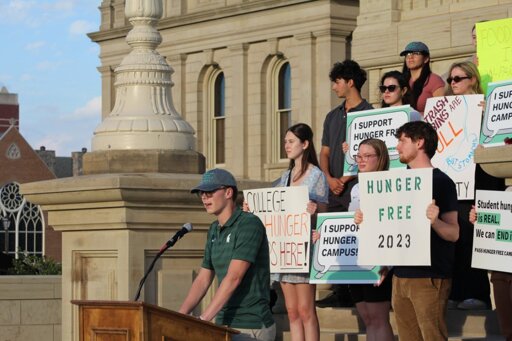
Another solution is the Hunger Free Campus bill, a state-level policy framework created by Swipe Out Hunger, the organization that I lead. The framework dedicates funding to public colleges to support campus food-access programs. Twelve states across the country—Washington, California, Minnesota, Michigan, Illinois, Oklahoma, Louisiana, Virginia, Maryland, Pennsylvania, New Jersey, and Massachusetts—have passed this bill, and another 11 states have introduced it.
Each state has tailored the bill to its students’ specific needs and determined which agencies would be best suited to fund the bill, allowing for more effective solutions. As a result, the more than $36 million distributed by these states since 2017 has led to new on-campus food pantries, improved access to fresh produce through partnerships with farmers’ markets, and added staffing to help students obtain support for basic needs.
Bracing for the Future
Legislation that funds food-access programs will be especially critical in the coming years. The passage of H.R. 1, also known as the “One Big Beautiful Bill Act,” last July represents the largest cut to SNAP funding in the program’s history, slashing an estimated $186 billion in federal support. This will put a significant burden on states to fund the program in the coming years.
Additionally, last November, the U.S. Department of Education announced a restructuring of the Fund for the Improvement of Postsecondary Education (FISPE). This action would effectively discontinue the Basic Needs Grants, the only federal program dedicated to funding basic needs access for college students.
“At a time when it feels like the federal government is leaving so many people behind, it is critical to remember that policy avenues still exist.”
While Congress voted to fund the Basic Needs Grant in the most recent budget bill, jeopardizing this resource through restructuring signals a significant deprioritization of college students at the federal level.
But this is not the way that the government has to—or should—work. At a time when it feels like the federal government is leaving so many people behind, it is critical to remember that policy avenues still exist.
States have the power to set their own priorities and stand behind efforts to end college student hunger, and legislators and advocates across the country are working to make that happen. Jaime Lechner is one such person—and began her journey from a core belief that politics can spark positive change for people across the country.
“I fell in love with government work because I thought it could be my best way to help the most amount of people in my lifetime … The fact that [politics] helps people fuels my excitement and passion for the work, especially for the bill itself.”
She’s not alone in this belief; 38 state groups have signed a letter of support for the bill, including multiple anti-hunger organizations, Canisius University, and Niagara University. Now, it’s up to the New York State Senate and Assembly to put this bill on the agenda and take action for college students across the state. According to Senator Jackson, this is a necessary step.
“Colleges and universities want to help their students to be successful and have the energy and the means to get a good education,” he said. “And that’s what this is about.”
The post Op-ed: 6 Million College Students Are Food Insecure. State SNAP Solutions Could Be a Lifeline. appeared first on Civil Eats.
From Civil Eats via This RSS Feed.