

More than a week has passed since the United States and Israel launched a joint attack on Iran. The assaults on the Islamic Republic have already claimed over 1,000 lives, including Ayatollah Ali Khamenei, and have been met with a swift response by Iran’s security forces. In retaliation for the attacks on its territory, Iran has effectively closed the Strait of Hormuz, a central shipping artery through which over 30% of the world’s crude oil trade passes and 20% of global liquefied natural gas (LNG) exports. This has disrupted global energy supplies, and just in the last week, the international Brent oil price has seen considerable increases and fluctuations.
Countries across Asia depend on imported oil and gas from Gulf countries that are currently facing major logistical challenges to export due to the Strait of Hormuz closure. Qatar, one of the world’s largest exporters of natural gas, also announced the suspension of production due to the war.
In response to the energy supply shake up, Asian countries have been forced to adopt emergency measures to mitigate the shortages of energy supplies and the rise in global crude prices.
India sees price hikes and rationing
On March 7, the Indian government announced an increase in the prices of cooking gas by 60 rupees per cylinder (over half a US dollar), citing the war as the cause of the price hike. The Ministry of Petroleum and Natural Gas also issued a rationing order on Monday, March 9, prioritizing essential services for supply of LPG cylinders. Reports have already begun to surface regarding shortages of cooking gas which has forced restaurants to shut down their business in different cities, despite the government’s initial claims that they have reserves which can last for weeks.
Oil prices, standing at around USD 60 per barrel before February 28, almost doubled on Monday, with the price approaching USD 120. So far, the Indian government has discarded the option of raising consumer fuel prices, but experts speculate that it might change course in the coming days.
Left parties in India have claimed that the governments’ policies are solely responsible for the energy crisis, as they failed to assess the impact of the war and shape a response on time.
Along similar lines, Pakistani government increased fuel prices by 20% last week, in what is considered to be the largest one-time increase ever.
Four-day work week
On Monday, Pakistani Prime Minister Shehbaz Sharif announced a four-day work week for the public sector and a two-week national school closure to minimize the consumption of energy products, Sharif said, asking provincial governments to implement additional fuel-saving measures. He declared that the country will have to use the existing reserves “judiciously,” as prices of oil in the international market may increase further in the coming days.
In the Philippines, the government led by Bongbong Marcos Jr. also announced the adoption of a four-day work week for public sector employees to cut energy consumption in the face of the war and increased fuel prices. Vietnam has asked people to avoid unnecessary use of vehicles and work from home.
Protests continue
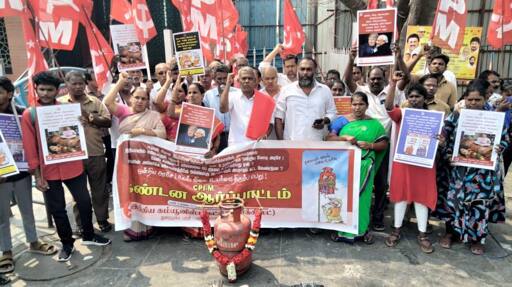
As governments across Asia scramble to mitigate the impacts of the energy shortages and price increases, protests against the war continue.
In India, several anti-war demonstrations were organized throughout the week, with protesters condemning the failure of the country’s ultra-right-wing government led by prime minister Narendra Modi to officially denounce the war. So far – despite the country’s claims to share historic relations with Iran and repercussions to be felt by millions of India’s citizens working in Arab countries – the Indian government has refused to condemn the attacks on the Islamic Republic, merely expressing concerns over the situation.
In a large meeting in Ernakulam, Kerala, on Sunday, chief minister Pinayarai Vijayan reiterated that the US and Israel are rogue nations attempting to create chaos and destruction in the region. He demanded that the Indian government condemn the US-Israeli aggression in Iran and adopt an anti-war position.
The country’s farmer organizations also organized anti-war protests across the country throughout the week.
Thousands of people have been mobilizing in the streets in Jammu and Kashmir in northern India since the beginning of the war. The protesters have expressed their support and solidarity with the Iranian people.
M A Baby, general secretary of the Communist Party of India (Marxist) had earlier demanded that instead of remaining silent on the repeated violations of international law by the US and Israel, India should “play a lead role in rallying all democratic voices together so that there is a cessation of violent attacks and counter-measures.”
Opposition parties and civil society groups in the country have accused the Modi government of having “surrendered” the country’s interests to the US by compromising on principles of anti-imperialism that had shaped India’s foreign policy for decades. Their criticism also focused on the government’s behavior vis-a-vis US attacks on an Iranian ship in the Indian Ocean on March 4, in which over a hundred people were killed. The ship IRIS Dena was attacked near India’s maritime borders as it was returning home after attending a naval exercise in India, where it had been officially invited.
Demands echoed in other countries in the region
The Shehbaz Sherif government in Pakistan has condemned the US-Israeli aggression in Iran, yet the opposition continues to demand a much stronger position. Several left groups including the Haqooq-e-Khalq Party (HKP), Awami Workers Party (AWP) and Tehreek-e-Tahafuze-e-Ayin-e-Pakistan (Movement to Save Pakistan’s Constitution), as well as the broader opposition party Pakistan Tehreek-e-Insaaf (PTI), have been organizing protests and meetings demanding the government cease all cooperation with the United States and President Donald Trump.
Similarly, left and progressive forces in countries such as Malaysia, Philippines, South Korea have organized protests against the war on Iran and demanded an immediate end of all hostilities. They also called on their governments to intervene to secure peace and stability.
The post Asian countries adopt emergency measures to cut fuel consumption amid US-Israeli war on Iran appeared first on Peoples Dispatch.
From Peoples Dispatch via This RSS Feed.