

The war on Iran was decades in the making, but is finally here. Decades of US-led economic sanctions proved ineffective in toppling Iranian sovereignty. Faced with Iran’s refusal to capitulate under economic pressure, the US and Israel pursued the much riskier strategy of an unprovoked military war of choice; this war’s unstated objective, given that regime change will not succeed, is to reduce Iran to a failed and dependent state. From the vantage point of US-Israel, Iran should be forever “neutered” under the command and control of their regional dominance. As the war enters its tenth day, Iranian resistance has frustrated the US-Israeli show of force.
Inside Iran, we all knew that the war would eventually come to us; however, people did not panic and life went on. The first US-Israeli bombs dropped on Saturday morning (February 28). I heard the Iranian interceptors engaging the US-Israeli bombing campaign, and then witnessed an explosion. Meanwhile, security forces, most of whom were in plain clothes, entered my street to block traffic and keep order.
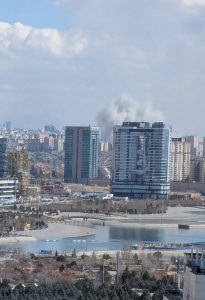
Tehran, photo by author
I live in Central Tehran, and just one block from me happens to be one of the largest Iranian Revolutionary Guard Corps garrisons where soldiers reside and train during their conscription. Since it was almost certain that the US and Israel would bomb the garrison, I headed to a friend’s place in West Tehran where the likelihood of imminent attacks were, at the time, lower. The next day, the bombs dropped. The US and Israel bombed my neighborhood, targeting the garrison and more, which shook the civilian population and shattered windows in our residential apartments.
Since February 28, the US and Israel have attacked several military and civilian locations. The civilian locations include homes, schools, businesses, and hospitals. As press outlets have reported worldwide, in Minab, a city in Iran’s south, the US bombed an elementary school, killing at least 168 girls. The historic Tehran bazaar and the Qajar-era Golsten Palace sustained damage during nearby explosions. Near my home, the iconic “Dey” fried chicken restaurant was destroyed and the female owner was killed. There are too many examples of death and destruction to enumerate here. On March 4th, the Ministry of Health recorded the death toll at 926, a number that will increase by mid-March. Industrial and energy infrastructure also sustained damage and destruction. On March 7, the Tehran’s oil refinery was bombed, creating black smoke in the atmosphere and darkened rain droplets, resembling scenes from the “Chernobyl” nuclear power plant disaster.
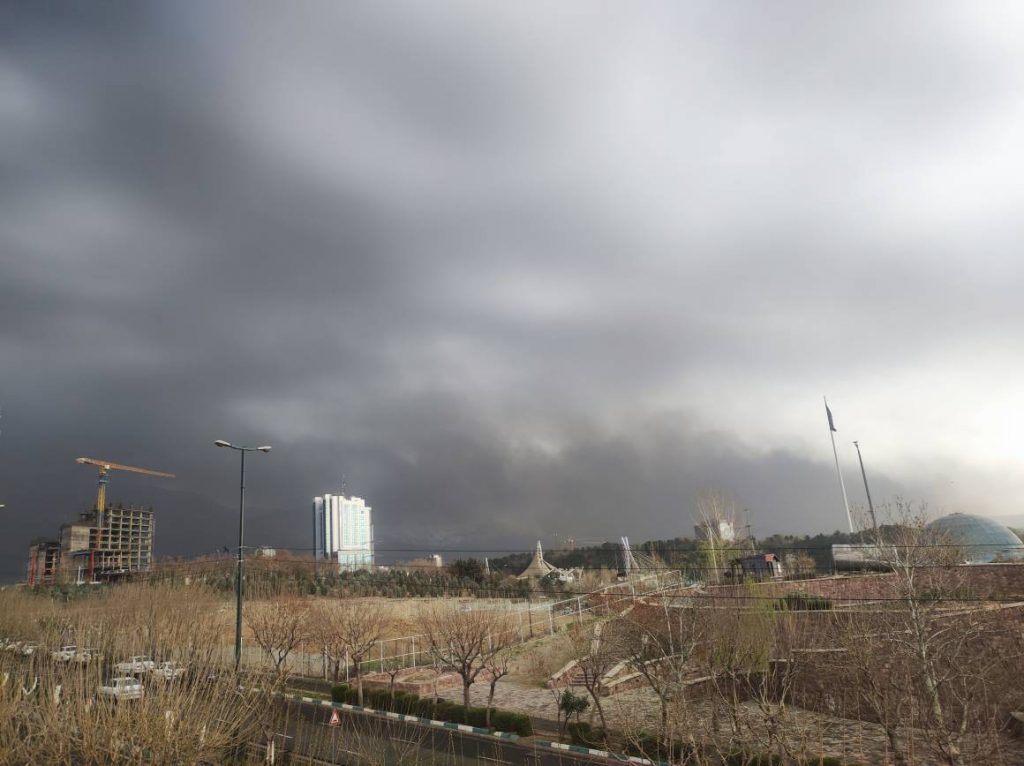
Photo by author
This time, Iran did not show restraint and retaliated forcefully, from day one, against US regional bases and Israel. Iranian media reports indicate that Iran’s missiles have destroyed key US war infrastructure in the region, including radar and missile defense systems, which has meant easier passage for Iranian missiles into Israel. Moreover, it appears Iran has followed US soldiers and officers who had vacated their bases, targeting their temporary residence with missiles. Iranian media are reporting U.S. causalities in the hundreds, a number which they claim U.S. authorities are suppressing for domestic audience. It is impossible to confirm these numbers. Iranian retaliation further targeted the global economy; Iranian armed forces warned that they would attack ships linked to adversarial countries that pass through the strait of Hormuz; this has effectively closed the strait, disrupting the capitalist world economy.
Iran has, thus far, boosted security forces at its borders and bombed certain Kurdish locations in Iraq to prevent a threatened US-supported intrusion from border towns there. Every night too, the Iranian people gather in major squares and mosques to demonstrate support of Iran’s sovereignty. The “uprising” that Trump talked so much about in the first days of the bombing is nowhere to be found. This has thwarted the foreign-aligned opposition, some of whom restored to violent confrontation during the January protests, from sowing civil unrest.
Iran’s forceful response came after the assassination of its leader, Sayyid Ali Khamenei. Iranian opposition media pushed a massive misinformation campaign that he had either hid in a bunker for months or fled to Moscow. All of this proved false. At the time of the assassination, he was in his public residence attending to his duties. To outsiders, this may appear as a bizarre security lapse that failed to protect the country’s top command; but, from a Shia spiritual perspective, people here view this as the Iranian leader standing tall against the oppressors and achieving martyrdom. For years, the Western-controlled media had suggested that the entire political system was built around his person. The Iranian opposition too believed that once he is killed, the Islamic Republic would collapse within days or even hours. All of this also proved false. The Iranian political system remained intact and Iran retaliated as it would have under his leadership.
What has impressed me during the present war is, the ability of Iranians to live amicably together despite the divisions that exist in Iranian society. In the first few days, there were long lines at gasoline stations as many were aiming to leave Tehran for more secure villages. But, other than this, life has had a surprising degree of normalcy. Indeed, many of my friends refuse to leave for quiet villages, staying in the capital to assist their fellow residents. Some got busy on their phones and laptops to inform the world outside about the violence unleashed on them, although communicating with the world outside has remained a challenge with internet restrictions imposed due to the war. Others are preparing iftar meals for emergency and security personnel as they respond to the war situation.
Most shops have remained open and there is no food insecurity, although inflation continues to be a problem. People do not hoard; they buy things according to their everyday needs. Those public services, which have not been subject to the destruction of the war, operate as expected. There is a high degree of social solidarity amidst the chaos of destruction.
There remains political differences amidst the appearance of unity. There exists currents within Iranian sociality who view the US-Israeli attacks with an air of political innocence, oblivious to the history of US military interventions in the region that have generated prolonged insecurity. They believed these attacks would dismantle the Islamic Republic system quickly and with little harm to the country, after which they would decide on a government of their own choosing. Iranians in the Western diasporas, funded and amplified by warring interests, have put up a loud and embarrassing display of this pro-war position. Some inside the country, impacted by the relentless propaganda originating from the diaspora, have adapted the same position. But as the war becomes more violent, impacting civilians and their homes, Iranians inside Iran are waking up to the fact that this war was never about their welfare or “freedom.” They are beginning to realize that their lives, their properties, and their country’s territorial integrity are the target here. Many are actually now standing behind the state’s defensive efforts as it confronts the dual forces of the pariah apartheid state and a declining empire, which, having dispensed with the rhetoric of freedom and democracy, openly admits to its desire for domination and plunder.
From BT News via This RSS Feed.