


Bullets:
Iranian Shahed drones cost between $20,000 and $50,000 to build and launch at targets.
To engage and destroy the drones, American and allied forces in the Persian Gulf use multimillion-dollar interceptor missiles.
In an unusual instance, an RAF pilot in an F-35 shot down two Iranian drones over Jordan. But close examination of the costs reveals that the UK spent far over half a million dollars to intercept two drones worth less than a fifth of that.
Iranian drones are punching through theater air defenses, and hitting very high-cost targets of great strategic value. Advanced radar systems used in air and ballistic missiles defense, and facilities for communications networks have been blown up.
Ironically, Shahed launches are successful, whether intercepted or not: the benefit/cost ratio is favorable to Iran in the extreme, irrespective of the outcome.
Inside China / Business is a reader-supported publication. To receive new posts and support my work, consider becoming a free or paid subscriber.
Report:
Good morning.
Media in the UK are celebrating this news, out of a Royal Air Force base in Jordan. This pilot was flying an RAF F-35, and shot down two Iranian drones. He was the first UK pilot to fly a stealth aircraft to destroy a target in combat.
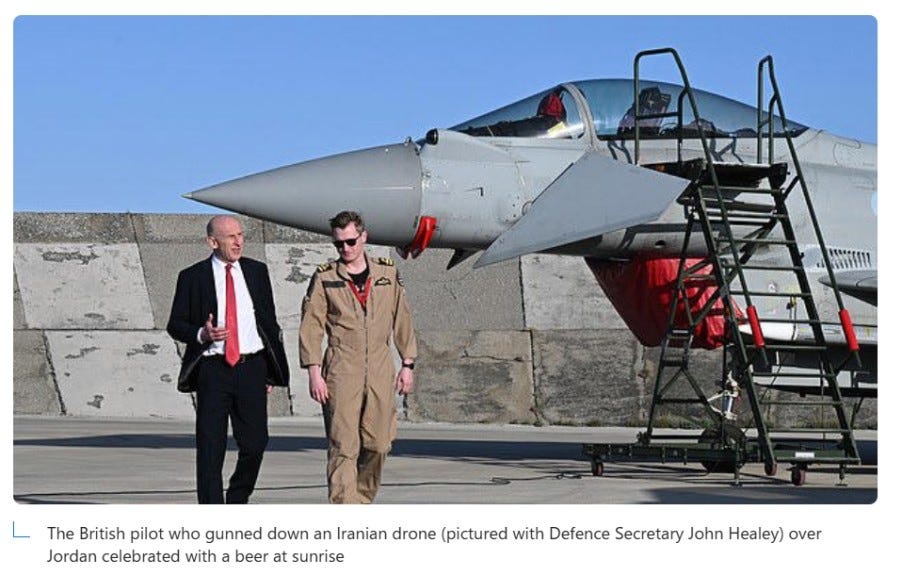
For security reasons, they didn’t provide his name, but for some reason they did put his photograph online, meeting here with the UK Defense Secretary.
The pilot flew for four hours, accompanied by two Typhoon jets, then destroyed two Iranian drones. ASRAAM are advanced, short-range, air-to-air missiles. He was airborne for four hours in an F-35. Just the flying alone carried a price tag of over $100,000. The cost per flight hour of the F35 is scandalously high, and recently the cost is over $33,000 per hour.
The Pentagon understood that operations cost for the F-35 was a grave concern a long time ago. Back in 2018, the Air Force was given a goal to reduce that cost to $25,000 per hour by last year, 2025. But defense officials at the time didn’t believe that objective was realistic at all: “Very difficult to meet”. It was a “stretch goal” from Defense Department leadership.
Granted this is the UK, not the United States. So the Royal Air Force may be running a much tighter ship. It’s hard to say. But assuming the UK can do it for far less, for $25,000 per flight operations hour, that still tells us that over $100,000 US was out the door before the drones were shot down, and we didn’t bother to check what it costs to fly the Typhoons around.
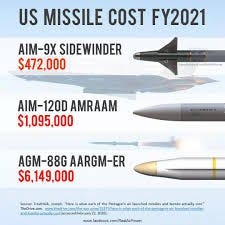
The pilot engaged the Iranian drones with ASRAAM missiles. It doesn’t say how many he used to shoot down two drones. But it was two, at a minimum. Here are the cost data on those: AIM-132’s were launched to intercept the drones, and cost $225,000 each. So at least two of those, plus the flight and operations cost, and the Royal Air Force spent far over half a million dollars to shoot down two Iranian Shahed drones.
Shahed drones cost between $20,000 and $50,000 to build. So the most optimistic cost-benefit case is that the UK Air Force spent $500,000, minimum, to destroy two drones that cost Iran $100,000, at the most.
And as bad as that is, for most of these engagements against Iranian drones, the math is a lot worse. The drones are typically intercepted using surface-launched missiles, and those cost much more. It’s a lot more expensive to shoot down a drone than to build one. Per interception, the cost ratio is AT BEST 10 to one. But it may be as high as 60 or 70 to one, according to insiders. Again, the cost to put them into the air and pointed to targets is $20 - $50,000. If Patriots are used to shoot them down, those are $3 million each. If medium-range air-to-air missiles are used instead, those go for over $1 million each:
So given these wildly disproportionate costs involved to engage, and intercept drones, compared to the costs to Iran to build and launch them, an obvious question arises—why bother shooting them down at all? And reading further we have our answer to that. The previous day a drone hit an RAF base in Cyprus, “raising major concerns about the standard” of air defenses there. The initial reports said that “damage was minor”, but later we learned that the drone hit a hangar used by U2 aircraft.
That also begs a lot more questions we’ll leave alone for now, but Iran is using these $50,000 drones to target assets of enormous strategic value. They destroyed an early-warning radar system in Qatar. That radar system tracks multiple inbounds at the same time, costs a billion dollars, and now it’s not working. These are “scarce”, these systems, and the higher-tier radar systems are fragile and easily damaged.
Elsewhere in Jordan, another drone took out a radar for ballistic missile defense. Other drones took out three radar domes used by American forces in Kuwait. They did more damage to communications systems used by the Fifth Fleet Headquarters in Bahrain. Another hit in Saudi Arabia.
Many of these drones are getting through, hitting key strategic targets vital to air defense and communications. In this one case, a $50,000 drone, at maximum, took down a one billion dollar-radar system. From the Iranian side, that is a 20,000 – to – 1 cost/benefit. And besides the money, it’s a theater-level asset that tracks inbound ballistic missiles, that is offline, indefinitely.
So the RAF should be happy. It’s little wonder they put their Defense Secretary on a plane to Jordan for handshakes and photo ops. They spent $500,000, or so, to destroy Shahed drones worth $100,000, or so. Eventually they’ll go broke doing that. Because theater-wide, nobody can afford to shoot down those Iranian drones. But they also can’t afford not to.
Be good.
Resources and links:
Low cost, high stakes: The vital interceptor missiles defending Gulf states against Iran’s drones
https://www.thenationalnews.com/news/gulf/2026/03/06/low-cost-high-stakes-the-vital-interceptor-missiles-defending-gulf-states-against-irans-drones
Wall Street Journal, Iran Is Hitting the Radars That Underpin U.S. Missile Defenses
https://www.wsj.com/world/iran-is-hitting-the-radars-that-underpin-u-s-missile-defenses-2edbfccc
New York Times, Iran Strikes U.S. Military Communication Infrastructure in Mideast
https://www.nytimes.com/2026/03/03/world/middleeast/iran-strikes-us-military-communication-infrastructure-in-mideast.html
The New Era of Drone Warfare Takes Root in Iran
https://www.cfr.org/articles/the-new-era-of-drone-warfare-takes-root-in-iran
New York Times, Iran’s Drones Cost a Fraction of the U.S. Weapons Shooting Them Down
https://www.nytimes.com/2026/03/04/business/iran-shahed-drones-missiles-us-war.html
JPO Seeks to Slash F-35A Flight-Hour Costs
https://www.airandspaceforces.com/jpo-seeks-to-slash-f-35a-flight-hour-costs
RAF pilot who gunned down Iranian drone and made history celebrated with a sunrise beer
https://www.msn.com/en-my/news/other/raf-pilot-who-gunned-down-iranian-drone-and-made-history-celebrated-with-a-sunrise-beer/ar-AA1XC3uP
Inside China / Business is a reader-supported publication. To receive new posts and support my work, consider becoming a free or paid subscriber.
From Inside China / Business via This RSS Feed.
Nobody can afford to shoot down Shaheds at this cost ratio indefinitely, but in the short term it’s fine. The strategic assumption is that the US and Israel will be able to destroy the Iranian drone manufacturing before they run out of money.
Whether that’s true or not is another matter.
Wouldn’t you need to factor in the damage the drones would have caused if they weren’t intercepted?
If someone is held hostage with a rusty kitchen knife, no one would argue that a police operation with cars, lots of personnel, medics, expensive weapons etc. is too expensive because the knife is so cheap.
I’d argue that defense or counter-offense is always more complex and expensive than offense because it needs way higher accuracy and flexibility.
