

Red-tagging is not just a smear campaign.
By Shan Kenshin Ecaldre
Bulatlat.com
Cabuyao City, LAGUNA —Yet another familiar script.
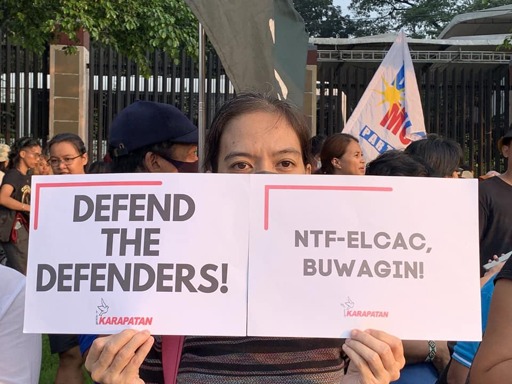
This was the reaction of community organizer Jeverlyn Seguin when she first heard that she and three other activists were being targeted by a proposed persona non grata resolution from Armed Forces of the Philippines (AFP) and National Task Force to End Local Communist Armed Conflict (NTF-ELCAC) in Bacoor City.
“It starts with threats,” she said in a statement. “Then harassment. Then red-tagging and fabricated accusations. We have seen this pattern before in Southern Tagalog.”
Seguin, who has long worked with farmers, workers, and urban poor communities in the region, is one of the four activists identified in a proposal to declare persona non grata in Bacoor, Cavite.
The other three were Aries Soledad, coordinator of fisherfolk group Pamalakaya–Cavite; Paolo Tarra, coordinator of the Coalition of Concerned Lasallians; and youth activist John Peter Angelo “Jpeg” Garcia, former chairperson of Youth Advocates for Peace with Justice–UPLB and third nominee of Kabataan Partylist in the 2025 elections.
The resolution was reportedly pushed before the Bacoor City council but did not move forward. Activists said that concerns over legal implications, particularly a Supreme Court ruling recognizing the dangers of red-tagging, may have prevented its passage.
Still, organizers said that the attempt reveals a deeper problem of the continuing use of public institutions to vilify critics and grassroots leaders.
“These are people who have spent years working alongside fisherfolk, farmers, workers, and young people,” Defend Southern Tagalog said in a statement. “Trying to brand them as unwelcome in their own communities is not governance. It is harassment dressed up as legislation.”
Taking the fight to the CHR
On March 6, several activists from Southern Tagalog brought their complaints to the Commission on Human Rights (CHR), citing intensifying attacks against organizers and community leaders in the region.
Among those who filed complaints were Seguin, Tarra, Soledad, and Garcia who said that they were repeatedly subjected to red-tagging, harassment, and intimidation, particularly through online platforms.
The filing coincided with a press conference commemorating the fifth anniversary of the Bloody Sunday massacre in Southern Tagalog.
For Tarra, the proposed resolution was not just a political maneuver but part of a broader climate of hostility against activists.
“Red-tagging is not just a smear campaign,” he said. “It places activists and community workers in real danger. Instead of addressing the urgent problems our communities face, government institutions are being used to silence dissent.”
“The attempt to label youth activists as enemies of the state only shows the government’s fear of organized young people,” Garcia said in a video message. “Young people who stand with workers, farmers, and marginalized communities.”
Memories
Soledad recalled how similar vilification campaigns preceded the killing of Bayan Cavite coordinator Emmanuel “Manny” Asuncion during the coordinated police operations on March 7, 2021, now widely known as Bloody Sunday.
Before the raids that left nine activists dead across the region, victims had been repeatedly accused online and in public forums of being linked to communist groups.
“We saw what happened to Manny,” Soledad said. “He was red-tagged again and again before he was killed. That is why we take these threats seriously.”
Human rights advocates have pointed to a 2022 Supreme Court ruling that recognized red-tagging as a threat to life, liberty, and security, warning that such labeling has historically preceded surveillance, harassment, and violence.
For activists, even the proposal of a persona non grata resolution can have consequences.
“It isolates people. It makes them targets,” Seguin said. “And it legitimizes suspicion against those who are simply speaking out.”
Voices from detention
The CHR complaints were not limited to red-tagging.
Former political prisoners Erlino Baez and Wilfredo Capareño also filed complaints, describing harsh jail conditions and the pressures faced by political detainees.
Both men were released on March 2 after a regional trial court in Lucena City dismissed the charges of illegal possession of firearms and explosives against them, granting their demurrer to evidence after nearly five years of detention.
“For almost five years we were deprived of our freedom based on fabricated charges,” Baez said. “Our experience shows how the justice system can be used to persecute activists.”
Capareño said that political detainees often endure overcrowded jails and limited access to basic services.
“Many are pressured to admit to crimes they did not commit,” he said. “These conditions violate our dignity and our rights.”
Under pressure
Other complaints brought before the CHR highlighted continuing tensions in rural communities.
Justin Umali of Bayan Laguna cited the situation in Lupang Casile where farmers asserting land rights have reportedly faced intimidation from private security forces.
“Instead of protecting farmers, authorities allow private interests to terrorize communities demanding genuine land reform,” Umali said.
Community organizers also reported the arrest of 21 farmers and residents linked to the land struggle.
Meanwhile, protesters who joined the EDSA@40 mobilization filed complaints against police officers they accused of harassment and intimidation during their march toward the EDSA Shrine.
Dissent not a crime
Activists are now calling on the Bacoor local government to formally withdraw and junk the proposed persona non grata resolution.
For them, the issue goes beyond the four individuals named in the proposal. “Local governments should focus on serving their constituents,” Defend Southern Tagalog said, citing unresolved issues in Bacoor including coastal reclamation projects, threats to fisherfolk livelihoods, and housing insecurity among urban poor families.
For Seguin, the controversy is also a reminder of why community organizing continues despite risks. “We work with farmers who are fighting for land, fisherfolk struggling to keep their livelihoods, and families facing demolition,” she said. (DAA)
*Disclosure: Justin Umali is a contributor to Bulatlat.
The post Southern Tagalog activists slam persona non grata bid appeared first on Bulatlat.
From Bulatlat via This RSS Feed.