

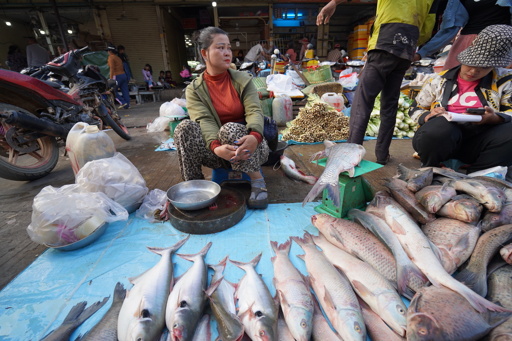
STUNG TRENG, Cambodia — Sunrise is still a long way off when the first fishing boats slip into the landing site at this provincial town along the Mekong River in northern Cambodia. The night’s catch is hauled ashore and moved in tubs and woven baskets to a nearby side street off the town’s main boulevard. By daylight, vendors have arranged the fish across tarps and reed mats laid directly on the street. Snakeheads, catfish, barbs and loaches lie in dense, gleaming rows as the market swells into a blur of motion and sound. Motorcycles crowd the edges while buyers weave through narrow passageways. Vendors weigh, sort and pack fish for kitchens, restaurants and traders heading off to Phnom Penh. On this morning in early February, a team of Cambodian and international researchers also converged on the fish markets here and in Kratie, a town about 140 kilometers (87 miles) downstream, to begin a two-week survey documenting the aquatic wealth of the world’s most productive river system. More than 2 million tons of fish are harvested from the Mekong each year. Biologist and survey member Sudeep Chandra observes Chitala ornata for sale at the Stung Treng market. Image © Chhut Chheana/Wonders of the Mekong. The survey builds on a rare historical benchmark. In 1994, the late ichthyologist Tyson Roberts conducted a detailed inventory of fish species appearing in the main Stung Treng market. Three decades later, researchers are replicating that work, returning in the same seasons, to enable a direct comparison…This article was originally published on Mongabay
From Conservation news via This RSS Feed.