

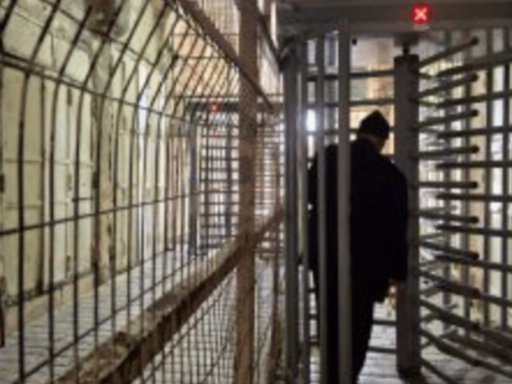

On the third Friday of Ramadan, Israeli occupation forces have restricted Palestinians in the West Bank city of Hebron from entering the Ibrahimi Mosque, a revered Muslim pilgrimage site.
Israel gatekeeps Ramadan in Hebron
Muslims gathered at the checkpoint to enter the mosque for Friday prayers, but Israeli forces allowed no more than 60 worshippers inside. Under normal circumstances, upwards of 5,000 Palestinians would attend Friday prayers at the Ibrahimi Mosque.
As the queue grew, the Canary spoke to several worshippers waiting at the mosque checkpoint.

Raneen, a 17 year-old Hebron resident, painted a different portrait of mosque life, prior to the war in Gaza.
People came to the old city in large numbers. But since then, there have been less people here, because they are scared- because soldiers make problems for everyone. Now, because of the Iran war, there are even less people. Unfortunately they only let 50 people in today. I came here three hours ago but it is not allowed for me to enter the mosque.
Qusai, 27 years-old, spoke of the significance of Friday congressional prayers, especially during the holy month of Ramadan.
We are surprised, because we arrived at the checkpoint, and saw that soldiers have closed the entrance to the mosque. It’s very important for our religion, and important to pray here. Many people waited for the soldiers to open the checkpoint, but they did not let many people through. We have waited a long time.
In conversation with the Canary, Mohammad, aged 64, described deliberate strategy by occupational forces to extend control over Palestinian territories.
Israel does this to make it hard to come to Ibrahimi Mosque and the old city, to make everything empty and control the area. We are feeling very sad, as we’ve come from far away and we aren’t allowed to go in.
The sliding scale of religious freedoms
Since its emergence in 1947, Israel’s ethnoreligious state has treated Islam as an elected enemy. The religious freedoms granted for one community, and denied for another.
Angered by these latest restrictions, elderly resident, Yazeed, hit back saying:
This is the occupation. They let 50 in so they can say the mosque is open today, but it isn’t! They are making control and do not let people have freedom to pray and go to their mosque.
This Ramadan, with its ongoing offensive war against Iran, the Israeli occupation has used the pretext of “security” to ground Palestinians, expand , and deny access to sites of worship in the West Bank. This has meant the journey to prayer has been markedly more difficult, with Palestinians forces to navigate a maze of check points and gates armed by occupational soldiers, and military checkpoints than usual. And there is growing uncertainty over whether the mosque will even be open.
This Ramadan, amid its ongoing offensive against Iran, the Israeli occupation has used the pretext of “security” to ground Palestinians, extend [restrictions](http://west/ Bank faces righter grip as Israel bombs Iran https://www.thecanary.co/uncategorized-en/2026/03/03/west-bank-faces-tighter/), and deny access to sites of worship in the West Bank. As a result, the journey to the Ibrahimi mosque, among others sites, has become laden with obstacles, with Palestinians forced to navigate a maze of gates and checkpoints manned by occupation soldiers. Uncertainty looms over when, and if, the mosque will reopen.
A mosque under siege
The restrictions began on the first day of Ramadan, when Israeli soldiers prevented Palestinians from entering the Ibrahimi Mosque, with reinforced deployments throughout the Old City surrounding the mosque.
Then, on Saturday 28 February, the first day of Israeli and America’s joint assault on Iran, occupation forces closed the gates of Ibrahimi Mosque “until further notice,” preventing both worshippers and Islamic Waqf staff from entering the compound.
Then, on Saturday 28 February — the first day of Israel and America’s joint assault on Iran — occupation forces closed the gates of the Ibrahimi Mosque ‘until further notice,’ shuttering the compound and preventing worshippers and Islamic Waqf (religious endowment) from entering.
For Palestinian residents, the restrictions represent another escalation in a decades long battle for control of the sacred site. Zionist control over Hebron, known as al Khalil in Arabic, began after 1967 when ‘Israel’ occupied the West Bank and East Jerusalem. But in 1994, an illegal Israeli settler stormed the mosque, and massacred 29 Muslim worshippers during dawn prayers. After this incident, Israeli occupation authorities divided the mosque complex in two – annexing half of the mosque where Jewish worshipers pray. The larger portion was allocated to Jewish worshipers, leaving Palestinian muslims with less than half.
The IOF, of course, controls access to the entire site, through the use of metal detectors, checkpoints and restricted entrances. These measures not only affect Palestinian worshippers, but also the daily life and social fabric of the old city of Hebron, where the mosque is located. This area is under the total control of the Israeli occupation’s military, and has illegal Israeli settlements located there.
Ibrahimi Mosque’s storied history
The Ibrahimi Mosque, known to Jews as the Cave of the Patriarchs, is revered by both communities. It stands above a cave believed to contain the tomb of the Prophet Ibrahim.
For centuries Muslims have travelled to Hebron to pray at the mosque. It is considered the fourth most sacred site in Islam, after the holy mosques in Mecca and Medina, and Jerusalem’s [Al-Aqsa Mosque,](http://israeli/ settlers storm Al-Aqsa Mosque with IDF protection https://share.google/G1xfOXxv3KSqrTViv) which is also currently closed to Palestinian worshippers. Praying at these sites during Ramadan carries special spiritual significance for worshipers observing the holy month.
Control over the mosque’s administration has increasingly shifted away from Islamic authorities in recent years. Israel occupational forces guard every entrance to the Ibrahimi Mosque, and the Israeli occupation has even placed CCTV cameras in the Muslim section, allowing them to surveil Palestinians while they pray. In 2025, Israeli authorities also removed the Hebron municipality’s role in managing the site and transferred control to a settler council linked to the nearby illegal settlement of Kiryat Arba.

Cleaving access
The decision followed earlier moves limiting the authority of the Islamic Waqf, the endowment historically responsible for the management of Islamic sites. The changes could allowstructural modifications to the complex, thought to include construction work and expanded facilities for Jewish worshippers, without Palestinian oversight.
These changes are part of an intentional broader transformation of the Old City of Hebron, by the Zionist regime. The area surrounding Ibrahimi Mosque lies in a heavily militarised zone where the IOF guard the settlers living in the illegal settlements established at the city’s centre. Military checkpoints, surveillance cameras and restricted streets now dominate what was once the busiest commercial district in the South of the West Bank. And the nearby Palestinian shops remain closed after years of closures and security restrictions.
For as long as the occupation tightens its grip on Hebron’s Old City, Palestinians will assemble — prideful and peaceful — outside the Ibrahimi Mosque, undetered and unafraid. Prayer at the mosque is more than a sacred act or a conversation with God — it asserts their visibility as part of Hebron’s cultural and religious fabric. It’s not heroic or provocative, but an affirmation of what should be ordinary, yet is criminalised under occupation.
Featured image via Charlie Jaay
By Charlie Jaay
From Canary via This RSS Feed.