

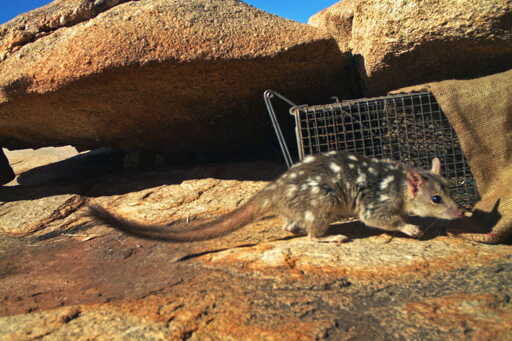
Despite its widespread biodiversity, Australia holds an unenviable record when it comes to wildlife: the highest mammalian extinction rate in the world. Since the arrival of Europeans and colonial expansion, at least 40 terrestrial mammal species have been lost, and others are facing serious threats. Notable among these is the northern quoll (Dasyurus hallucatus), a small, carnivorous marsupial that ranges through tropical areas of the continent and is considered endangered on the IUCN Red List due to threats posed by introduced animals gone feral, habitat change, and landscape degradation. The loss of mammalian biodiversity has coincided with widespread threats to the preservation of First Nations cultural knowledge in Australia. Over the past two centuries, Indigenous people have been forcibly removed from their lands and resettled in other parts of the continent. During this time, traditional land management practices and cultural knowledge of local biodiversity have largely not been considered by the scientific establishment. Now, however, a recent study has used Indigenous cultural and ecological knowledge (ICEK) alongside Western scientific methods as way to help conserve northern quolls, and potentially other species, into the future. The study, published in January in the journal Wildlife Research, was led by members of the Martu people, whose traditional lands span portions of the western desert region in Western Australia, the country’s largest state. Northern quolls, known in the Martu language as wiminyji, were only identified by modern science in this part of the country in 2012, despite Martu elders knowing of the species’ presence…This article was originally published on Mongabay
From Conservation news via This RSS Feed.