

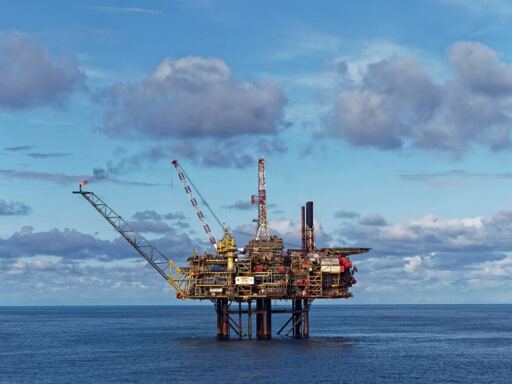

Twice as many people in Scotland (41%) support the Windfall Tax than oppose it (19%), with support cutting across all political parties and across all parts of the country, according to new polling.
The Windfall Tax (Energy Profits Levy) was levied on oil and gas companies operating in the UK in May 2022. This was in response to record oil and gas industry profits and the rapid increase in energy costs following the Russian invasion of Ukraine.
New surge in energy costs
The polling took place in mid-February, before the US and Israel set about plunging west Asia into turmoil. In recent days, wholesale energy costs have surged 30% year on year as a result of conflict in the Middle East and sit at levels last seen in winter 2022/23.
New analysis by 350.org shows that Europe effectively paid around €1.4bn extra for gas in the first week following price spikes triggered by the war against Iran, highlighting the financial cost and risks of the continent’s continued dependence on fossil fuels.
Gas prices in Europe rose sharply after the conflict began, jumping from around €30 per megawatt hour (MWh) to roughly €50 per MWh and higher as markets reacted to instability affecting global energy supplies. And oil prices have also shot up as supplies come under attack and restriction.
Campaigners say the figures show how geopolitical crises linked to fossil fuels rapidly translate into higher costs for households and businesses across Europe. If this crisis continues, fossil fuel prices are likely to rise even higher.
Andreas Sieber, head of policy at 350.org, said:
This is not an energy crisis, this is a fossil fuel crisis. In the first week alone since the Iran war, Europe has lost €1.4bn to higher gas prices. Instead of losing billions to fossil fuel price spikes, Europe needs to accelerate the energy transition that will lead to lower bills and strengthen energy security.
Continued instability will lead to further volatility in global fuel markets, meaning households will face additional energy price pressures in the months ahead unless structural changes are made. Then the sun and the wind don’t send bills, they also don’t have to travel through the Strait of Hormuz.
To put the scale of the loss into perspective, €1.4bn would be enough to install solar power for at least 500,000 homes across Europe, permanently lowering energy bills and reducing exposure to volatile fossil fuel markets.
Oil and gas companies profit from crisis-driven price spikes, while households and other businesses absorb higher prices. A windfall tax on carbon majors could protect families now while funding simple renewable solutions, from balcony solar to electric bikes, that lower bills permanently and give people control over their own energy.
Energy firms have seen their share prices rise over 7% in the last month (compared to the FTSE 100 rise of 0.43%). This includes North Sea operators who have lobbied heavily to scrap the windfall tax.
A spokesperson for the End Fuel Poverty Coalition said:
Despite the intense lobbying by the oil and gas industry – and their political allies – the Windfall Tax retains the support of the public.
It’s no surprise that twice as many Scots are in favour of the tax than oppose it and nearly a fifth say that they strongly support the measure.
As long as people see the disparity between their own living conditions and the huge profits made by energy firms, this support will continue.
Cross-party support for windfall tax
The survey spoke to over two thousand adults in Scotland in a poll that reflects the political make-up of the nation’s voters. It revealed that Scottish voters from all parties supported the windfall tax.
Support for the windfall tax is highest among people intending to use their Holyrood list vote for the SNP (48%), Labour (53%), Liberal Democrat (61%) and Green (47%). Conservative and Reform UK voters were more likely to support the tax than oppose it (Conservatives 37% support, 34% oppose; Reform UK 32% support, 30% oppose). Similar results were found among constituency voting intention.
Frazer Scott, chief executive of Energy Action Scotland, commented:
Energy companies continue to make excessive profits at the expense of people – people who cannot heat their homes to a safe level and are burdened by £5.5bn of unrepayable domestic energy debt.
Until there is reform that puts people at the heart of the energy system it is right for big business to put its fair share back to help those that need it most.
Jamie Livingstone, head of Oxfam Scotland, said:
People aren’t daft; they know that the companies that have polluted our politics and plundered our planet shouldn’t be let off the hook for the spiralling climate destruction they continue to cause.
Energy giants have racked up years of eye-watering profits. Politicians must ensure they pick up more, not less, of the tab for the shift to a clean energy future instead of leaving hard pressed Scots and communities globally facing famine and floods to foot the bill.
Fossil fuel companies helped light the fire and continue to fuel it, so it’s only fair they help pay to put it out.
Friends of the Earth Scotland oil and gas campaigns manager Rosie Hampton commented:
With the conflict in the Middle East, energy companies could again be making the windfall profits that have caused the cost-of-living pain and suffering in the last five years. People will be rightly worried about household energy bills soaring again as greedy oil giants capitalise on the violence.
We must not forget that this tax will go to supporting the NHS, educating children and protecting our environment so any politicians calling for the tax to end are demanding less support for vital public services.
Previous End Fuel Poverty Coalition research found that just a handful of energy firms have made around £40bn in UK profits in the last two years, even with the Energy Profits Levy in place.
The government has committed to phasing out the tax by 2030 to be replaced by a new tax regime for the sector.
Featured image via the Canary
By The Canary
From Canary via This RSS Feed.