

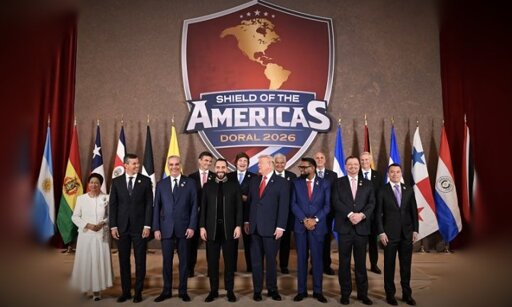
In the midst of the war against Iran, President Trump convened a summit in Miami with 12 Latin American leaders. At this “Shield of the Americas Summit,” as the White House called it, Trump announced the creation of a new military coalition to combat drug cartels in the region.
This invitation was directed exclusively to the right-wing leaders of the region who are aligned with Washington. To complete the picture, Kristi Noem will have a new role as special envoy for the agreement, after her dismissal as DHS secretary.
In the group photo, on either side of Trump, are the president of El Salvador, Nayib Bukele, and the president of Guyana, Irfaan Ali. Trump has heavily praised Bukele for his brutal crackdown on alleged organized crime and illegal immigration. Guyana, although a very small country, possesses vast offshore oil reserves (more than 11 billion barrels) and has a rapidly growing economy, in addition to other strategic resources of interest to the United States.
In the front row of the photograph were the presidents of Paraguay, Santiago Peña; Costa Rica, Rodrigo Chaves; the Dominican Republic, Luis Abinader; Ecuador, Daniel Noboa; and the prime minister of Trinidad and Tobago, Kamla Persad-Bissessar. In the back row were the presidents of Bolivia, Rodrigo Paz; Argentina, Javier Milei; Honduras, Nasry Asfura; Panama, José Raúl Mulino; and the president-elect of Chile, José Antonio Kast.
Reviving the Monroe Doctrine
“We come together to announce a brand new military coalition to eradicate the criminal cartels plaguing our region,” Trump said in his opening speech. The fight against drug trafficking is a pretext for more direct imperialist intervention in the continent, a tactic already used under the Reagan administration in the 1980s in the so-called War on Drugs. The speech also focused on rejecting all “foreign influence” in America as part of Trump’s new Monroe Doctrine, which includes the Panama Canal as a major issue.
The warning of “foreign influence” refers to China, as the rival power is involved in a particularly tense situation regarding the canal. No sooner had Trump assumed the presidency than he warned he was going to reclaim the canal. Although China doesn’t operate the canal, it’s the second-largest user and has significant investments in the region.
Under U.S. pressure, Panama canceled the concession granted to a Hong Kong company to operate the canal. The goal is to limit China’s expansion on the continent, and particularly the interoceanic waterway. The Asian country has a strategic interest in this waterway, and the United States obviously does too, as approximately 40 percent of all North American container traffic passes through it annually.
In this context, China has been building a large port in the city of Chancay, Peru, the first phase of which was inaugurated last year. This megaproject, belonging to the Chinese company Cosco Shipping, is designed to be the main logistics hub for South America and Asia.
Trump’s true objective is to consolidate a Latin American alliance with far-right governments to limit the expansionist aims of the Chinese capitalist power in the Americas. To grasp the magnitude of China’s advance, one need only consider that in the year 2000, bilateral trade between Latin America and the Caribbean and the Asian nation was around $12 billion, while in 2024 it had reached approximately $520 billion.
In his bombastic and perhaps also dangerous rhetoric, Trump has given his alliance with Latin American countries a military — not merely commercial — character, invoking supposed anti-drug objectives and using a warmongering name: “Shield of the Americas.”
This summit also takes place in the context of the attack on Iran that he is carrying out alongside Israel, his partner in the Middle East. Imperialist European countries have joined this attack, and President Milei was among the first world leaders to applaud the aggression.
Faced with the shameful passivity of the rest of the governments of Latin America, which barely made any pronouncements for peace or a call for respect for international rules that no longer exist, a strong anti-imperialist and internationalist current is becoming more necessary every day, both in Latin America and worldwide. Such a movement has an important precedent in the mobilizations and actions like the encampments at universities in the United States, England, and other countries, as well as the general strike in Italy.
This article was first published in Spanish at La Izquierda Diarioon March 7, 2026.
The post Trump “Shield of the Americas” Alliance Aims to Advance U.S. Imperialism in Latin America appeared first on Left Voice.
From Left Voice via This RSS Feed.