

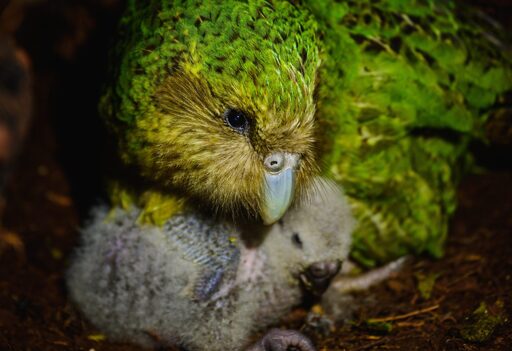
A total of 59 healthy kākāpō chicks have hatched over the last few weeks, according to the latest tally by Aotearoa New Zealand’s Department of Conservation. This marks one of the most successful recent breeding seasons for this critically endangered bird, whose last breeding season was four years ago. The kākāpō (Strigops habroptilus), a flightless bird in the parrot family endemic to Aotearoa New Zealand, has a total population of 236 adults, up from a low of just 51 individuals in the 1990s. Around the same period, the surviving birds were relocated to three predator-free Aotearoa New Zealand islands — Whenua Hou, Pukenui and Te Kākahu-o-Tamatea — but they’ve still struggled with low reproduction rates. “Every new chick brings the species further from the brink of extinction,” Deidre Vercoe, the Department of Conservation’s operations manager for kākāpō, told Mongabay by email. “There’s always a sense of hope and optimism for the future.” Kākāpō only breed in years when the native rimu (Dacrydium cupressinum) tree produces a heavy crop of fruits, which happens every 2-4 years. A chick named Tīwhiri-A1-2026, born on Feb. 14, was the first kākāpō to hatch in four years. Image courtesy of Lydia Uddstrom/New Zealand Department of Conservation. So far this year, 140 fertile eggs have been identified and 52 healthy chicks were born, with an extra seven chicks assumed via remote technology. The data are shared with the public every Friday, with an uploaded photo of the tally written in marker on the department’s refrigerator. Though more…This article was originally published on Mongabay
From Conservation news via This RSS Feed.