


Angela Yu Zhang
Special to ICT
When Emma Albert finally felt safe enough to assess the damage outside her home in Kipnuk, Alaska, the smell of the destruction hit her immediately: sewage, oil, trash, dead pets, and a beached beluga whale. “The smell was so strong, it hurt my nose,” she said.
Emma and her family were living in Kipnuk, Alaska, when Typhoon Halong struck in October. The storm — the worst in a series of Arctic typhoons, according to a media briefing by the Association of Village Council Presidents — tore through the Yukon-Kuskokwim Delta, a region in western Alaska that is the size of Oregon.
More than 1,600 people were evacuated to places like Anchorage, Fairbanks, and Bethel, making this the largest mass evacuation in Alaskan history. The Alberts were some of those evacuees now living in Anchorage.
Now that most residents have been evacuated and are in the process of resettling, the attention is turning to cleanup of the physical damage left behind.
Kipnuk Council Leader Doreen Carter described her mother’s experience during the storm. “Waking up to the storm the morning after, everything was unrecognizable,” she said. “Everything was destroyed.”
The Yukon-Kuskokwim Delta has been home for thousands of years to Kipnuk and more than 50 other rural communities of mostly Alaskan Native residents. Structures in these villages are connected by boardwalks, with no roads in or out of the community.
Their remote location and harsh tundra environment preclude infrastructure like a sewage system, a municipal trash transfer system, or below-ground heating oil tanks as seen in the rest of Alaska. Typhoon Halong damaged most of these communities, ripping houses off foundations and floating them out to sea, sometimes with people still in them.

Homes and boardwalks were dislodged in Kipnuk, Alaska, after Typhoon Halong struck in October 2025. Credit: Courtesy of Alaska Chadux̂ Network
Approximately 90 percent of Kipnuk was devastated by Typhoon Halong, displacing people from not only their homes but their ancestral lands. Rebuilding this hard-hit village will take a long time. The contamination of oil, sewage, trash, debris must be cleaned up before people can safely return.
The unique landscape of rural Alaska is particularly at risk for widespread contamination after flooding.
Lynn Zender, executive director of the Zender Environmental Health and Research Group, calls these rural communities “land islanded.” They are only accessible by plane, and boats in the summer when the water isn’t frozen over. This makes it difficult to have resources for a sewage treatment plant or landfill system.
Instead, most residents carry their waste out to open wastewater lagoons, and their trash out to unfilled holes in the tundra. Many of these makeshift landfills are within a mile of town or a body of drinkable water, according to Zender.
In addition, each house is heated with its own oil tank, and each community may have a larger community tank. In most homes, these tanks can be buried below ground. But the permafrost Kipnuk is built on is too hard to dig into, so the tanks sit at ground level, said Buddy Custard, chief executive officer of the Alaska Chadux Network, an organization that is helping to clean up the oil pollution.
The exposed sewage, landfills, and oil tanks were especially vulnerable to the flooding that severed tanks from homes and strewed the contents of dump sites all over the tundra.

A crew member from Alaska Chadux̂ Network inspecting an oil drum for damage and in preparation for safe storage in Kipnuk, Alaska, on October 2025. Credit: Courtesy of Alaska Chadux̂ Network
The flooding swept through houses, which also washed out things like batteries and household chemicals. All of these contaminants are harmful to human health, causing anything from minor irritation to multi-organ damage.
“Every single resident was a first responder [after the flooding], and everyone was talking about the water they were walking through,” Zender said. “They’re being exposed to all the pathogens from the lagoons that have basically untreated human sewage … walking through floodwaters contaminated with fuel oil, trying to clean up materials that are hazardous.”
This contamination threatens the subsistence lifestyle that has been passed down through many generations.
Whether they are hunting, gathering berries, or collecting rainwater, many villagers in places like Kipnuk rely on the land for sustenance.
Contamination from oil or chemicals can have long-lasting impacts on subsistence resources, said Davin Hollen, coastal community resilience specialist for Alaska Sea Grants. The flooding also carried oil, sewage, and debris all over the tundra, including to the lakes where residents like Emma would have gone to chip ice from for drinking water.
“I wouldn’t want to get ice around that area,” Emma said. “[If we returned], we would have to go far, far away to get drinking water.”
The U.S. Western Alaska and Arctic Sectors of the Coast Guard and the Alaska Department of Environmental Conservation conducted post-storm assessments to capture the degree of pollution.
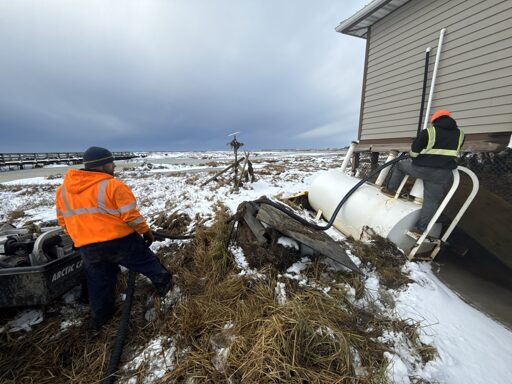
They contracted out to groups like the Alaska Chadux Network and Resolve Marine Group for oil clean-up. Shortly after Typhoon Halong, crews were on the ground siphoning oil out of damaged oil tanks and storing it in secondary containers for safe disposal. Approximately 120 tanks were damaged by floodwaters, according to Alaska’s environmental conservation department.
Those responsible for pollution clean-up were in a race against time.

Response technicians from the Alaska Chadux̂ Network prepare to siphon oil out of an up-ended damaged home heating oil storage tank after Typhoon Halong’s destruction in Kipnuk, Alaska, on October 2025. Credit: Courtesy of Alaska Chadux̂ Network
In the winter, ice traps any free-floating oil and debris that could otherwise be cleared. The waterways out of Kipnuk are also frozen over, preventing the barrels of oil from being shipped to safe containment sites. All clean-up has been paused until the spring thaw, after which the damage and long-term effects can be assessed more accurately.
The environmental conservation department and Coast Guard said they were unsure how long cleanup might last.
Many tanks are still pinned under debris, and fuel sheen can be seen in “almost every puddle under ice,” according to the latest updates on the Alaska environmental conservation department’s website in December.
Kipnuk’s water reservoir was contaminated by saltwater, and the equipment that can treat this water won’t arrive until the spring.
For the few people who chose to stay behind and help rebuild, they are relying on drinking water provided by schools in the area or on bottled water that is being sent up, said council leader Carter.
Coastal storms and typhoons have always been part of the climate in Alaska. However, compared to Typhoon Merbok in 2022 which damaged structures in western Alaska, Typhoon Halong has been far more destructive, said Christopher Houvener, Marine Science Technician for the Coast Guard.
This trend of increasing damage from storms and flooding will only worsen due to climate change, according to Sheryl Musgrove, director of the climate justice program at Alaska Institute for Justice.

Homes and boardwalks were dislodged in Kipnuk, Alaska, after Typhoon Halong struck in October 2025. Credit: Courtesy of Alaska Chadux̂ Network
Alaska is particularly hard hit by climate change as the fastest warming state in the United States.
Warming temperatures are preventing the formation of sea ice, a protective barrier against flooding, and melting the permafrost that comprises 85 percent of Alaska’s land mass, including the villages on the Yukon-Kuskokwim Delta.
The thawing permafrost causes the land to sink, making it more vulnerable to flooding and erosion.
“It’s this really vicious cycle,” Musgrove said. “And on the forefront are the tribes in Western Alaska.”
On the ground, crews are also seeing more oil spills due to this cycle.
When the Alaska Chadux Network was founded in 1993, the crew mostly responded to oil spills from small boats or vessels. Recently, that has changed.
“You’re seeing more and more flooding on the river system because of the permafrost melting,” ] Custard said. “What we’re seeing now are more of these [oil] tank spills [from houses] … driven by environmental type incidents.”

Response technicians with the Alaska Chadux̂ Network siphoning oil from damaged tanks into containers for safe storage in Kipnuk, Alaska, on October 2025. Credit: Courtesy of Alaska Chadux̂ Network
A 2022 federal report found that 115 communities are vulnerable to destruction similar to what was seen after Typhoon Halong. Displacement for these communities means more than just losing their home — it means losing the link to their ancestral land that they have lived on for thousands of years, and possibly not being able to return.
The pollution caused by Typhoon Halong is the main concern for Kipnuk residents on returning home, according to Carter.
But even if that is cleaned up in the spring, Carter isn’t certain that people will want to go back in the face of worsening storms.
The council has been holding meetings to discuss resilience measures like laying rocks down as an improvised seawall or building a community fridge on sturdy beams. They recognize that these are stopgap measures instead of infrastructure change such as building more protected areas for treated sewage, trash, or oil.
But the sheer distance of these villages from any existing infrastructure makes the resource cost to build and maintain almost insurmountable, especially for a smaller community with less capital resources, Zender said.
“We have this sort of one-size-fits-all mentality … that national models of how we approach a solution will work regardless of scale,” she said.

Crew members from the Alaska Chadux̂ Network prepare oil containers for winter safe storage as part of the oil clean-up process in Kipnuk, Alaska, on October 2025. Credit: Courtesy of Alaska Chadux̂ Network
But another solution was also proposed during village meetings, Carter said: relocation, to a site 15 miles away from Kipnuk that sits on rock, not permafrost.
“[The youth] are our next generation, and we need to think about them,” Carter said. “They don’t want to go through this again, because they know it’s just going to happen again.”
Once a decision is made, it will be hard to fund, especially given the cancellation of a $20 million grant from the Environmental Protection Agency that could have been used to strengthen climate resilience.
Regardless, any decision will have to wait until the spring thaw, when the contamination can be re-assessed.
In the meantime, many have faith that these communities will rebuild, including Buddy Custard: “The one thing about Alaskans, we’re a resilient lot.”
Angela Y. Zhang is a pediatrician and journalist based in Seattle, Washington. Follow her on Bluesky at @zhangela.bsky.social and on Twitter at @zh_angela.
The post Post-Typhoon Halong: Contamination threatens subsistence, drinking water, a move back home appeared first on ICT.
From ICT via This RSS Feed.