

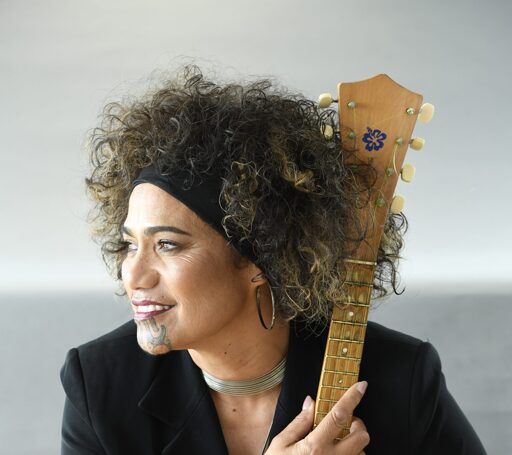

Betty-Anne as a solo artist. (Photo supplied)
She was the voice of Ardijah, and Ardijah was the sound of South Auckland. With their distinctive blend of soul-funk and Pacific rhythms, Ardijah, led by Betty-Anne and Ryan Monga, was a welcome relief for those who didn’t warm to the “Dunedin sound” that dominated the New Zealand music scene in the 1980s.
Now, four decades after their first hit, Betty-Anne is back as a solo artist. Her new album Slow Burn comes out next month. Here she is catching up with Dale.
Tēnā koe, Betty-Anne. How does it feel to be recognised by just your first name? We only have to say “Betty-Anne”, and everyone knows who we’re talking about. Maybe you’d be kind enough to tell us about those names and where they come from?
I think I was named after an aunty on my dad’s side. Yeah, Aunty Betty Elvin from Katikati. But I don’t know where the Anne came from, to tell the truth. I think that was the era when “Anne” was at the end of everything.
Do you have any other names?
Oh yes. Maryrose. See? It was that era!
Betty-Anne Maryrose. Wow.
I love that my parents gave me those names because they had meaning for them at that time. But, I mean, when I was a kid, I did say to myself: “Man, when I get old enough” — you know, and I’m gritting my teeth — “I want to change my name. I can’t stand my name.”
But I changed my mind. After I left school at 15 or 16, I was all cool with Betty-Anne.
I’d got to that age where I was good in my skin, and I started to embrace that part of myself.
Now everyone knows Betty-Anne. You don’t even need a surname.
Most musos are exposed to music at home, and I’m just wondering if yours was a musical whānau?
It wasn’t until I was in my early 20s, after I’d left home and started performing and creating music with Ryan and the Ardijah boys, that I heard through an uncle: “Oh, your dad used to play in the band. Used to play drums.”
And I’m going: “Huh?”
And then he told me that my aunties, Dad’s older siblings, were singers. They were the Hall Sisters.
I didn’t know any of that. I remember my parents having parties and singing around the table with my aunties and uncles. We would always have a guitar in the whare, always, and my brothers used to play a little bit of guitar.
But were we a musical whānau? No, not really. Not at all.
Did you have any records in the whānau’s stash of LPs?
No. We had a stereogram, but that wasn’t until my brothers were teenagers. They were a lot older than me, and they’d have the latest Solid Gold Hits album or Queen. We mainly listened to the radio in our house, but my parents didn’t really listen to music. I just remember my dad playing the radio, and it would be the races.
A very familiar sound in Māori houses.
Yeah, the races.
Were you a big whānau? Where did you grow up?
There were eight of us kids, but our sister passed away as a baby.
I was born in Tauranga. When I was about three or four years old, we moved to Tāmaki. I was told that we moved for my father’s mahi. All I remember is he worked for James Hardie in Penrose — I assume he was a labourer. He provided for us.
We lived in Ponsonby, Kingsland, Sandringham and Mount Albert for the first few years.
Around that time, my mum became a Christian, and she started going to church. And then we would always have praise music in our home. My mum was really strong with that, and she would sing quite a lot around the house, so I suppose that was one of the influences I had.
Okay, church, harmonies, choirs, it all rings true. So, are you part of Ria Hall’s line? Are you guys the same Halls?
Yes. My father and Ria’s father’s mother were brother and sister. So, Ri’s my niece — her dad Freddie is my first cousin. And my maiden name is Hall.
How about your whakapapa lines? You have multiple iwi connections?
Ki te taha o toku pāpā: Ngāiterangi, Ngāti Ranginui, Tūwharetoa, Tainui.
Ki te taha o toku māmā: Ngāpuhi, Ngāti Whātua.

Betty-Anne and Ryan Monga in the 1990s.
Tēnā koe. Who might you describe as your musical heroes when you were a young teen, Betty-Anne?
I didn’t really find the music that I loved until later, when I was about 15. After meeting the Ardijah boys, I started listening to 45s, buying my own music, and just hanging out with them, learning and growing together.
For me, once I was exposed to Ella Fitzgerald and Sarah Vaughan, and that era of music, man, there was no turning back. I do love Stevie Wonder and obviously Michael Jackson as well, and I really love the Bee Gees. And country music as well. I used to listen to a lot of Olivia Newton-John.
Well, Ella Fitzgerald and Sarah Vaughan had beautiful vocal control and wonderful voices. I read somewhere that you met Ryan and the Ardijah boys at your first talent quest when you were 15. Where was it? Was it on the back of a truck? Was it in a beach sound shell, and did you have a backing band? And what did you sing?
Actually, my very first talent quest was before I met the boys in Ardijah. I sang at the Manukau City Centre. They had a talent quest during the school holidays, and that’s where I met Annie Crummer. I would’ve been maybe 14.
Did you beat her? Did you win?
Oh, heck no.
You came second?
No, no, I didn’t. But I won a box of ETA chips. ETA chicken chips. A BIG box. I was with my little brother and sister, and we were over the moon, you know? We had chips for a week.
A big box of ETA chips. What a prize! Did the Queen of Avondale, i.e. Annie Crummer, win the talent quest?
No, she didn’t, actually. It was this young lady from Thames. I forgot what her name was. She sang a country song, and she was lovely. I’ll be honest, she had the look. She wasn’t kind of rough around the edges.
I mean, I was just 14 or 15, I was living in Māngere, and my parents had just divorced, so I was looking after my brother and sister for the school holidays.
When I reflect on it now, Annie should’ve won it. Maybe Annie came second. She sang Elvis Presley’s “Love Me Tender”, and she had this long mane of hair. I remember it so, so vividly. I said to my little sister: “Look at her, she’s beautiful. She can sing, eh?”
Two of our big guns on the same stage in 1979. What did you sing?
What did I sing? It was either “Together We Are Beautiful” by Fern Kinney or Freddy Fender’s “Before the Text Teardrop Falls.” Oh man, I love him.
I would have given you a box of potato chips, too.
I even learned the Spanish part of it, but I don’t think I did a very good job.
You could always make it up.
Well, this is right!

Ardijah promotional portrait 1986.
So there was another talent quest where you met the Ardijah boys?
Yes, I met them at a talent quest in Papatoetoe in 1980. They were a boys’ group covers band then.
What about your voice, Betty-Anne? Have you had any lessons, or is this eau-natural?
Well, I haven’t been to lessons as such or had a vocal coach. But I think your life’s journey is a lesson. And I do believe in really listening to the voice and homing in on where the tone is coming from, or where you can draw your power, whether it’s from your pelvic area or your diaphragm, and the resonance you can create through your face, your nose, and all of that.
I mean, I don’t know about head voice and all that stuff, really. But I’ve listened a lot. When I was a kid, my dad was always very critical when he watched people singing on the telly. He would say: “Oh, she’s flat,” or “She’s sharp.” And he was correct. So I got an understanding of that.
Now that you’re in your 60s, do you sense your voice is as good as it has ever been, and perhaps, in some ways, at its best?
Ahh, people say to me. “Oh, you sound just the same, Betty-Anne, as your records from way back.” I don’t, actually. I know I don’t. My voice is deeper even when I speak to you. If you listen to “Give Me Your Number” or “Do To You” or “Watching You”, it’s quite fresh. I can hear it. It’s a young woman. I’m not a young woman.
But I love my voice right now because it has a big tone compared to what it was 30 years ago. You can hear the innocence in my voice from that time, and now it’s got some real substance.
I want to touch on your Ardijah days, but just briefly, because I know that you’re in a different stage of your life now.
Yes. All good.
Looking at Ardijah’s catalogue, it’s hard to tell who wrote what. Are you one of the songwriters?
Well, the majority of the catalogue is Ryan writing — you know, it’s his expression. We were a team, and I never want to play that down. I acknowledge always the gifts that Ryan brought. He’s a beautiful songwriter, beautiful melodies, very creative.
That said, we did embark on it together, and it was a partnership. Nothing was ever, “Oh, that’s you, and this is me.” When it came to Ardijah, it was us, everything. It was us.
Our family, our relationship, and the music, how can they not be intertwined?
Well, you know, Ardijah are credited with sort of developing this “Polyfonk” sound, with the funk and the ukulele. And you inspired so many to weave aspects of culture into the way they present New Zealand’s music, which we do now with the reo. And these sorts of tones of the Pacific, even if it’s hip-hop, have become the norm.
If you listen to our first albums, Ardijah and Take a Chance, there’s no ukulele in there. It wasn’t really until “Silly Love Songs” that we incorporated it. But we always had a ukulele at Ryan’s parents’ home, and we’d hear Cook Island and Tahitian music all the time at their house, so we started dabbling with it in our little studio in the garage.
I love them, you know, Ryan’s mum and dad. They were a big influence on us incorporating a little bit of the pātē, the Cook Island drum, and then the ukulele.
And even on the new album that I have coming out, it has a little bit of that. Not as much as Ardijah, but I still love those elements. Ardijah is still massive in my heart. It’s part of who I am and how I’ve evolved.

Betty-Anne and Ryan Monga on the cover of Ardijah’s second album, Take A Chance.
I know you’re taking a breather from Ardijah right now, but would you one day consider getting back up on stage, you guys?
Not at the moment, no. I’m on another path, and I really need to see this through. Even though it’s quite moke moke, you know, it’s quite lonely. I’m not used to making all the decisions, so it’s quite mind-boggling. However, we’re there now, we’ve found our way.
When I say we, I’m referring to the musicians who contributed to all the recordings on my new album. My children, who are my peers as well, have contributed and have agreed to be on this journey, not even necessarily to awhi mum, but because they want to be part of it.
And I wanted them to be there because I believed they could add a different colour that would be different from Ardijah. They do all the backing vocals on the album, and it gives it something else.
I know it’s hard for people who want it to sound the same and not change, and people have said to me: “Well, it’s different, eh, Betty?” I wanna ask: “What do you mean by different?” But I say: “Yeah, it is, bro, but we’ll be okay.”
All these years later, the situation’s changed. You’re on your own. It’s exciting. It’s challenging. Your first solo album, Slow Burn, is coming out next month. You released your first single, “You Remain” last November, and then the reo Māori version, “Pūmau Tonu Koe”. You’ve been on the reo journey for a while now, tuahine.
Well, you know, Dale, I’ve been on that journey forever. I think I saw you maybe 10 or 15 years ago at Te Ataarangi, at a noho down in Ōtaki, eh, bro?

On the cover of Rip It Up magazine in June 1987.
True. My goodness.
So, I’ve been on that journey to find what is mine, what I believe is ours, and I want to keep learning. Life does get in the way, but we can still have the reo there and beside us when we get the opportunities.
And “Pūmau Tonu Koe” was very much that. I think the emotion that I deliver on that waiata has more depth than the English version. I’m not trying to play them off at all, but I do hear it and feel it.
Well, I thoroughly enjoyed both versions. You’re living out on the beautiful Āwhitu Peninsula now, which is more rural than Māngere. Tell me, how is that influencing your directions and the approach to life?
I’ve been living in Āwhitu for nearly two years. Very remote. I’ve only got bulls and dairy girls around me, not many humans. It’s inspiring, very peaceful, and we recorded the album there over about six months.
I set up my whare, the recording space, studio space, and then also a control room. And when we first started working on the album, we all kind of lived there for three or four days.
I’m grateful for Awhitu, but it’s a long way to drive. I come into Tāmaki at least twice a week for mahi, or for waka ama training and coaching, and to visit my whānau.
You got acknowledged for your contribution to music in the New Year’s Honours a couple of years ago, Betty-Anne. While musos tend not to go out to get accolades of that type, I guess those kinds of things just recognise your lifelong contribution to New Zealand music. How did that sit with you when you were acknowledged in such a way?
To tell the truth, I was whakamā about it. But I’m grateful. And it’s not for me, you know? It’s for our community, for all of us who were part of this journey.
Well, there’s no one more deserving. You’ll always hold a special place in the soundtrack of the lives of many New Zealanders. But your journey is continuing, tuahine, in a slightly different way as we get older. Do you think you’re just gonna sing till you can’t sing no more, Betty-Anne?
I think so, Dale. I never really thought about that because this is just who we are. It’s a bit like breathing, isn’t it? As long as you can breathe, that’s all you need to sing.
Well, sis, it’s been a pleasure talking with you today. Is there something you’d like to add?
I can say this. This industry is tough. It can spit you out as fast as it embraces you. But our families will love us unconditionally, and they will tell you the truth. And that’s so important.
That’s been my saving grace in a lot of ways. My children, especially in the last three years, have helped their mum through some real trials. Keeping my whānau and friends close on this journey has been important.

(This interview has been edited for length and clarity.)
The post Betty-Anne: Beyond Ardijah appeared first on E-Tangata.
From E-Tangata via This RSS Feed.