

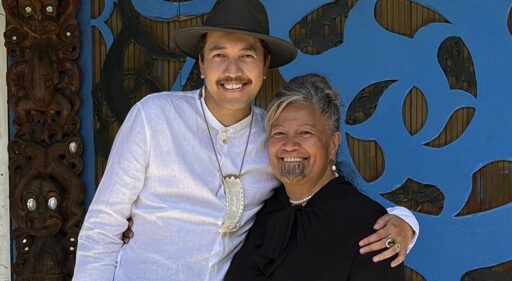

“What would it mean to put more trust in us and our practice?” asks Jaye Wainui, the CEO of Kirikiriroa Family Services Trust. He’s pictured with Mariameno Kapa-Kingi, the trust’s first chief executive when it was set up 26 years ago.
A community organisation in Hamilton that’s been going for 26 years, helping whānau through early support, and social services, says its government contract is among four similar services under review. They’re fearful funding won’t be renewed and whānau will suffer.
Here’s the chief executive, Jaye Wainui.
A mother I work with at Kirikiriroa Family Services Trust recently told me she finally felt safe for the first time in years. Her words stayed with me. They reminded me that trust, not policy, is what truly keeps whānau safe.
It was one of those moments that show how our work changes lives.
Yet, too often, the systems meant to support whānau make that safety fragile. As a 32-year-old chief executive who has spent most of my adult life in social services, public health, and community wellbeing, I can tell you that what we need most to do this work isn’t data, strategy, or even funding. It’s trust.
Not trust in strategies or policies, but trust in people like us, who stand closest to the work — the kaimahi on the frontline and the community leaders who know their whānau best.
Over the past year, I’ve watched the sector twist itself into knots trying to adapt to yet another round of government reform.
The proposed options for reform are either to move the service to a Social Investment Agency, re-prioritise the funding (meaning we could lose parts of the service), or disestablish us entirely.
Programmes that have supported thousands of whānau are suddenly under review. Contracts that provide stability for workers hang in limbo. Community providers wait months for clarity while being told to carry on as usual.
For the people we serve — tamariki, rangatahi, and whānau — this isn’t about abstract policy. Our services mean kai on the table, rent paid, a safe home, a chance to heal, and a reason to hope.
When providers operate in a low-trust climate, they start to micromanage. Reporting layers multiply. Quiet successes, like the ones that can’t be captured in spreadsheets, are buried under forms and frameworks.
This level of control creates fragility, not stability. Frontline staff burn out. Relationships built over years can be broken by one bureaucratic decision. Providers start speaking the language of compliance instead of compassion.
Our sector has been forced into survival mode for so long that genuine partnership feels almost foreign.
Here at Kirikiriroa Family Services Trust, we’re rebuilding around a kaupapa called Te Pā Harakeke. It’s based on the idea that the rito, the young flax shoot, thrives only when protected by the outer leaves, the awhi rito, the collective strength wrapped around it. That’s how we see our mahi — we’re providing the protection and support that help whānau grow.
What would it mean to put more trust in us and our practice?
Trust in our practice would give staff the power to make decisions based on their experience and the multitude of human circumstances and variables they come across, rather than a narrowly prescribed set of options.
It would mean leadership that removes barriers — like too many approvals for small decisions, slow delivery, and micro-management of staff — instead of creating them.
It would mean communities defining success in their own terms.
In our world, success might look like a rangatahi returning to school after months away, or a parent saying: “We finally feel safe.” If we want systems that work, we must listen to those who live inside them. Systems that demand certainty in a world of uncertainty serve no one.
I’m not saying we shouldn’t be accountable or transparent — far from it. But a requirement to be accountable shouldn’t be used to shut down conversations about the risk to whānau, or encourage thoughtless adherence to procedures that don’t fit the reality we’re up against, limiting our ability to help whānau in the best way possible.
When government decisions threaten our ability to serve, our responsibility is to speak up clearly, respectfully, and publicly. Silence protects systems, not people.
If Aotearoa is serious about transforming social services, trust must become the currency of reform. That means trusting providers to innovate, not just implement. Trusting communities to lead solutions. Valuing lived experience alongside data. Believing that care and accountability can coexist.
In practice, that looks like long-term funding contracts, commissioning frameworks co-designed with iwi and hapori Māori, and government stepping back far enough for the community to step forward. Above all, it means relationships built on mutual respect, not transactions based on fear and the threat of having our funding withdrawn.
Every time trust is broken, the cost lands on those least able to bear it. When funding dries up, whānau lose support. When bureaucracy prevails, kaimahi carry the emotional weight. Brilliant workers leave not because they stopped caring, but because the system stopped caring for them.
My message is simple. Choose trust. Every time we model it, we invite others to do the same. And maybe, if enough of us keep doing that, we can rebuild not just our services, but the faith that people once had in them.

Jaye Wainui (Photo supplied)
Jaye Wainui is the tumu whakarae, chief executive of Kirikiriroa Family Services Trust.
The post Services in limbo appeared first on E-Tangata.
From E-Tangata via This RSS Feed.