

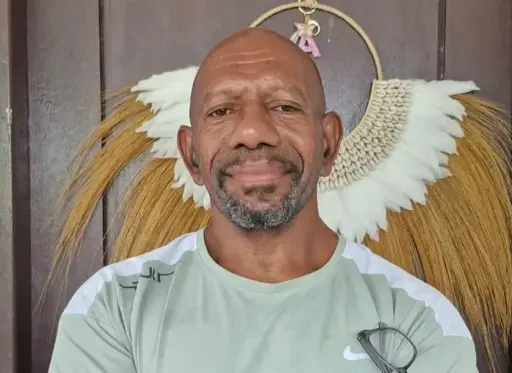

“Forests and wetlands are increasingly reimagined as strategic assets for national food and energy security, rather than understood as living spaces for Indigenous communities,” writes Laurens Minipko. (Photo supplied)
The Indonesian government is planning massive sugar cane, rice, and palm plantations on Papuan forest land.
For the Indigenous people who live on that land, this push for “food security” is a false promise, writes Laurens Minipko, an Indigenous Papuan activist who lives in Timika.
Indonesia’s president, Prabowo Subianto, has set an ambitious target. He wants to make the country self-sufficient in food for its more than 280 million people.
To achieve this, his administration is promoting large-scale sugarcane, rice and oil palm plantations, including on forest lands in Papua, a region long framed as Indonesia’s resource frontier.
For Indigenous Papuans who live on these lands, however, this push for “food security” carries a different meaning. It risks repeating a familiar pattern where development projects designed to meet national targets end up weakening local food systems and customary land rights.
Within the framework of critical political ecology, development should never be seen as neutral. Geographer David Harvey describes how modern capitalism operates through “accumulation by dispossession”, in which land and resources are appropriated in the name of public interest and then inserted into circuits of capital.
In Papua, this dynamic is not an abstract theory. Forests and wetlands are increasingly reimagined as strategic assets for national food and energy security, rather than understood as living spaces for Indigenous communities.
For Papuan people, sago, for example, is not merely a carbohydrate. It is an ecological archive of culture and identity — and it represents our ethic of sufficiency.
Sago grows without forcing the land into intensive, extractive labour. It sustains long-standing relationships between people, rivers, forests and soil. Through sago, communities learn the meaning of “enough” — not accumulation.
Replacing sago landscapes with monocrop plantations is therefore not simply a change in commodities. It represents a shift in worldview — from living with the land, to re-organising the land for distant markets.
This logic has surfaced before in large-scale state projects such as the Merauke Integrated Food and Energy Estate (MIFEE) and the National Strategic Projects (PSN), and more recently in the creation of new autonomous provinces in Papua. While each initiative differs in form, they share a common assumption — that Papua is a strategic space that can be legitimately engineered from above.

Two million hectares of native forest and wetlands are due to be cleared for Indonesia’s food and energy development project in Merauke, West Papua.
This photo, from November 2024, is the project’s base camp in the Wanam subdistrict of Merauke. (Photo: LBH Papua)
Under this logic, customary lands are remapped as investment corridors. Forests become production zones. The land “works”, but much of its value flows elsewhere.
In December 2025, during a briefing at the State Palace for governors and regents from across Papua, President Prabowo reaffirmed his government’s commitment to accelerating development, safeguarding national assets, and strengthening food and energy self-sufficiency at the regional level.
Papua was presented as central to Indonesia’s future energy and food independence, and the president promised hospitals, schools, tourism and infrastructure.
At first glance, such commitments sound promising. Yet the broader framework matters. Papua continues to be imagined primarily as a strategic zone for national ambition, rather than as a homeland shaped by Indigenous relationships to land and food.
This tension became evident when the Governor of Central Papua, speaking as the chair of the association of Papuan governors, warned that accelerated development would falter if Special Autonomy (Otsus) funds were reduced, as President Prabowo indicated in a 2025 presidential instruction that will cut 50.6 trillion Indonesian rupiah (around NZ$5 billion) from the allocation.
These funds are a crucial source of financing for health, education, and local public services. The contradiction he highlighted is stark: Papua is being urged to accelerate, while key fiscal support is constrained.
Papua is, in effect, being asked to run while its shoes are taken away.
The position of elected local leaders in this context is complex. Governors, the elected heads of Indonesia’s provinces, and regents, who lead the districts, stand between central state directives and the everyday realities of Indigenous communities.
In effect, they’re serving two masters whose needs and ambitions not only don’t align but are in direct conflict.Political theorist Antonio Gramsci might describe this as a struggle between hegemonies or systems of power — in this case, the authority of state-capital development, and the authority of local society.
Regional autonomy in Indonesia was designed to allow governors and regents to interpret — and, when necessary, question — central policies that conflict with local ecological realities and Indigenous rights. Without the ethical courage to challenge the central government, the office of the governor risks becoming little more than an administrative extension of Jakarta.
When regional leaders align uncritically with central directives, that’s not neutrality. A choice has been made.

Indigenous peoples in Papua are mobilising against the Indonesian government’s behemoth food and energy development project. This image is from a community meeting of Malind Anim people in Merauke in November 2024. (Photo: LBH Papua)
The cry “We need sago, not oil” is therefore more than a slogan. It is a political and ethical claim about what should be the foundation of our development.
As long as Papua is treated primarily as an energy frontier and strategic project zone, while local food systems and Indigenous living spaces are marginalised, “development” will continue to mean something very different for Indigenous Papuans.
A great nation is not the one that builds the fastest projects. It is the one that understands what its people should eat, whose voices must be heard, and which lands must never be sacrificed in the name of progress.
Laurens Minipko is a Papuan writer from Timika, in Indonesia’s Papua region. He writes on political ecology, Indigenous rights, and development in West Papua.
The post Why Papuans want sago, not oil appeared first on E-Tangata.
From E-Tangata via This RSS Feed.