

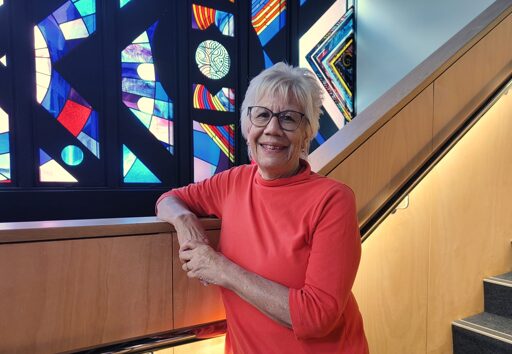

Sandy Morrison (Photo supplied)
Waikato University Professor Sandy Morrison has taken up a new role with the Intergovernmental Panel on Climate Change (IPCC).
*She joins a group of more than 600 experts worldwide tasked with determining how much we know about climate change, its impacts, and how communities might adapt.*Sandy will co-lead a team of Australasian authors, and part of her job is also to ensure Indigenous knowledge is taken on board in a meaningful way.
Here she is explaining the task ahead.
The Intergovernmental Panel on Climate Change is responsible for comprehensive scientific assessments on climate change, and it generally focuses on the physical sciences.
However, we really need to know how climate change is affecting our communities and people. So I’m in a working group to assess how vulnerable our socio-economic and natural systems are to climate change, and to look at adaptation options.
The IPCC is currently in its seventh assessment cycle, and there’s a huge push to bring Indigenous knowledge into all sections of the resulting report.
This is thanks to a determined group of Indigenous scholars who’ve been involved with the IPCC before, and who recognised this omission and advocated for change.
Although it’s been a long time coming, the IPCC has accepted that we need more than one knowledge system contributing to solutions. It recognises that the inclusion of Indigenous knowledges can expand and deepen human knowledge systems. We need to be talking across disciplines, not just operating in silos of expertise.
While there are only about a dozen or so Indigenous scholars in the current authorship team, we are collaborating well, and we’re committed to making Indigenous knowledges visible.
Indigenous peoples of the Amazon are fighting to keep their forests and the livelihoods that depend on them. Indigenous peoples in the Arctic are facing futures without ice, on which they’ve also built their cultures and meaningful ways of living.
Closer to home, our Pacific whānau face rising sea levels, which threaten the continued existence of their countries, to the extent that we need to plan for people to move and consider the impact on both the countries sending people away and those receiving new populations.
Such mobility is a global issue of concern with no easy answers. What is our role as Māori in these decisions? Are there opportunities for Māori and Pacific peoples to work together for the common good of both? These are the sorts of questions I’m thinking hard about.
But right now we’re seeing a weakening of our climate change targets here in Aotearoa, even as climate change is hitting home for New Zealanders.
I certainly sense a groundswell of people who now take climate change seriously and accept that it’s on our doorstep. Perhaps the extreme events that have been occurring around the country will prompt a shift in the current policy direction. But we shouldn’t have to go through tragedy to connect the dots. We end up reacting rather than thinking through a sustainable, proactive strategy.
As an educator, I’m also thinking about improving climate literacy and education in all our communities. What do our communities need to activate their own agency? How do we teach them to recognise and assess hazards and risks, and respond appropriately?
Many years ago, I was in the Philippines after Super Typhoon Haiyan (known locally as Yolanda). When I talked with the communities there, they said they didn’t understand how dangerous a storm surge could be and didn’t evacuate in time. One of the community leaders also objected strongly to being described as a “resilient community”, saying that communities, particularly Indigenous ones, are expected to bounce back without any systemic change or additional resources.
Before the term “climate change” emerged, Indigenous peoples appreciated and practised the principle of kaitiakitanga, the interconnectedness and care for the natural world. We continue to do so using practical and intergenerational knowledge, our lived experience of place, and observation.
However, with a changing climate, some maramataka and tohu that have been used for hundreds of years need to be used differently because the speed of change is accelerating. Because of the extent of our colonising experience and our unapologetic efforts to seek the return of our land and waters, we continue to be active kaitiaki, ensuring that our decision-making is based on ensuring a healthy environment and a healthy community. This speaks to the heart of a climate change strategy.
Many Treaty settlements have provisions to restore the mauri (life force) of our natural resources, whether that’s our rivers, lakes or forests.
There’s currently a Climate Change Inquiry before the Waitangi Tribunal asking whether the Crown’s response to climate change is consistent with the principles of Te Tiriti. It relates to a wide range of climate policies and decisions. Yet at the other end of the spectrum, we also have recent rulings granting legal personhood to natural features of the landscape which are groundbreaking examples of kaitiakitanga.
I believe that sound leadership and social cohesion are the two most important factors for adaptation to climate change and during extreme weather events.
Māori already have cultural infrastructure in place and a value system that mobilises quickly in times of need. We have seen this system activated in recent weather events. I also believe that tribal organisations have a critical role in defining climate risks and policy responses, especially to maintain the mauri (life force) and tapu (sacredness) of the land and people.
It is this spiritual relationship that is so often missing in scientific reports, and that I hope will be highlighted in the next IPCC report.
Sandy Morrison is the Coordinating Lead Author for the Intergovernmental Panel on Climate Change (Assessment Report 7 WG11 Australasia chapter). She is an interdisciplinary scholar with a focus on Indigenous models to address developmental issues for Indigenous and Pacific peoples, especially climate change. In 2009, she was inducted into the International Adult and Community Education Hall of Fame at the University of Oklahoma.
She is from Ngāti Whakaue, Ngāti Maniapoto, Ngāti Rārua and Ngāti Tama ki te Tau Ihu o te Waka a Māui.
The post Sandy Morrison: Bringing Indigenous thought to the IPCC appeared first on E-Tangata.
From E-Tangata via This RSS Feed.