

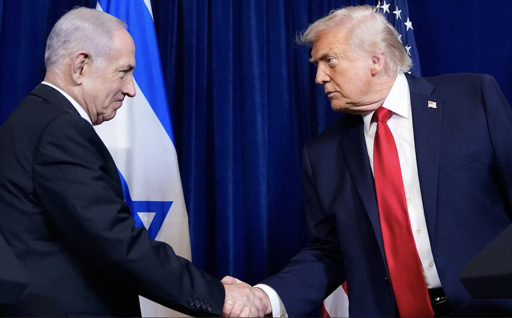
The offensive launched by Donald Trump alongside Benjamin Netanyahu against Iran not only reopens the military front in the Middle East; it exposes the most fragile point of the current U.S. imperial strategy. The alliance with Israel, presented as an unbreakable pillar, could become the most vulnerable link in the aggression.
Netanyahu made this clear in his interview on Fox News: he does not need to “drag” Washington into anything. According to him, Trump “understands” that Iran is an existential threat and that the war will be “quick and decisive.” The Israeli prime minister reduced the picture to moral childishness: “We are fighting the bad guys. We’re the good guys.”
But that simplification does not resolve the strategic contradictions the war has unleashed at the very heart of U.S. power.
What Rubio Said, What Trump Corrected
The White House’s communication following the offensive revealed immediate cracks. Secretary of State Marco Rubio suggested that Washington intervened because Israel was about to attack Iran, which would have provoked retaliation against U.S. interests. In other words, the United States would have gone to war to avoid being dragged in by Israel.
The admission was explosive. In the MAGA universe, where the “America First” discourse rejects costly wars that lack a benefit, the idea that Israel “forced Washington’s hand” sparked furious criticism. Trump tried to qualify his remarks, speaking of imminent threats and, in his meeting with German Chancellor Friedrich Merz, going so far as to say that “if anything, I might have forced Israel’s hand.”
The fact that the White House felt the need to correct Rubio’s framing shows that the relationship with Israel is a very sensitive issue — not only with the Democrats, but within the GOP itself.
Genocide in Palestine and Erosion of Consensus
The background is undeniable: the devastation of Gaza and accusations of genocide against Israel have deeply eroded its international image. The open war against Iran compounds that wound.
According to Gallup, for the first time in recent history, American public opinion is more sympathetic to the Palestinians than the Israelis. Among young people — including sectors of the nationalist right — there is a growing belief that Israel acts as an autonomous actor that exploits American power for its own ends.
Influential voices on the conservative side, such as Tucker Carlson, denounced the operation as “Israel’s war.” Even extremist sectors, like those led by Nick Fuentes, spoke of a “war of aggression for Israel.” Although motivated by their own agendas and, in some cases, openly antisemitic, these criticisms reveal that bipartisan support for Israel is no longer automatic.
Israel and the United States: a Counterrevolutionary Alliance with Divergent Strategic Interests
From an operational point of view, the United States needs Israel in its military advance against Iran. It needs it as a logistical platform, as an advanced military enclave, and as a source of regional intelligence. Operational coordination between the Pentagon and the Israel Defense Forces is now closer than ever.
For the moment, the alliance works because interests converge, but this will not always be the case. Trump faces the challenge of achieving quick and easily marketable success without getting bogged down in a protracted war. The president has adopted a particularly bellicose public stance and has called on the Iranian people to “take back [their] country,” but there remains ambiguity about whether there is an organized plan for regime change and for the “day after” the war.
Unlike the U.S. president, Netanyahu needs permanent war to preserve his power and physical integrity. A chronic conflict or even a chaotic collapse of the Iranian state would not necessarily be a problem for the Israeli government. On the contrary, it would allow Netanyahu to keep the U.S. trapped in the Middle East for years. In this way, Israel would continue to use U.S. military power to consolidate its regional position and pursue its strategic project of “Greater Israel,” while Washington would once again be bogged down in a protracted war in a region that, at least in official discourse, is no longer its priority in the face of the Indo-Pacific. This scenario naturally favors China and Xi Jinping.
A Decisive Test for the Zionist State and its “Special Relationship” with the U.S.
In this context, tensions are likely to intensify within the Trump administration between maintaining maximum military pressure — aimed at striking Iran’s nuclear program, its missiles, and its regional networks—and limiting the economic and political costs of the war, as well as the risks of uncontrollable escalation.
If the conflict drags on, energy markets destabilize, and casualties increase or new indirect fronts are activated, the political cost will fall mainly on Washington. Israel can tolerate permanent war; the current government needs it for its own political survival. Trump, on the other hand, faces midterm elections, a fragile economy, and a deeply polarized electorate.
In this context, the main risk to the alliance would be a relatively rapid U.S. withdrawal, which Washington would try to present as a victory — the decapitation of the Iranian leadership and the degradation of its military capabilities — while reducing its direct involvement in the conflict. Such a move would clash with the maximalist strategy of Netanyahu’s government and leave Israel on the front line against a wounded but undefeated enemy.
Even worse for the strategic interests of the Zionist state would be the consolidation in the United States of the perception that Israel pushed Washington into a poorly defined and potentially endless war. If that narrative takes hold, the damage could go far beyond the military outcome of the conflict. Israel’s real strategic capital is not only its military power, but also the bipartisan consensus that for decades has sustained its privileged relationship with the world’s leading superpower.
In that sense, the war against Iran could become more than just a military episode: a decisive test for the continuity of this alliance, one of the central pillars of the counterrevolutionary order in the Middle East.
Originally published in Spanish on March 5 in La Izquierda Diario.
The post Israel May Be the Weak Point in Trump’s Imperialist Aggression Against Iran appeared first on Left Voice.
From Left Voice via This RSS Feed.