

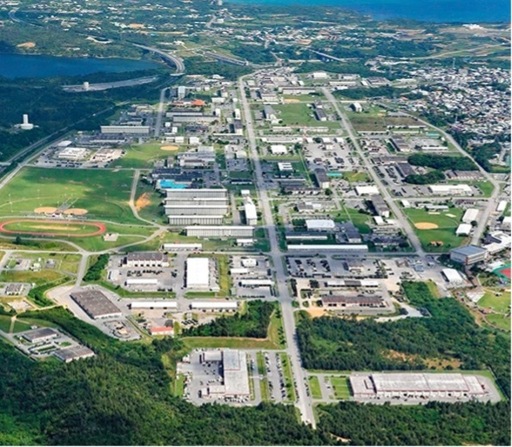

Camp Hansen, located in Kin, Okinawa Prefecture (Asahi Shimbun file photo)
By Mohammed Abunahel, WorldBEYONDWar, March 7, 2026
Camp Hansen is a United States Marine Corps base on the Japanese island of Okinawa, embedded in a broader constellation of U.S. military installations on the island since the end of World War II. The camp itself was built in the mid-1960s on the former Chimu Airfield. The camp is situated in the town of Kin, near the northern shore of Kin Bay, and is the second-northernmost major installation on Okinawa, with Camp Schwab to the north.
The camp’s presence raises chronic and unresolved issues: legal impunity for crimes by servicemen, environmental contamination of land and water, public safety risks from military exercises, and ongoing opposition from local communities. These issues are not episodic, but entrenched in Okinawa’s post-war political and social fabric.
This article traces the historical legacy of Camp Hansen, documents violence and impunity associated with its personnel, and situates these within tangible environmental harms that continue to affect Okinawa’s air, water, and community well-being. The intent here is to foreground the lived harms that bases impose on everyday people and on fragile ecosystems.
Camp Hansen was completed on 20 September 1965, two decades after the industrial scale assault on Okinawa during World War II and amid continued U.S. military occupation that persisted until the island’s reversion to Japan in 1972. While official accounts treat the installation’s construction as part of alliance realignment following the Pacific War, local memory frames it as a continuation of military dispossession, a process that reconfigured vast tracts of land, restricted local autonomy, and embedded a foreign military footprint in residential landscapes.
Crucially, this footprint came with legal protections for U.S. personnel through the Japan–U.S. Status of Forces Agreement (SOFA). The SOFA grants the U.S. primary custody of its service members in certain cases until indictment, and has repeatedly been cited by Okinawans and scholars as a structural shield against local justice.
The most infamous criminal case linked to Camp Hansen occurred on 4 September 1995, when three U.S. servicemen assigned to the base abducted and raped a 12-year-old Okinawan girl in the village of Kin. The attack, characterized by its brutality and the victim’s age, shocked Japanese and international publics and catalysed island-wide demonstrations that drew tens of thousands of residents demanding accountability.
Yet the handling of the case exposed systemic problems:
Japanese police were initially denied immediate custody of the suspects by U.S. military police under the SOFA’s custody provisions, generating outrage and accusations that the agreement facilitated impunity for servicemen.
Press coverage at the time noted that images of the suspects’ faces were initially withheld by U.S. authorities, citing privacy concerns—a choice widely criticised in Japan as insensitive and opaque.
Although the men were ultimately tried in Japanese courts, the incident entrenched Okinawan distrust of U.S. forces and triggered the largest anti-American demonstrations in decades.
International human rights monitoring continues to highlight sexual violence linked to the U.S. military presence in Okinawa as a persistent threat to local women’s safety. A 2023 United Nations review reported that, since 1945, tens of thousands of criminal incidents involving U.S. personnel have been recorded in Okinawa, including hundreds of rapes, even as actual numbers are believed to be higher due to underreporting.
This pattern reflects not isolated aberrations but structural vulnerability: the legal privileges afforded to U.S. forces under SOFA, combined with asymmetries in jurisdiction and prosecutorial reach, often leave local communities feeling both unsafe and powerless.
In recent years, environmental harm linked to Camp Hansen and other U.S. installations has become one of the most persistent and scientifically documented grievances on Okinawa. Central to these concerns are per- and polyfluoroalkyl substances (PFAS), a class of synthetic chemicals historically used in firefighting foams and other industrial applications. These so-called “forever chemicals” do not break down in the environment and can bioaccumulate in food chains and human tissues.
Okinawa’s own environmental surveys have repeatedly found PFOS (perfluorooctane sulfonate) and related compounds in groundwater and freshwater sources around U.S. bases, including Camp Hansen, at concentrations exceeding Japan’s national guidance values. Local tests by the Kin Town Office in June 2020 detected PFOS and related organic fluorine compounds at levels high enough to halt water intake from some wells used for municipal supply.
The Okinawa Prefectural Government has tried repeatedly, four times since 2016, to gain access to U.S. base lands to conduct on-site environmental investigations under the 1973 environmental cooperation agreement, but the U.S. military has refused, citing requirements that Okinawan authorities provide definitive proof of contamination sources. That refusal not only stalls accountability, it denies local residents access to scientific truth about their own water and land.
Experts and local activists warn that the presence of PFAS at levels above regulatory thresholds entails real health risks, from cancer to metabolic and developmental disorders, especially in communities reliant on local water sources. Independent sampling at Camp Hansen’s drainage channels has found chemical signatures consistent with firefighting foams historically used on bases, though U.S. authorities have been reluctant to acknowledge causal links.
Such environmental degradation is not divorced from broader cultural life. In Okinawan dialect, “Ka” refers to natural springs long integral to domestic and ceremonial life; contamination has thus disrupted not just water security but also cultural practices tied to those waters.
While Okinawa hosts only about 0.6% of Japan’s land area, it bears the burden of roughly 70% of U.S. military bases in Japan. The spatial concentration of military land has profound implications for local governance, land use, and economic development. Communities near Camp Hansen and other installations must navigate restricted access to wild lands, constraints on agriculture and fishing areas, and the overshadowing presence of armed personnel in daily life.
Efforts to return land, some parcels have been transferred back in past decades, are uneven and often tied to broader political negotiations that leave communities in limbo. The result is not simply economic displacement but a sense of ongoing occupation that hinders long-term planning and reinforces Okinawan perceptions of second-class citizenship within Japan itself.
In conclusion, Camp Hansen sits at the center of a deeply contested nexus of security, sovereignty, and justice. The camp cannot be separated from the real harms experienced by Okinawan communities: sexual violence linked to legal privilege and impunity, environmental contamination that threatens water safety and health, and the social and economic pressures of prolonged territorial militarization.
These harms illustrate why debates over bases cannot be reduced to abstract calculus. Okinawans protesting outside base gates, demanding jurisdictional reform and environmental transparency, are voicing concrete grievances rooted in decades of lived consequence, and their claims deserve sustained attention from policymakers, scholars, and civil society alike.
The path forward requires not only technical assessment of contamination or periodic criminal investigations; it demands serious consideration of who bears the burdens of foreign military presence and whether long-term deployments can be reconciled with the rights and wellbeing of host communities. The question Okinawa poses is urgent and unresolved: can alliance and security coexist with justice and environmental integrity? The evidence so far suggests that, absent fundamental changes in policy and accountability, the answer remains out of reach.
The post Camp Hansen in Okinawa is an Example of Violence, Contamination, and the Enduring Burden of a Foreign Military Base appeared first on World BEYOND War.
From World BEYOND War via This RSS Feed.