


By Mohammed Abunahel, World BEYOND War, March 7, 2026
For decades, the sprawling U.S. Army garrison at Camp Humphreys has been touted by its military patrons as a linchpin of regional security on the Korean peninsula. But beneath glossy public relations and base ceremonies lies a history of disruption, local resistance, environmental strain, and geopolitical dependency that complicates official narratives.
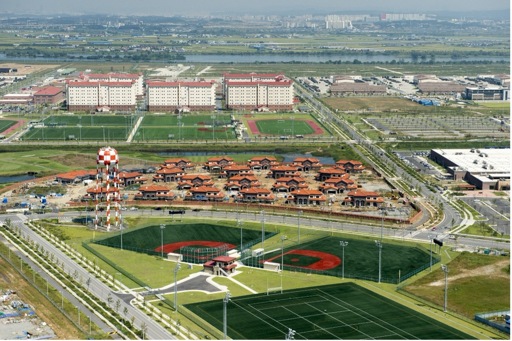
What became the largest overseas U.S. military base grew from rice paddies and farming villages into a fortified expanse roughly the size of central Washington, D.C. by around 2020. Its transformation is one of the most expensive and politically consequential U.S. base projects in the Pacific, but it is also one of the most contested.
The site that became Camp Humphreys began in 1919 as a Japanese military airfield, later rechristened K-6 by the U.S. during the Korean War. In 1962, it was named Camp Humphreys.
But the base’s modern size and prominence derive from a controversial early-2000s expansion plan. In 2004, South Korean and U.S. authorities agreed to relocate most U.S. forces from Seoul and northern garrisons, sites closer to the demilitarized border, to Humphreys in Pyeongtaek in the south. The stated intent was operational efficiency and reduced vulnerability.
The result was not only a massive increase in troop and family housing, schools, clinics, shops, and military facilities but also a deep rupture in the lives of nearby peasants and villagers who had farmed the land for generations.
The most visible negative impact of the base’s growth was forced displacement and land expropriation, particularly in villages such as Daechu-ri. Many residents were pressured or compelled to sell land for the expansion. Compensation, often averaging around 600 million won per resident (approximately $600,000 USD at the time), was disputed by villagers as inequitable, calculated without full consultation, and inadequate to replace lost livelihoods.
In late 2005 and into 2006, farmers and activists staged prolonged protests against what they saw as coerced eviction. South Korean authorities deployed thousands of police and even military personnel to break up demonstrations, a stark symbol of state power enforcing foreign military interests against local resistance.
While official accounts tend to frame the confrontations as maintaining public order amid fringe militancy, multiple local testimonies and human rights observers saw them as disproportionate state force against rural communities defending their land. The construction of base perimeters often erased rice fields and farm plots that had sustained families for generations.
High-volume military activity on vast land tracts inevitably leaves environmental footprints. Scholars of military ecology underscore how training, vehicle traffic, equipment storage, and base infrastructure can fragment soil structure and introduce heavy metals and petroleum compounds into ecosystems. These effects are well documented in military-impacted sites globally, including lead contamination and soil compaction, which increase erosion and disrupt hydrology.
Within South Korea, activists and environmental writers have linked U.S. bases to patterns of ecological degradation, including soil and water stresses, forest fragmentation, and hazardous waste concerns, though systematic environmental impact assessments often remain opaque or incomplete.
The U.S. Army has publicly emphasized environmental management efforts at Humphreys, including compliance with Korean standards and internal monitoring systems, but these are framed in operational terms that prioritize military mission continuity as much as environmental protection.
Independent environmental audits are rare, and base authorities have not released comprehensive contamination mappings accessible to the public. This opacity hinders robust accountability for pollution liabilities that may affect farming communities downwind or downstream from the base.
Camp Humphreys sits at the intersection of South Korean national sovereignty and U.S. interests. While Seoul officially supports U.S. forces as a deterrent to North Korean aggression, many citizens and civil society groups argue that treaty arrangements and base expansions reflect unequal power dynamics rather than mutual defense.
Scholars critical of the U.S.–South Korea alliance describe such military footprints as forms of neo-colonial dependency: structures that grant leverage to an external power while constraining domestic political decision-making on base siting, funding burdens, and security policy.
South Koreans pay a significant share of the cost associated with U.S. forces under the “Special Measures Agreement,” yet public opinion surveys show ambivalence toward bases: most citizens support the alliance overall but not always base relocations in their own backyards.
Military host communities worldwide grapple with social issues arising from foreign troop presence. Reports from Korea have regularly highlighted incidents that strain local-base relations, from traffic accidents and noise pollution to alcohol-related violence.
While detailed crime statistics specific to Camp Humphreys remain scattered, national reporting and civil society accounts point to recurring concerns about U.S. service member conduct, particularly in interactions with local civilians. Some of these issues echo broader patterns seen at overseas installations, where jurisdictional complexities under Status of Forces Agreements (SOFAs) can make legal accountability for U.S. personnel opaque or protracted.
A notable historical example outside Humphreys but indicative of such tensions is the McFarland toxic dumping scandal at the Yongsan Garrison, where formaldehyde was illegally discharged into the Han River and fueled public outrage over base accountability. That incident inspired cultural memory through media representations such as Bong Joon-ho’s film The Host.
Although not at Humphreys, episodes like McFarland’s highlight structural problems in U.S. base operations in South Korea, where environmental harm or criminal acts by base personnel can reverberate through local communities with limited redress.
Camp Humphreys is not merely a U.S. military installation. Its story intersects with rural displacement, contested sovereignty, environmental uncertainty, and societal friction. Official narratives emphasizing alliance-building and security obscure lived experiences of communities displaced or marginalized by base expansion.
Limitations in the available public data, especially rigorous environmental and social impact assessments, complicate any definitive accounting of harm. But what is clear from detailed reporting and scholarly critiques is that the costs and benefits of such bases are neither evenly shared nor transparently evaluated.
Given this uneven ledger, continued public scrutiny, independent research, and accountable governance remain essential. If Camp Humphreys symbolizes the U.S.–South Korea alliance, it is one defined not only by calculus but also by local sacrifices that have yet to be adequately acknowledged or addressed.
The post Empire in Pyeongtaek: The Real Cost of Camp Humphreys appeared first on World BEYOND War.
From World BEYOND War via This RSS Feed.