

On Tuesday, we opened our phones to see footage from the funeral of over 160 girls killed by Israeli strikes on Shajareh Tayyebeh, an all-girls school in Minab, Iran — child-sized coffins carried by a crowd of wailing mothers, teachers, and community members. This was the horrifying aftermath of just one air strike; since Saturday’s attacks on Minab, over 1,000 civilians in Iran have lost their lives in the United States and Israel’s imperialist war, which threatens to drag the world further into misery.
Despite campaign promises to end U.S. involvement in destructive wars, President Donald Trump and Israeli prime minister Benjamin Netanyahu have launched a massive military assault on Iran, targeting its leadership and military infrastructure with the aim of regime change and imperialist dominance over the oil-rich country’s resources. So far, in just over a year of Trump’s presidency, the United States has bombed seven countries and attacked two others with the goal of regime change — kidnapping Venezuelan president Nicolás Maduro and assassinating Iran’s Supreme Leader Ali Hosseini Khamenei. Amid all this, Trump has threatened a “friendly takeover” of Cuba while depriving the country of fuel.
The war is extremely unpopular in the United States — less than one in four Americans say they support the strikes in Iran. At least six U.S. armed forces members have died since the conflict began. “That’s the way it is,” Trump said in a video address on Sunday. “There will likely be more.”
We cannot sink into despair, apathy, or numbness. The Palestine movement of recent years has awakened an anti-imperialist sensibility among growing sectors of the working class and youth worldwide, and there’s no turning back. Learning from the Arab Spring, Black Lives Matter, the Palestine movement, and the ongoing anti-ICE movement in the U.S., we must unite to build a massive international anti-war movement led by the working class and youth.
In the movement for Palestine, students organized encampments at their schools, and their teachers defended them from administration and campus police. In an unprecedented example, the university faculty UAW 4811 went on strike across California in defense of Palestine and the right to protest, and against the violent right-wing assault on the UCLA encampment.
As workers in the heart of the imperialist beast, we have the power to grind the gears of the war machine to a halt. That’s why, as our comrade James Hoff wrote after the attacks on Venezuela, the time for an anti-imperialist labor movement is now.
And educators have a key role to play.
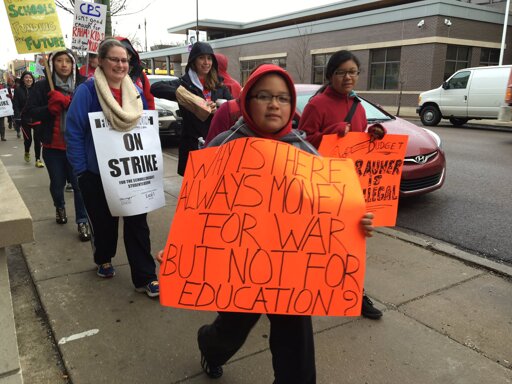
Money for Books and Education, Not for War and Occupation
In our workplaces, many may ask, What does stopping the war have to do with our working conditions? How is it related to our union? Let’s look at the numbers.
Military funding for the last fiscal year amounted to $826 billion, plus at least $150 billion raised through the One Big Beautiful Bill Act, which received bipartisan support. For the upcoming fiscal year, Trump aims to increase military funding to $1.5 trillion, surpassing Cold War spending levels. Even though the Department of Homeland Security has been “shut down,” it continues to operate with a $165 billion infusion from the OBBBA, which also allocated $75 billion to ICE and $64 billion to CBP.
As of January, at least $12 billion was cut from education in Trump’s first year in office, eliminating programs that support English-language learners and the children of migrant farmworkers, while cutting the budget of the Office for Civil Rights by more than a third. The Congressional Budget Office’s latest cost estimate shows that the reconciliation package would reduce federal Medicaid spending over a decade by an estimated $911 billion (after accounting for interactions that produce overlapping reductions across different provisions of the law) and increase the number of uninsured people by 10 million.
But this goes far beyond Trump; imperialism is bipartisan. According to an article summarizing an analysis by Brown University’s Watson Institute of International and Public Affairs,
U.S.-led wars since 2001 have directly caused the deaths of about 940,000 people across Afghanistan, Pakistan, Iraq, Syria, Yemen and other conflict zones. This does not include indirect deaths, namely those caused by loss of access to food, healthcare or war-related diseases. The U.S. has spent an estimated $5.8 trillion funding its more than two decades of conflict. … In addition … the U.S. is expected to have to lay out at least another $2.2 trillion for veterans’ care over the next 30 years. This would bring the total estimated cost of U.S. wars since 2001 to $8 trillion.
As stated in PSC-CUNY’s December statement against imperialist threats on Venezuela,
U.S. militarization … carried out even as federal aid is slashed, benefits are cut, Affordable Care Act premiums are set to rise, and public resources are clawed back from New York City — diverts desperately needed funds from education, healthcare, housing, infrastructure and other social needs at a time when CUNY remains chronically underfunded.
For teachers, it’s impossible to view this without recognizing it as a labor issue, highlighting why public sector unions, and specifically educators’ unions, have such an important role to play. At stake aren’t just our working conditions but the learning conditions of the children of the working and middle classes. Every dollar spent on imperialist war is a dollar that could have been spent on education.
In the past year, educators have played a crucial role in the fight against ICE in Minneapolis and St. Paul and have gone on strike in San Francisco, mobilizing around sanctuary protections as a key demand. United Teachers of Los Angeles, along with SEIU Local 99, which represents support staff, just overwhelmingly voted to authorize a strike. Educators across the country have formed committees against ICE terror and mobilized after the ICE murders of Renée Good and Alex Pretti. We must also take the lead in the labor movement to mobilize against imperialism.
While we strongly oppose imperialism, we must remain politically independent of the Iranian regime, which offers no progressive solution for workers and youth. During the protests in Iran earlier this year, the Coordination Council of Iranian Teachers’ Trade Associations reported that government forces were responsible for the executions of more than 230 children and teenagers. But in this context, we must stand firmly against the imperialist aggressor, resisting more “liberal” imperialist narratives that promote a “democratic transition” behind the barrel of a gun, as with the Democrats in office who oppose the attacks merely on procedural grounds.
Our calls for “hands off Iran and Lebanon” must be accompanied by unwavering solidarity with the region’s workers, oppressed, and youth.
Labor Must Take the Lead in a Mass Movement against U.S. Imperialism
In this movement and all the struggles ahead for the growing labor movement, we should unite the anti-war movement with our labor struggles at home — from bread-and-butter demands addressing obscene wealth inequality to protecting students and communities from ICE and other political demands.
This coming May Day, workers and organizations like the May Day Strong coalition are calling for mass actions against Trump’s attacks, with calls for a mass day of no work, no school, and no shopping.
But we can’t wait for May Day. Labor must engage with and lead the anti-war protests now. As rank-and-file teachers, we must demand that our unions, such as the National Education Association and the American Federation of Teachers — which recently released a statement against the war — mobilize their massive memberships to take to the streets.
May Day coalitions are also organizing boycotts against corporations like Target, Amazon, Palantir, Hilton, and Home Depot for their assistance to Trump’s authoritarian, anti-immigrant, and imperialist agenda. Unions like the Minneapolis Federation of Educators have taken part in mobilizations, direct actions, and boycotts of these corporations. While we should absolutely target these corporations, let’s be clear: boycotts and pressure campaigns alone are not enough. From Target to Amazon, corporations have proved that they will post Black Lives Matter statements and wave Pride flags only as long as it guarantees their profits. There is no “progressive stance” for these multinational union-busting corporations; exploitation is part of their DNA.
That’s why our fight against ICE and imperialism is tied to our fight for labor rights, union recognition, and safe working conditions. This means we must also fight anti-worker laws, like the Taft-Hartley Act, that undermine the labor movement by making it illegal to have political or solidarity strikes. Additionally, we must stand shoulder to shoulder with the students who are walking out of their schools and taking to the streets against ICE terror. By breaking these chains and divisions within the working class — through strike power and solidarity — we can wage a serious fight to halt the war machine, end ICE aggression, and win the world our students and communities deserve.
Our struggles are interconnected; our fight for our class siblings abroad is inextricably linked to our fight against right-wing attacks on immigrants, trans folks, workers, and students. From our unions and our schools, we must speak out loudly as educators against Trump’s aggression and organize for the kind of strike action that can grind the gears of U.S. imperialism to a halt. Money for health care and education, not for war and militarization!
The post Educators Must Take the Lead in Opposing the Imperialist War on Iran appeared first on Left Voice.
From Left Voice via This RSS Feed.