

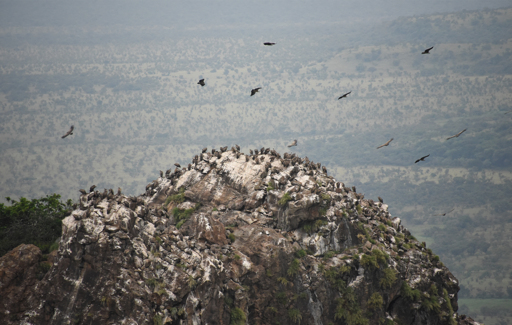
Populations of Rüppell’s vultures have fallen by more than 90% over the past four decades. Knowing exactly where these critically endangered birds breed can allow conservationists to put protective measures in place. But Rüppell’s historically occupied a vast swathe of West, Central and East Africa; finding their remaining colonies is a daunting task. A team of researchers says it has successfully tested a way to find vulture colonies remotely, pinpointing dozens of potential sites across seven countries using open-access satellite imagery. The vultures helped. Like other cliff-nesting birds, their droppings lavishly daub cliff faces below their nests with whitewash. Bulgarian ornithologist Ivaylo Angelov, zoomed in on satellite images of mountainous areas across more than 6 million square kilometers (2.3 million square miles), seeking out cliffs over 20 meters (65 feet) high as well as sites documented in old bird atlases of the region. Ivaylo Angelov studies a Rüppell’s vulture nesting colony in Ethiopia in 2009. Image courtesy of Nikolay Terziev. Angelov and his colleagues pinpointed 232 previously undocumented nesting sites. Most of these were in Sudan, South Sudan and Chad, but they found others in the Central African Republic, Eritrea, Ethiopia and Somalia. The work took weeks but was “immensely satisfying.” “I love geography, I love travel, and it was an absolute joy for me to zoom in and check all these incredible mountains,” Angelov says. “I had the feeling that I’m there.” In the region surrounding Sudan’s Jebel Marra mountains, in the southwest of the country, the team located…This article was originally published on Mongabay
From Conservation news via This RSS Feed.