


Luna Reyna
Underscore Native News + ICT
SEATTLE — Benjamin Brockie’s place of calm and contemplation on the University of Washington campus is the Drumheller Fountain, a 210-foot diameter basin that shoots water up to 100 feet high in the summer with views of Mount Rainier.
It’s a stark contrast to the limited recreation areas of the prisons he was at for over two decades: the dust or mud bowl of bare earth surrounded by barbed wire fences, and hearing the sharp ping of the metal detectors when walking into the prison education building. The building had no windows, or only windows that look right back out into the loading dock, with more fences and razor wire.

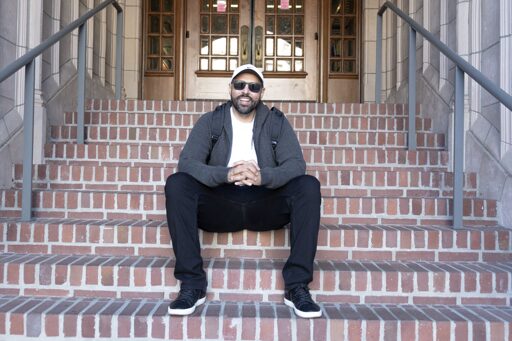
Benjamin Brockie, Aaniiih of the Fork Belknap Reservation, sits in front of the Drumheller Fountain on the University of Washington campus. Photo by Luna Reyna, Underscore Native News + ICT.
Brockie, Aaniiih of the Fork Belknap Reservation, is a husband, father, college student double majoring in sociology and American Indian studies where he is also a dean’s list student and a two-year Marygate Scholar recipient. He is on track to graduate in June and is determined to attend law school following graduation.
He was also incarcerated for over 22 years. His original sentence was over 67 years in prison for two robberies when he was 20. For seven years, Brockie worked with attorneys through the Clemency Project to obtain a clemency hearing. Following a recommendation from the Clemency & Pardons Board, Governor Inslee commuted Brockie’s sentence in fall of 2024.
Since his release he has continuously worked towards creating change in the prison system and is an advocate for his friends still incarcerated.
He sits on the board of Civil Survival, which provides legal representation and reentry support, and advocates for policy reform in Washington State. He is an Indigenous outreach specialist for Living With Conviction, which works to secure economic and racial justice for formerly incarcerated people and paralegal for Just Solutions, and Native American Reentry Services’ King County outreach specialist.
He has also addressed the Washington State Supreme Court as part of a Symposium hosted by the Supreme Court’s Minority and Justice Commission titled, “TÁĆELŚW̱ SIÁM: A Call to Justice for Indigenous Peoples.” Recently, he spoke at a rally in Olympia organized by Charles Longshore, Skokomish. Brockie and others shared their stories of incarceration and advocated for reform and community.
Braiding resources
As a college student right out of prison, he learned first hand the gaps in support for people like himself reentering society. This inspired him to start a registered student organization on campus for formerly incarcerated students.
“What I’m trying to do is create a community for people that were formerly incarcerated at UW. University of Washington does not have a reentry navigator,” Brockie said. “They had nothing for me when I got there, as far as any type of reentry resources.”
In May, Brockie’s registered student organization will be hosting a panel at University of Washington to talk about the importance of higher education in prison, recidivism and the need to have reentry navigators at schools like UW. Doug Baldwin, former receiver with the Seattle Seahawks who now sits on the Clemency and Pardons Board, Washington Supreme Court Justice Montoya Lewis, and Brockie himself will be sitting on the panel.
Brockie was overwhelmed and too embarrassed to ask anyone on campus for help. He didn’t want to perpetuate any stereotypes about former inmates but he needed support and knew that he couldn’t be the only one. So he created the support group through the student organization.

Benjamin Brockie, Aaniiih of the Fork Belknap Reservation, stands in front of the two pillars on the University of Washington campus. Photo by Luna Reyna, Underscore Native News + ICT.
“I want to create a community where those individuals can come together and feel safe,” Brockie said.
He’s also hoping to “shake trees” at the university for technical resources for his student organization. Things like Canvas – the online course web sites used to distribute syllabi, reading lists, class meeting calendars and other course materials – are extremely hard to navigate for previously incarcerated people re-entering society with decades of distance between them and the new technology.
“I am so overwhelmed by technology,” Brockie said. “That is a major downfall of the Department of Corrections. They are definitely behind in allowing individuals to experience things like the internet, smartphones, emails, Canvas.”
Brockie is also advocating for the university to create access to resources and higher education material for those that are currently incarcerated. And hopes to create legislation that allows incarcerated people to take university classes virtually. Brockie wants the University of Washington to feel attainable for everyone so that the recidivism rates seen, particularly for Native peoples, are reduced.
More than 45 percent of incarcerated Native people returned to prison, or recidivate, within 36 months of release, according to the Washington state Department of Corrections.
Research cited by the Department of Justice “shows that inmates who participate in correctional education programs have 43 percent lower odds of returning to prison than those who do not, and that every dollar spent on prison education saves four to five dollars on the costs of re-incarceration.”
This leaves a much smaller percentage of people who recidivate which Brockie believes could be prevented if leaders within individual Native nations prioritized reentry programs as well.

Benjamin Brockie, Aaniiih of the Fork Belknap Reservation, walks on the University of Washington campus. Photo by Luna Reyna, Underscore Native News + ICT.
“Tribes can do so much more to help those individuals that are incarcerated, certain programming and cultural teachings, mentors,” Brockie said.
He went on to explain that people go to prison because they’re lost, they do drugs because of peer pressure, because they’re dealing with trauma. They join gangs because they want to belong and helping those who are lost to re identifying with their culture, often helps people choose a better path.
Brockie believes this braided with other reentry and education resources would make a world of difference.
“As Indian people, when we braid our hair it’s stronger. Once we take that sweet grass and braid it, it becomes safer. And I think anything that we can braid together becomes safer and stronger, and that includes ourselves,” Brockie said.
Religious discrimination
Brockie understands the need for these braided supports well because these are elements that helped him succeed in getting his own freedom and helped him stay on that path while incarcerated.
He led talking circles and organized the annual powwows which meant working with prison administration to get things approved. He organized dance practices, worked with the drum group in prison and organized the regalia-making program for the ceremonies. When he assigned others he calls “brothers” to tasks, it created a brotherhood Brockie is proud of.

Singing River Drum Group drum at Huy’s 2nd Annual “Welcome Home” Honoring and Celebration at the Eighth Generation Warehouse on November 6, 2025. Photo by Luna Reyna, Underscore Native News + ICT.
“Powwow means everything to us in there,” Brockie said.
Brockie also created a program called Prevention by Early Intervention for at-risk juveniles. The mission of the program was to empower youth but Covid shut it completely down so he pivoted and created a food drive. Brockie and others incarcerated with him purchased prepackaged non-perishable food from within prison and donated it to Coastal Harvest food bank in 2020, St. Leo’s in 2021, and Ballard food bank in 2022 and Labateyah House in 2024.
“Leading is about sacrifice. You’re the last one to eat. You’re the last one to get to do anything fun, and sometimes you’re the poorest, because you’re trying to make sure that everybody else is taken care of,” Brockie said.
According to Brockie, because he was a Native religious leader, the department of corrections labeled him a gang leader.

Resilience Inside: The Ongoing Fight for Indigenous Religious Freedoms Inside Washington’s Prisons documentary consent form at Huy’s 2nd Annual “Welcome Home” Honoring and Celebration at the Eighth Generation Warehouse on November 6, 2025. Gabe Galanda, Round Valley Indian Tribe, chairman of Huy, informed people that there are videographers and photographers there for the documentary. Photo by Luna Reyna, Underscore Native News + ICT.
“Native American religion and spirituality is supposed to be protected by the religious freedom act, but we’re considered a gang in prison,” Brockie said.
When someone is labeled a gang leader they are considered a security threat group, which affects their ability to transfer, when or if they are released from prison and when released their parole officer then gives more stringent rules, according to Brockie.
“But individuals that go to Catholic Church, or Christian Church, that organize choir, that organize prayer group, that organize their yearly event, they’re not labeled as [security threat group],” Brockie said. “There’s only two religious groups in prison that get labeled as [security threat group] for being leaders and that is Native American religions and Muslim religion. That, in itself, is a form of prejudice that deeply affects us.”
Although his leadership role had its difficulties, Brockie believes it was a privilege.
“You get painted with this scarlet letter that is completely unfair when all you’re trying to do is help your people to get stabilized, find themselves and learn the culture, right? Learn these traditions, learn these ways of living and empower them with knowledge,” Brockie said. “I am definitely the person I am today because of those responsibilities. I think it’s an honor, and I’m very proud of what I did. I just feel privileged.”
Education
The education portion of the braided supports reduces recidivism rates.
In Washington state prisons, free college programs and courses are only available to incarcerated individuals with seven years or less until they are released back into society. For people like Brockie who was sentenced to more than 67 years, he was never a priority for education.
While at Airway Heights Prison, Brockie pushed teachers and prison deans to let him learn. He even bartered his paintings to get them to let him in certain classes. He was able to piecemeal classes together and show that he was dedicated and determined to be in class.
Eventually Airway Heights and later Coyote Ridge Correction Center, let him take classes until somebody with seven years or less came and wanted to learn. Then he would get bumped.

Benjamin Brockie, Aaniiih of the Fork Belknap Reservation, sits on a bench under a tree on the University of Washington campus. Photo by Luna Reyna, Underscore Native News + ICT.
In 2021 the Stafford Creek Correction Center stopped allowing Brockie to take courses so he decided to finish his degree through a correspondence course for people who are incarcerated with the University in Colorado. His sister sent him the money for the course and he finished his associates degree in human and social services in prison. He was able to walk with other graduates in Stafford Creek in 2023.
“There is this argument that people that are incarcerated shouldn’t get educated for free. That is a safeguard of capitalism,” Brockie said. “I think the argument isn’t that prisoners shouldn’t get educated for free. The argument is, why doesn’t everybody get educated, regardless if they are in prison or in community or not?”
Brockie believes that higher education will help those incarcerated become critical thinkers and better communicators which will positively impact their relationships with family, children, partners, and their interpersonal communication.
He also pointed out that education could positively impact college rates of the children of previously incarcerated individuals.

Benjamin Brockie, Aaniiih of the Fork Belknap Reservation, sits in front of the sociology building on the University of Washington campus. Photo by Luna Reyna, Underscore Native News + ICT.
There is data on how children are more likely to attend college and earn an undergraduate degree if their parents have. There is also data that children are much more likely to have contact with the criminal justice system if their parents do so Brockie asked, “What happens when we marry those two statistics, when you have an incarcerated person who then gets their degree in prison, does getting that degree in prison offset that child’s chances of becoming in contact with the criminal justice system? Does it promote their ability to then seek out higher education in their own lives?”
“If we really care about communities, if we really care about the next generation, and if we really care about recidivism rates, we should do everything we can to make sure that individuals that are incarcerated are finding ways to become better people. And I think education plays a major part in that for long term offenders,” Brockie said.
He said that the narrative that it is a waste of time, and taxpayers’ resources and money to educate people with longer sentences because they’re probably not going to get out of prison is false. He said that those people are a major part of the overall health of the prison system – which he likens to a riverbed.
“When you come to prison, individuals with seven years or more are those river beds,” Brockie said. “They’re a fixture in the prison system. Those individuals that have seven years or less, they’re that river water moving through. But if that river bed, if those individuals doing a significant amount of time aren’t healthy, we don’t have a healthy community in prison, right? If we want to talk about making sure that the next generation doesn’t recidivate, then we have cleaner and healthier prison communities, and we have healthy environments for all those that live and work there.”
Lifelong dreams
Since his release, Brockie says he continues to run into barriers to achieve his goals. With his degrees and lived experience he has struggled to find full-time employment.
“For me, taking that knowledge of 22 years of incarceration and getting that contextual credibility of a [Doctor of Law] degree, amplifies my voice, gives credibility to what I am saying,” Brockie said.

The welcome table at Huy’s 2nd Annual “Welcome Home” Honoring and Celebration at the Eighth Generation Warehouse on November 6, 2025. Photo by Luna Reyna, Underscore Native News + ICT.
“If 22 years gives me a seat at the table, getting my [Doctor of Law] gives me a microphone at that table,” Brockie continued. “People will listen to me when I say I am a lawyer, and this is what’s wrong with their system. I am a lawyer, and this is what you need to do to fix it. And I am a lawyer, you’re not going to bulldog me or run over these people because I’m going to stand up for their rights. I think that in itself, gives me a weapon. It is a new arrow in my quiver, and I plan to use that by challenging the system.”
Brockie hopes to work in tribal law after law school and is interested in immigration law.
“I want to give back and protect my people,” Brockie said.
But his biggest focus right now is his family.

The welcome table at Huy’s 2nd Annual “Welcome Home” Honoring and Celebration at the Eighth Generation Warehouse on November 6, 2025. Photo by Luna Reyna, Underscore Native News + ICT.
“My son is the absolute best thing that’s ever happened to me,” Brockie said. “He is our world. My wife and I constantly talk, especially every night when he’s laying between us, like how beautiful he is, how lucky we are.”
Now, Brockie and his wife are building for his future.
“Being a dad has been my dream since I was a little kid,” Brockie said.
Brockie grew up without a father. Now, he’s excited to change that pattern for his son with the support of his wife.
“I’m lucky. My wife does 99 percent of the work. She allows me to focus on school, she allows me to focus on my job, and then she even allows me to go golfing and like, do things with my family and stuff, because she wants me to have a balanced life, so she sacrifices her profession, her education and her fun for us,” Brockie said. “I’m grateful that she cares for me and she knows that I have this rare opportunity and I need to take advantage of it. My success is not really my success. My success is a part of the people that love and believe in me.”
Support systems
Other than his wife, and family, community support from Gabe Galanda, chairman of Huy, have been impactful for Brockie.
Huy, is an Indigenous nonprofit based in Washington state that works to provide economic, educational, rehabilitative, and religious support to Indigenous prisoners, especially focusing on helping them rejoin their communities after release. The organization gets its name from a Coast Salish Lushootseed word that means “see you again.”
Huy supports access to Indigenous religious and cultural activities within the Washington Department of Corrections, such as annual powwows, regalia making, drum circles, and, most recently, sacred medicine garden development and programming that Brockie was a part of while incarcerated.

Left to right: Benjamin Brockie, Aaniiih of the Fork Belknap Reservation, Winona Stevens, Hochunk, executive director & founder of Native American Reentry Services, Minty LongEarth, Santee citizen also of Creek/Choctaw descent, a Huy advisor. Brockie introduces each relative who has returned home from incarceration before they walk up and are blanketed by Stevens and Longearth. Photo by Luna Reyna, Underscore Native News + ICT.
In 2024, Brockie was part of a “Welcome Home” celebration hosted by Huy at the Eighth Generation warehouse where he and others who had been recently reentered society were wrapped in the Never Say Goodbye wool blanket. The blanket was created to raise awareness, and money towards support for Indigenous people incarcerated across the Pacific Northwest and beyond.
Galanda became a mentor that Brockie could lean on for resources, professional, personal, and spiritual advice.
In 2025, Galanda invited Brockie to be a guest speaker for Huy’s second annual Welcome Home celebration.
“I feel honored that he believes in me, sees the work that I’ve been doing. I think the celebration is exactly what we need,” Brockie said.
“I also know that the most important thing Indigenous people have is community, and I think coming back into the community, being welcomed back into the community, is huge,” Brockie continued. “I think it sets an example. It makes re-entry tangible for individuals. It gives them something to look forward to. People want to come home. They want to get [invited] to this award ceremony. They’re able to see that their community cares about them. They feel a part of something. They’re going to be able to come to this event and rub shoulders with Indigenous professionals that can open up doors that sometimes are closed to them.”

Left to right: Gabe Galanda, Round Valley Indian Tribe, chairman of Huy, and Benjamin Brockie, Aaniiih of the Fork Belknap Reservation. Galanda gifted Brockie a beaded medallion for his leadership and accomplishments at Huy’s 2nd Annual “Welcome Home” Honoring and Celebration at the Eighth Generation Warehouse on November 6, 2025. Photo by Luna Reyna, Underscore Native News + ICT.
During the 2024 Welcome Home event, Brockie met Washington Supreme Court Justice Montoya Lewis, who Brockie says has been very supportive.
“Who would have thought 15 months ago, when I was in prison, that I would be texting with a state supreme court justice,” Brockie said.
And although things haven’t been easy, Brockie is grateful for his wife, son, and the opportunities that have opened up for him because of his support system and he wants to pass that on.
“I’m setting up for the next person, hopefully at this year’s event, to lead next year’s event, and we continue that human link, reaching back into the system and helping those individuals, and pulling our relatives out,” Brockie said.
This story is co-published by Underscore Native Newsand ICT, a news partnership that covers Indigenous communities in the Pacific Northwest.
The post From a life sentence to law school appeared first on ICT.
From ICT via This RSS Feed.