

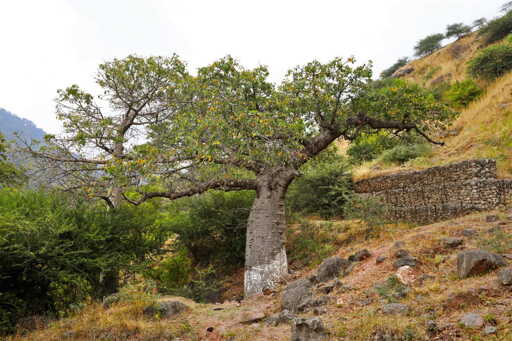
A couple of years ago, Sarah Venter wrote an article gently picking apart alarm over the specter of Africa’s iconic baobabs dying off due to climate change. Her review found that while a number of famously large and ancient trees had indeed collapsed in worsening conditions, Adansonia digitata were generally proving resilient. When she heard about fears that a new pest was killing worrying numbers of baobabs in Oman, she set off to investigate, at the invitation of Oman’s Environmental Authority. There are eight species of baobab, members of the genus Adansonia. A. digitata is widely distributed across East, West and Southern Africa; one species is restricted to northwestern Australia; and the other six are found only in Madagascar, believed to be the center of origin for this striking family of trees that stand majestically on barrel-like trunks and can live for well over a thousand years. Three of Madagascar’s baobab species are threatened — A. grandidieri and A. suarezensis are listed as endangered on the IUCN Red List, and A. perrieri is critically endangered — by logging, charcoal production, wildfires, and mining of the forests they’re found in. Historical records and genetic research suggest baobabs reached Oman, on the Arabian Peninsula, centuries ago as part of the circulation of valuable plants between northeastern Africa, the Persian Gulf and South Asia by nomadic and fishing communities on the Indian Ocean. Batocera rufomaculata adult (a) and larvae (b). Images courtesy of Sarah Venter. It was the health of about 100 baobabs…This article was originally published on Mongabay
From Conservation news via This RSS Feed.