


Kevin Abourezk
ICT
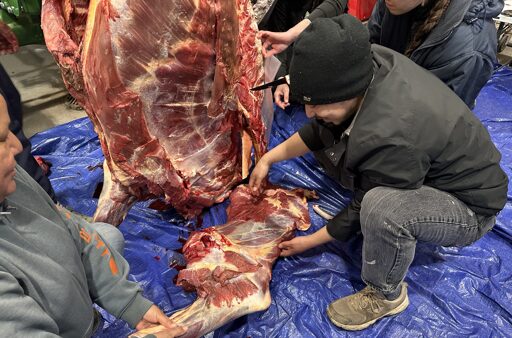
BELLEVUE, Nebraska – The 23-year-old Omaha Nation man grips the knife in his right hand and cuts tendon and fat from a buffalo carcass hanging before him until the appendage, a leg, falls to the ground onto a blue tarp.
His teacher, an Oglala Lakota woman, beams widely.
“Have you ever butchered?” Lisa Mni asks him.
“This is my first time,” Carlos Grant says.
“Then you come in and take off a leg like that?” Mni says, eliciting laughter from several people standing nearby. “Wow. Dang.”
“He’s tapping into ancestral knowledge,” one of the bystanders says.
The scene unfolded in late February inside a garage in Bellevue, a suburb of Omaha, Nebraska. The Bluebird Cultural Initiative, a Native nonprofit that focuses on cultural revitalization, hosted the event, which began with organizers harvesting the three-year-old male buffalo on the Rosebud Indian Reservation in South Dakota and transporting it to Bellevue.

Steve Tamayo (center), founder of Bluebird Cultural Initiative, welcomes participants of a buffalo butchering workshop hosted by his organization in Bellevue, Nebraska, on Feb. 21, 2026. (Kevin Abourezk/ICT)
Nearly 20 people took part in the butchering, which began with Bluebird Cultural Initiative founder Steve Tamayo explaining the purpose of the gathering. He encouraged everyone in attendance to get involved in butchering the buffalo carcass.
“We’re going to have cutting stations,” he said. “That meat is going to work its way down. We’re going to have bags that we’re going to seal it up with. Everyone around this circle will all benefit and take some of this home.”
He then introduced Mni and Arlo Iron Cloud, who served as the primary educators during the butchering.
“Wherever we go, wherever we share, we don’t like to be called experts,” Iron Cloud said. “We’re all going to learn something together. You guys are going to teach us things too.”
Mni said she and Iron Cloud prefer to teach people how to butcher buffalo without being too hard on learners, who are likely to make mistakes and who often will quit learning if they are treated harshly by their teachers.
“The only way you’re going to truly learn is when you’re relaxed and you’re feeling good,” she said. “When you get scolded or shamed out, those walls come up and you’re not learning nothing except ‘get out of the way’ and not to mess up.”
She said she and Iron Cloud have worked with many Indigenous communities educating others about how to harvest and butcher buffalo but still learn something new every time they do so.

Lisa Mni, right, teaches a woman how to butcher a buffalo during a cultural butchering workshop held Feb. 21, 2026, in Bellevue, Nebraska. (Kevin Abourezk/ICT)
She said one such lesson was that Lakota and Cheyenne people believe that you shouldn’t eat the thymus gland of a buffalo, believing that the organ carried human flesh from a time when the buffalo ate human beings. She cited the Great Race story, which tells of a race between human beings and buffalo that the buffalo won, leading to the supremacy of human beings on the earth.
“Before the Great Race, they used to eat us. Now they carry us,” she said. “These guys still carry us.”

Arlo Iron Cloud cuts meat from a buffalo skull during a butchering workshop held Feb. 21, 2026, in Bellevue, Nebraska. (Kevin Abourezk/ICT)
Prior to the butchering, Bluebird Cultural Initiative removed the hide and skull from the buffalo carcass and planned to tan the hide and use the buffalo’s skull for ceremonial purposes and its face for use as a mask.
Iron Cloud, Oglala Lakota and Diné, said lessons about how to harvest and butcher buffalo should be an integral part of the education of Native children. He said he would like to see schools incorporate such lessons into their curriculum. He said learning how to kill and butcher buffalo helps young people reconnect to nature and their own Indigenous roots.
“When we force them into institutions that aren’t natural and don’t belong to us, I don’t see us ever being able to fully adapt to that process, but if we really want to strengthen our nation, our people, I think it’s important to incorporate this into their lives because it gives the understanding and the base of what it means to be an Indigenous person connected to the land,” he said.
Tamayo, Sicangu Lakota, said it’s important to use all parts of the buffalo, including the offal, which includes tendons, bones, the tongue, heart, kidney and other parts of the animal’s innards – parts that are typically discarded by non-Native butchers. He said Native people use many of those parts for ceremonial purposes, as well to create weapons and other instruments. He said even the skin of a buffalo penis, or pizzle, was once used to connect wooden handles to large stones to construct war clubs.
“That’s why our clubs never broke, and if you look at and go into museums today, they’re still intact,” Tamayo said. “They were created a couple hundred years ago but still intact and still usable, which I find amazing.”

During the butchering, participants were encouraged to taste various parts of the buffalo meat. Tamayo said he was even able to taste gall stones, which tasted like NyQuil. “And actually, it’s medicine for us,” he said.
Those who helped butcher the buffalo each got to take home two large vacuum-sealed bags of buffalo meat.
For some though, the greatest reward came from the butchering itself.
After he finished cutting a leg from the carcass, Carlos Grant carried it to a nearby table and hoisted it up to get a photo taken as he smiled like a boy celebrating catching his first big fish.

Carlos Grant poses with a leg from a buffalo carcass that he removed during a butchering workshop held in Bellevue, Nebraska, on Feb. 21, 2026. (Kevin Abourezk/ICT)
The post ‘Tapping into ancestral knowledge’ through buffalo butchering appeared first on ICT.
From ICT via This RSS Feed.