

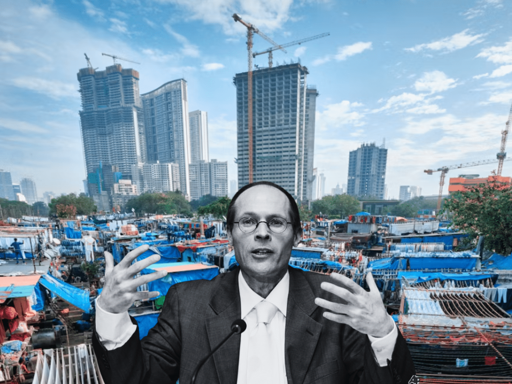

World leaders’ relentless focus on economic growth is a key driver of social inequality and extreme poverty. That same centering of profit at all costs is fuelling the climate crisis and hastening the death of our planet.
But then, the Canary would say that, wouldn’t we? We’re a bunch of rabid leftists who probably read Marx on the shitter before wiping with recycled toilet paper.
Except it’s not us that said it — it’s the UN special rapporteur on extreme poverty and human rights, Professor Olivier De Schutter. In April, he will present his findings to the UN and advocate for a global shift toward a ‘Beyond Growth’ approach.
New economies for eradicating poverty
De Schutter leads a team entitled ‘New Economies for Eradicating Poverty,’ or ‘NEEP’. At the heart of what they do is the Roadmap for Eradicating Poverty Beyond Growth, a blue print for:
expand[ing] the range of policy options available in the fight against poverty, beyond those that rely on economic growth.
Once finished, the Roadmap will offer a catalogue of concrete policy measures that governments, international agencies, and other stakeholders can implement that place human rights, care, and well-being at the centre of the economy, while respecting planetary boundaries.
The roadmap will set out policies for both richer and poorer countries, having suffered under the pursuit of endless growth. De Schutter stated that, in the case of poorer nations:
Although these countries still need to create resources to invest in hospitals, schools, infrastructure and so on, the growth that they are forced to pursue, particularly to reimburse their foreign debt … means they must export, and in order to export, they must produce not for their own population and not based on ecological considerations, but based solely on what the big buyers in global supply chains demand.
Likewise, for richer countries, the roadmap will suggest that:
instead of public revenue being raised by taxing income from labour or economic activity, we should ensure that public revenue is raised by taxing wealth, financial assets, immovable property, financial transactions, and all the ills of the economy, including from the extractive industry and especially of fossil energy.
Beyond growth
The special rapporteur argues that politicians must set aside the growth mindset focusing on the profits and the:
frivolous and destructive demands of the ultra-rich
In its place, world leaders must adopt a new mindset to fight ecological collapse, inequality and the far-right. De Schutter states:
The scarce resources we have should be used to prioritise the basic needs of people in poverty and to create what is of societal value rather than serve the frivolous desires of the ultra-rich.
As such, the roadmap argues for policies including debt cancellation, universal basic income, job guarantees, and an extreme wealth tax. De Schutter also took care to distinguish the movement beyond growth from uncontrolled economic collapse:
We should avoid the confusion between recession or stagnation of the kind we saw after 2008 or 1929 and the carefully planned and democratically controlled transition to something else.
This shift in mindset would involve a re-ordering of the way we conceptualise the global economy. Only yesterday, UK chancellor Rachel Reeves gave her spring statement on the country’s finances, with that fictional holy grail of growth front-and-center.
Beyond GDP, beyond inequality
As such, one might assume that an anti-growth stance is a fringe idea within the UN. However, De Schutter argues that an increasing number of individuals within the organisation have believed in the “imperative of moving beyond growth” for years. However, their:
existing mandate does not always allow them to say this politically at the highest level, and there is a taboo still about questioning growth.
As such, the special rapporteur’s findings could provide a crucial mandate for ‘beyond growth’ arguments within the UN.
Towards this end, De Schutter is advocating to establish a UN body to ensure that:
the economy is redistributive and sustainable by design rather than encouraging destructive growth and then trying to make up for the mess that creates.
This new body, he argues, could follow the pattern of the Intergovernmental Panel on Climate Change (IPCC).
This goal is also backed up by the timing of the report. Its April release will coincide with two similar initiatives, as reported in the Guardian:
one instigated by the UN secretary general, António Guterres, which looks at replacing GDP as the key measure of economic success, and a second report by a G20 panel of independent experts on global inequality led by the renowned economist Joseph Stiglitz.
De Schutter argues that this moment in time offers:
a realistic opportunity to shape the post-2030 agenda with a viable alternative that will reconcile planetary boundaries with social justice and the fight against poverty and inequalities. That’s the challenge and the opportunity.
Now, this article should of course come with hefty caveats. This is the UN we’re talking about — a world body famed for a focus on talk over action. After all, the IPCC has warned and warned of imminent planetary destruction, but we’re still sleepwalking towards annihilation.
We can criticise the proposed roadmap for failing to go far enough, for coming too late, for revolving around the presumption of a money-based economy. The idea of a wealth tax is a curb on extreme wealth, but it doesn’t eliminate inequality altogether.
All of these things should be said. However, the news of NEEP’s work is notable still — even the fucking UN is cottoning on to the simple fact that we must abandon the pursuit of economic growth in order to survive.
Endless growth is a fiction; it is not economically, socially or ecologically possible. Rather, its pursuit is a cancer on our societies and our world.
Featured image via the Canary
From Canary via This RSS Feed.