

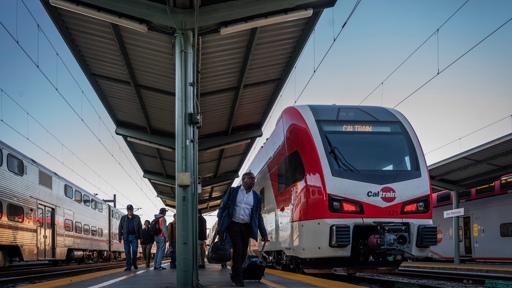
Adina Levin took Caltrain to San Francisco from her home in Menlo Park one night last month. A 40-minute ride on a train seems mundane, but Levin’s trip reflected a big change to the region’s transportation ecosystem — the result of a sweeping modernization of the rail corridor.
Caltrain, the commuter rail line linking San Francisco to Silicon Valley, spent $2.4 billion electrifying 51 miles of track in 2024, removing diesel trains from that segment of the system. The electric trains accelerate much faster, shaving as much as 23 minutes off the ride between San Francisco and San Jose. Getting up to speed so quickly allowed the agency to add stops without lengthening overall trip times, increasing the number of stations served each weekday by about 20 percent.
That meant Levin, who leads the public transit advocacy organization Seamless Bay Area, could catch one of the trains that run every half hour until 10 p.m. each weeknight. Beyond making trips easier to plan, the improved service encourages more people to ride, and weekend ridership has more than doubled. “Before electrification, coming home at 10 o’clock at night, the trains were once an hour,” she said. “If you missed the train, that’s a very miserable experience.”
Caltrain’s electrification offers a glimpse of how rail systems can improve service, attract riders, and cut emissions without building new lines. Upgrading existing corridors can complement plans for high-speed rail — or provide a faster, cheaper way to improve regional transit — even as agencies grapple with post-pandemic ridership declines and uncertain funding.
Ditching diesel on its busiest corridor has made Caltrain a more appealing option, with ridership jumping 60 percent last year. Riders appreciate the quieter cars and smoother trips, and the benefits extend beyond comfort: A study by the University of California, Berkeley found the electric trains expose riders to 89 percent less carcinogenic black carbon — a reduction one of the researchers said is comparable to what California cities achieved over three decades of clean-air regulation.
Caltrain estimates the shift to electric trains will cut roughly 250,000 metric tons of carbon emissions annually. The faster, more convenient service could deepen those reductions if more people choose rail over driving as they return to the office in greater numbers.
The transit agency’s gains stand out in a region where ridership across 27 public transit agencies remains well below pre-pandemic levels — a challenge seen nationwide. The Bay Area’s high rate of remote work was especially hard on systems like Caltrain that rely upon fares for much of their revenue. Although people are returning to the office, Caltrain’s ridership remains roughly 60 percent what it was before COVID. To preserve service, the state approved a $590 million emergency loan to four local agencies, including Caltrain, and voters may also be asked to raise sales tax to fund public transit.
Electrifying Caltrain could shape the future of transportation beyond the Bay Area. California continues pursuing its dream of building a high-speed rail line linking San Francisco and Los Angeles, a system that will share a stretch of track Caltrain just upgraded.
Read Next
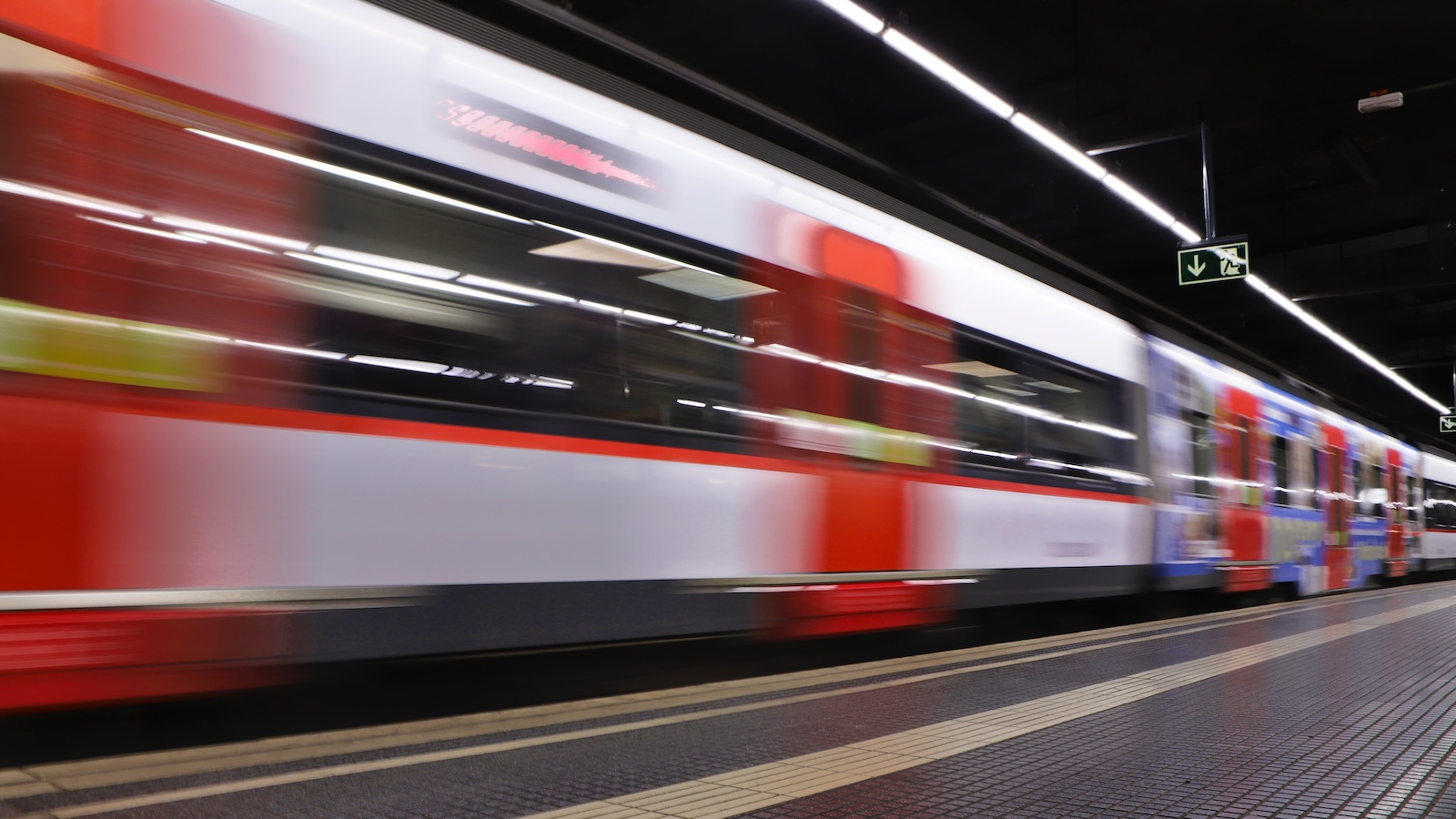
Barcelona is turning subway trains into power stations
The project also raises larger questions about rail investment. With shrinking federal support for projects designed to get people out of cars, local and state governments may favor smaller electrification projects over larger, more ambitious efforts. Even Caltrain was not cheap: The agency faced $462 million in cost overruns due to pandemic disruptions, funding delays during the first Trump administration, and lawsuits. But Yonah Freemark, an Urban Institute researcher, said the country should pursue projects of all sizes, and that “states and localities need to be stepping up to do more of the work themselves.”
Electric rail was once widespread, Freemark said, but diesel took over as cities eliminated electric streetcars and razed interurban lines and the price of gas fell. While railway electrification remains rare in the U.S., it has seen some success. Fully electrifying Amtrak’s Northeast Corridor enabled the higher-speed Acela line, boosting market share from New York to Washington, D.C., from 37 to 83 percent between 2000 and 2021.
Caltrain considers its project a model for others. “This was the first diesel-to-electric transition in a generation that took place on an active rail line, and while it was certainly a complicated process, we proved that it could be done,” agency spokesperson Dan Lieberman told Grist.
The Caltrain system continues south of San Jose to the city of Gilroy, but that stretch is owned by Union Pacific and has not been electrified. For now, riders going to the end of the line transfer to diesel trains, but Caltrain plans to roll out battery-powered machines in 2028. It hopes to electrify its entire system by 2035.
Zack Deutsch-Gross, who leads the transportation and housing advocacy organization TransForm CA, said Caltrain’s electrification shows how mass transit can expand beyond commuters to people looking for a ride anytime. The line has proven popular with sports fans, for example, and ridership spiked 11 percent in the week before Super Bowl LX at Levi’s Stadium south of San Francisco. The arena will host six FIFA World Cup matches this summer.
Levin sees Caltrain’s electrification as a key step toward building a world-class transit system, one that runs all day long, into the evening, and on the weekends. “It’s a bread-and-butter piece of the transportation system,” she said. “You can use it to go to an office job. You can use it to go visit a friend. You can use it for whatever it is that you’re doing.”
This story was originally published by Grist with the headline How electrifying a Bay Area rail system made trains faster, cleaner, and more frequent on Mar 5, 2026.
From Grist via This RSS Feed.