

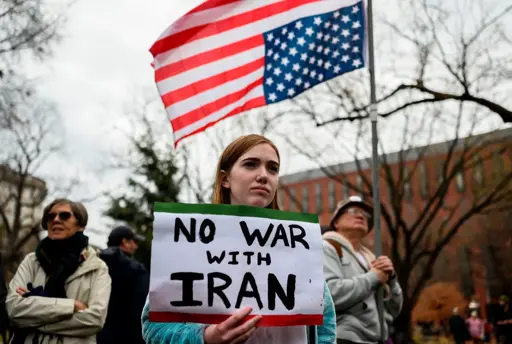
Over the weekend, in response to the brutal U.S.-Israeli attack on Iran, many socialists across the United States took to the streets to denounce yet another imperialist war. Eric Blanc, a leading intellectual of the reformist Left in the country, spent the weekend coming up with foreign policy advice for the Democratic Party.
This advice is the crux of Blanc’s latest article, “Cut the Military Budget in Half,” published in his newsletter, “Labor Politics,” and in Jacobin. The main argument of the piece is exactly what the title suggests. Blanc advocates for cutting the U.S. military budget in half and for socialists to bet on that perspective toward…the midterms election.
In the Marxist tradition — from Marx, through Rosa Luxemburg, to Trotsky and Lenin — the position of socialists regarding military spending has been to refuse to vote for or endorse the military budgets of the capitalists. In the case of socialists who engage in politics in imperialist countries, fighting to cut military spending as if we were just another progressive bourgeois politician ultimately means endorsing a budget that goes directly to the indiscriminate slaughter of our siblings in the so-called Global South. Calling for cuts to the military budget in the midst of imperialist aggression, such as the current escalation against Iran, is a denial of the entire socialist tradition.
Even when the U.S. military isn’t directly massacring workers, the billions spent on it every year go toward maintaining an international system of oppression where the vast majority of the world is forced to live under the constant threat of violence and tyranny by U.S. boots, bullets, and bombs.
Blanc, the editors of Jacobin, and the Democratic Socialists of America (DSA) as a whole have correctly opposed the intervention of the United States and Israel against Iran. However, the editors of Jacobin do not do so from the perspective of building an anti-imperialist movement in the streets, schools, and workplaces that would actually confront imperialist slaughter. Blanc seems to think the role of socialists should be to explain to elected officials in charge of this system how they can align more with American skepticism of war and bloated military spending, without actually dismantling imperialism.
For example, Blanc writes:
Anti-MAGA forces need to stop treating military budget cuts like a fringe talking point. In the midterms and in 2028, we should agitate for serious reforms to the US war machine. What’s a reasonable but ambitious starting point? Cut the armed forces’ $886 billion budget in half.
Already the United States and Israel have killed hundreds of Iranian civilians, including over 100 children. Each day that this offensive continues more and more people will die. But there is no sense of that urgency in Blanc’s conception of the tasks of the Left. Instead, Blanc is focused on midterms, elections which are months away.
Who is Blanc’s audience?
The idea of dialoging with the war on Iran through the lens of midterms is a symptom of a larger problem with how Blanc and Jacobin conceive of the role of socialists. That is, they have a political orientation to elected officials within the Democratic Party and those who organize in the service of Democrats. The struggle in the streets, schools, and workplaces is put entirely at the service of electing more progressive politicians and pressuring them to enact gradualist policies from above. Rather than putting that struggle at the center of the fight against capitalism as a decisive, independent, driving force, Blanc omits the role of class struggle in opposing the war altogether. He writes:
What almost never gets seriously questioned in mainstream US politics is the premise itself: that Washington has the right to bomb, invade, or attack any country across the globe whenever it decides it has a sufficiently good reason. There are important exceptions — Bernie Sanders, Alexandria Ocasio-Cortez, James Talarico, and others have taken clearer antiwar stances.
The omission in question is that even when Blanc references elected officials who he sees as anti-war voices, he did not mention Rashida Tlaib. The lack of acknowledgement of Tlaib has significant political implications because unlike AOC, Sanders, or Talarico, Tlaib made two points in her denouncement of the war that Blanc would likely prefer socialists avoid like the plague: 1) Tlaib said very clearly that “warmongering politicians in both parties” support the war, and 2) she said that a “mass anti-war movement” is necessary to stop it.
Tlaib’s statement was hands down the strongest condemnation of this war from any high-profile “democratic-socialist” politician. As Left Voice we share the perspective that a mass anti-war movement is necessary; however, Tlaib’s strategy of doing politics within the imperialist Democratic Party is completely at odds with fighting for the interests of working people and opposing the U.S. war machine. Importantly, though, Tlaib’s statements are a reflection of a profound phenomenon that is undoubtedly expressed both outside and inside DSA: a strong rejection of the war and the imperialist bipartisanship responsible for the genocide in Gaza, coupled with a strong distrust of the Democrats.
Instead of dialoguing with the role that this already existing left phenomenon can play in deepening an anti-imperialist consciousness, Blanc makes a more “common-sense” proposal:
Cutting the military budget in half is ambitious and would be controversial, since so many communities across the US economically rely on supplying goods and services to the military. Why not start with a smaller proposed cut? This is a reasonable question.
My response is, first, that $443 billion a year is still a huge amount of money. Second, there’s a huge amount of fat that can be quickly and easily cut because military spending is rampant with waste, irrationality, and lack of financial accountability. Third, there is strong precedent for a massive military cut: military spending was cut in half from 1945 to 1946 in the wake of World War II. By 1948, the armed forces budget had been cut 89% from its wartime total, as factories converted to peacetime use. The same conversion strategy used then — deep Pentagon cuts combined with job guarantees, wage protections, retraining, union-led transition planning, and long-term public contracts for civilian production — can be used to transition us today away from an economy oriented toward destruction, toward one based on producing services and providing goods that humans actually need.
What Blanc is advocating for is a scenario where the United States is still the dominant military power in the world, but with a friendlier face. Essentially, an imperialism where American workers get quality social programs — which they absolutely deserve, as all workers do — but where the relationship of exploitation and military dominance that the United States relies on for its wealth is not questioned. Blanc’s program is one solely for the U.S. working class, and has nothing to say for workers in Iran, Gaza, Venezuela, Cuba, and countless others who suffer precisely because the United States maintains the largest military in the world, whether that military receives $886 billion in funding or $443 billion.
Blanc argues that this needs to be the demand because the military still holds a lot of prestige in the United States and many communities economically depend on the war machine. This is true, but where Blanc goes wrong is where he and Jacobin writers often go wrong: As they see it, the task of socialists is to appeal to the most conservative tendencies of the U.S. working class and masses.
Socialists should of course always strive to understand, sympathize, and engage meaningfully with where the working class and masses are at. But that should never mean watering down our basic principles because concretely this means watering down our strategy for liberation for our class. The United States has constructed a massive propaganda machine that spends significant resources to equate its imperialist interests with the interests and security of the working class — including some very reactionary beliefs that only serve to divide our class. Socialists in the United States have a unique responsibility (and opportunity!) to challenge the relationship the U.S. working class has to U.S. imperialism, one of the greatest enemies of the international working class.
Leading our class to fight for more
The adaptation to chauvinist prejudices of broad sectors of the American working class and their trust in the military is, in reality, an adaptation to the union bureaucracy, which uses its most conservative base to keep the labor movement far away from anti-imperialist ideas. It is absolutely true that military spending in the United States takes resources away from social programs, but the American working class can only liberate itself if it goes beyond its “bread and butter” program and embraces proletarian internationalism. Instead of unions using their strategic power to escalate the fights against Trump’s attacks on workers in the United States and internationally, the union bureaucracy has been a key factor limiting the resistance against Trump.
For Blanc, the idea that labor might play a leading role in movements against oppression and imperialism is childish, relegated to “online” spaces, and can only possibly happen after years and years of steady organizing. But the Italian general strike for Palestine and the mass wildcat shutdown in Minneapolis for immigrant rights show that the working class is more than just a base for maneuvering to achieve limited reforms in Congress. Further, these experiences show that state violence can rapidly advance the consciousness of workers even in imperialist countries.
There is not currently a mass anti-war movement in the United States, but there has also never been a deeper questioning of U.S. imperialism, at least not in my lifetime. This was shown most recently in the movement against the genocide in Palestine which, even in retreat, has profoundly changed how people in the United States feel about Israel and Palestine, with more Americans sympathizing with Palestinians over Israelis for the first time in history. That came from a movement, not pragmatic policy proposals. And this phenomenon even had powerful expressions in labor. The task of socialists is not to minimize these shifts, but to link them to an organic anti-war sentiment growing in the United States that recognizes the absurdity of imperialist war while working and poor people cannot make ends meet each month under the pressure of low and precarious wages, lack of access to healthcare, rent, and rising prices.
Beyond growing sympathies with those resisting imperialist oppression in the Middle East today, the United States has a rich history of anti-war movements. From the very start of the United States as an empire in the Spanish-American War, the United States has had intellectuals, activists, workers, and oppressed people willing to risk their social standing, freedom, and lives to speak out against imperialism. This history of resistance has never been a given, but it has always been fought for, from Eugene Debs bravely denouncing WWI to MLK going against the advice of his “pragmatic” allies and condemning the war in Vietnam. Beyond these individual figures were always organizations of the revolutionary Left and thousands of anti-imperialist activists who fought — even when it was considered “extreme” or “unrealistic” — to advance the consciousness of the U.S. working class and broader public.
It is this tradition that Blanc eschews by instead focusing on policy proposals for a kinder U.S. imperialism. By shirking this responsibility, Blanc is aiming to convince other socialists, including leaders of DSA with its 100,000 members and prominent media and intellectual resources, that our focus should not be on building an anti-war movement based on the best traditions of the anti-imperialist U.S. Left.
At Left Voice, we believe the task at hand is to build a united front against this war and against the system of U.S. imperialism which makes wars inevitable. We unapologetically call for the defeat of the United States and Israel, not because we believe that this will immediately be a popular demand, but because we believe that socialist ideas can and are winning influence, and we can convince even more people of these ideas by presenting a clear analysis and principled response to imperialist aggression. This must be the basis for building a Left that takes seriously the task of uniting with workers of all countries, the vast majority of whom are oppressed by the United States, and winning over the smaller but still very real leaders of the U.S. working class who are willing to fight in their workplaces, their unions, and their communities for an end to imperialism.
We know that there are many comrades organizing in DSA who see it as an urgent task to organize these sectors and build an anti-war opposition in the streets. We look forward to fighting alongside them and alongside other anti-imperialist sectors in the United States and around the world. The conclusion we want to discuss with all those DSA members is that we have to break with the Democrats. We have to build a working-class party with a socialist perspective. And we have to have a program independent of the Democrats, far from the framework of wanting to make imperialism a little less brutal or more democratic. In times of crises, wars, and revolutions, Blanc’s “pragmatic” approach is the most utopian thing in the world.
In the spirit of the united front, we invite Blanc and the folks at Jacobin to join us in the streets, and we hope they encourage their countless readers to organize the anti-war movement that we need.
The post A Less Expensive War Machine? A Debate with Eric Blanc appeared first on Left Voice.
From Left Voice via This RSS Feed.