

By Nora Loreto, Truthout, March 4, 2026
Canadian Prime Minister Mark Carney stunned the world with a dazzling speech at Davos in January. He warned that the old order was dying and that it was time for global leaders to get serious about what must replace it. “Stop invoking ‘rules-based international order’ as though it still functions as advertised,” Carney said. “Call it what it is: a system of intensifying great power rivalry, where the most powerful pursue their interests using economic integration as coercion.”
The motivations for Carney’s speech have since come under question this week following his response to the joint U.S.-Israeli war on Iran, which is widely considered to be illegal under international law. In a statement, Carney wrote: “Canada supports the United States acting to prevent Iran from obtaining a nuclear weapon and to prevent its regime from further threatening international peace and security.”
Less than two weeks before releasing that statement, on February 17, Carney invoked the crumbling rules-based international order to justify the need for Canada’s first-ever Defence Industrial Strategy. It promises to massively invest in military spending in Canada. He promised to “take advantage of $180 billion in defence procurement opportunities and $290 billion in defence-related capital investment opportunities in Canada over the next 10 years.”
At its core, the Defence Industrial Strategy aims to massively increase profits within the military industry. Carney’s plan promises to increase the revenue of arms companies in Canada by 240 percent over the next decade.
Carney promises that this new strategy would create 125,000 new jobs and increase Canada’s military exports by 50 percent. The total number of defense industry jobs in Canada would rise from 81,200 to 206,000 — an increase of 254 percent. Ultimately, Carney says, he hopes that Canada will be able to domestically produce 70 percent of the Canadian Armed Forces’ (CAF) supply needs.
Rachel Small, an organizer with World BEYOND War-Canada, says that using the military industry to jumpstart Canada’s economy is risky, and questions just how much this announcement will create jobs, given that arms manufacturing has not traditionally created many new jobs in the country. “Banking Canada’s future on military production, militarism, and deeper engagement in the global arms race I think is the opposite of what most people in Canada want. I also think that it’s a deeply unproven and unrealistic model for economic prosperity,” Small told Truthout.
The peace organization Project Ploughshares notes that the economic returns that countries can get from investing in the military are small, when compared to the economic returns of investing in public sector jobs in health care and education.
While the Defence Industrial Strategy is being hailed as ambitious, Kelsey Gallagher from Project Ploughshares believes that it’s aspirational rather than a practical roadmap. “We are in a time of rearmament across the West, this is not just Canada. To see Canada coming to a place where the vast majority of the military goods procured for the CAF were coming from Canadian firms, I would be surprised,” Gallagher told Truthout.
Canada to Become a Major Global Arms Exporter?
Indeed, Canada currently doesn’t produce enough of what the Canadian Armed Forces needs to reach the promise of 70 percent and would have to significantly expand what is built in Canada to reach that goal. For example, many of the items that Canada does produce, like sensor technology components, are add-ons to other pieces of equipment that aren’t built in Canada. “The global arms industry is a specialized part of the global economy, and it’s also quite monopolized and increasingly so,” Gallagher said, adding that it will be difficult for Canada to enter new industries, scale up quickly, and start producing items that Canada’s Armed Forces need but are currently made outside of Canada.
But even inside of Canada, the companies that dominate the arms industry are mostly not Canadian. Of Canada’s top 10 military companies, ranked by the publication Canadian Defence Review for their success and impact, five are U.S.-owned.
In 2024, Canada exported 2.5 billion Canadian dollars’ worth of military goods. Canada sent the most military equipment (measured in terms of value) to Saudi Arabia, at 1.3 billion Canadian dollars. Most of those exports were armored vehicles made in London, Ontario, by General Dynamics.
At their peak in 2019, Canada’s military exports reached 4.03 billion Canadian dollars. These numbers are reported via Global Affairs Canada through export permits — a system that tracks military exports based on international conventions. Military exports to the United States are excluded from official data because goods exported to the U.S. are not subject to these permits. They are subject to a pact that doesn’t require the same level of transparency as other international imports and exports. The pact goes back to 1956 and oversees defense trade between the two countries.
Canada hopes to streamline arms export permits through the Defence Industrial Strategy, something that Gallagher warns could impact the international agreements that Canada has signed that dictate the responsibility a nation-state has in reporting and transparency around arms exports. Canada’s export permits are guided by four international conventions and the country has a responsibility to uphold these conventions in how it reports on military imports and exports, he says.
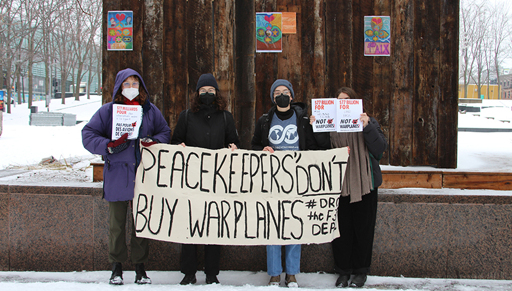
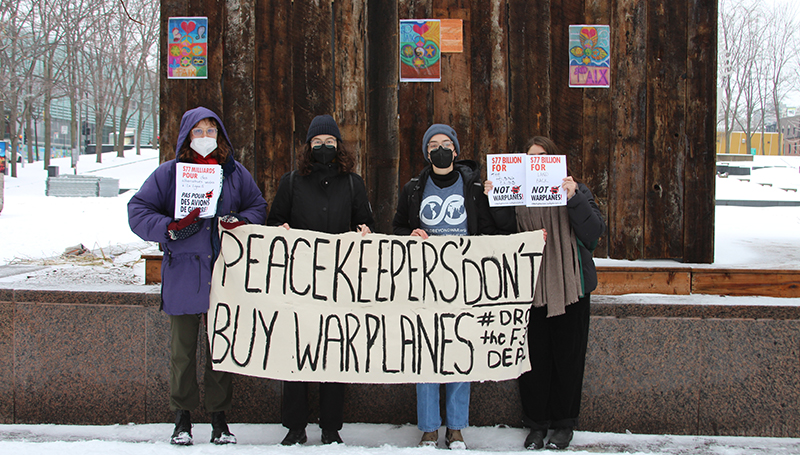
The same day that the federal government made this announcement, World BEYOND War-Canada was involved in a national day of action on February 17, calling for an end to the loopholes that exist within Canada’s military import and export regulations that allow for arms to be exported with little oversight. New Democratic Party Member of Parliament Jenny Kwan has served a motion, Bill C-233, that would tighten up Canada’s arms imports and exports policies. It would also make it easier for Canada to stop allowing exports to countries engaging in war crimes.
Small says Canadian military equipment is currently being used in Gaza by the Israeli military, against Venezuelan fishermen by the U.S. military, and in Minneapolis, Minnesota, by federal immigration agents using Canadian-made armored vehicles. Canadian arms exported to the United Arab Emirates have been used in Sudan by the Rapid Support Forces, and there is photographic evidence that some light armored vehicles that Canada exported to Saudi Arabia have ended up in battle in Yemen.
One former Canadian general also told CBC News that it’s likely some members of the Canadian military played a role in the logistics for the initial U.S. strikes on Iran, which are widely considered to be in breach of international law. While Carney and the Department of National Defence have disputed that, there are still lingering questions about the nature of Canadian service member exchanges with U.S. Central Command.
Gallagher warns that the logic that Canada must scale up its military to keep Canada safe leads to a situation where Canadian companies will seek other opportunities around the world to sell their goods when the Canadian Armed Forces have as much as they need.
“If you’re ballooning a military budget, that’s a choice to steal those funds from health care, housing, public services — from the things that actually guarantee the security and health of people from across this country,” says Small.
Nora Loreto is a writer and activist based in Quebec City. She is also the president of the Canadian Freelance Union.
The post Critics Slam Carney’s Plan to Jump-Start Canada’s Economy via Military Industry appeared first on World BEYOND War.
From World BEYOND War via This RSS Feed.