


Editor’s note: This is one in an occasional series on “forgotten” ancestors who may not have been fully recognized for their achievements.
Raymond Wilson
Special to ICT
Navajo health advocate and politician Annie Dodge Wauneka played a significant role in improving health conditions for her people by blending traditional Navajo customs with Western science.
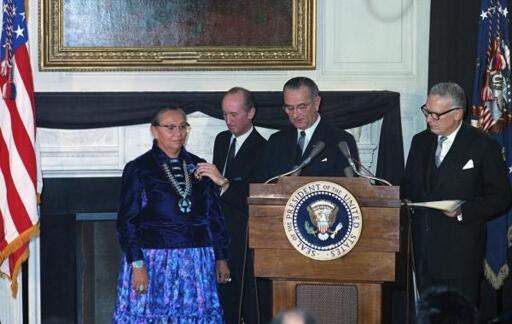
Her early brushes with illness — including surviving the Spanish Flu while attending Indian boarding school — helped shape her life’s work, and in 1963 she became the first Native American to receive the prestigious U.S. Presidential Medal of Freedom.

Annie Dodge Wauneka was a Navajo health advocate and political leader who worked for decades to improve the health of Indigenous people. She died in 1997 at age 87. Credit: Historic photo
Wauneka also received the Navajo Medal of Honor in 1984, and in 2000 was inducted posthumously into the National Women’s Hall of Fame.
She was born on the Navajo Reservation on April 11, 1910, near Sawmill, Arizona, daughter to Henry Chee Dodge, a powerful tribal leader who was involved in Navajo governance for decades.
As a child, Annie helped her family care for their sheep and goat herds, but in 1918, she began attending the Bureau of Indian Affairs boarding school at Fort Defiance, Arizona.
Annie and other students at the school fell victim to the 1918 Influenza Pandemic, known as the Spanish Flu, which claimed more than 50 million lives worldwide. Many Navajos died, but Annie was among those who survived, and she helped nurses at the school tend to her sick classmates.
Another illness, trachoma, an infectious eye disease, struck the boarding school a bit later. Annie and other students who were not infected were sent to St. Michael Catholic Mission School in Saint Michaels, Arizona. She later returned to the Fort Defiance school after the outbreak had ended.
Both experiences were instrumental in convincing her to pursue healthcare, and she become a major advocate involved in improving Navajo health conditions.
She continued her education at the Albuquerque Indian School in New Mexico, where she met and later married George Wauneka. Between 1929 and 1950, they had nine children, some of whom were born with disabilities.
Wauneka and her husband ran a family ranch at Tanner Springs, Arizona, and she began accompanying her father to different meetings on the reservation. She became knowledgeable about politics and reservation conditions and issues, and later served as a Navajo chapter representative.
In 1951, Wauneka became the second woman to be elected to the Navajo Tribal Council, a position she held for nearly 30 years. Her new position enabled her to become extremely successful in improving healthcare issues on the reservation during the following decades.
She later became chair of the Health and Welfare Committee and, in conjunction with the use of traditional healing ceremonies, she stressed the importance of proper hospital care and trained physicians to combat sickness and the spread of disease.
Wauneka continued her studies, taking courses on tuberculosis and other illnesses at the University of Arizona in Tucson, and subsequently received a bachelor’s degree in public health. She also wrote a medical dictionary in English and the Navajo language to help patients and non-Native physicians communicate medical issues.
She served on the advisory boards of the U.S. Surgeon General and the U.S. Public Health Service, and produced a weekly radio program that addressed pregnancy and proper newborn and child care, and illnesses such as dysentery.
In addition to her major role in improving Navajo healthcare, Wauneka also served as a role model to other Native and non-Native females at a time when few women held political positions.
She earned the respect of her people as an influential champion regarding important issues such as sovereignty, unemployment, developing natural resources, and improving reservation dwellings and travel concerns.
Wauneka went to Washington, D.C., on many occasions and met with U.S. presidents and members of Congress, BIA commissioners, and other federal officials to discuss reservation issues.
She was the recipient of numerous awards and honors. In addition to the Presidential Medal and Navajo honor, she was recognized by the Navajo Tribal Council as the Legendary Mother of the Navajo Nation. She also received the Arizona Women’s Press Club Woman of Achievement Award, and the Josephine B. Hughes Memorial Award for promoting health and welfare, both in 1958; the Indian Council Fire Distinguished Indian Award, in 1959, 14 years after her father had received it; the Ladies Home Journal Woman of the Year Award, 1976; and she was inducted into the Arizona Women’s Hall of Fame posthumously in 2002.
Wauneka also received honorary doctorates from the University of Arizona and the University of New Mexico.
She ultimately fell to Alzheimer’s disease, however, and died Nov. 10, 1997, at Flagstaff Medical Center in Arizona. She was 87.
Sources: Navajo Nation website, and books by author Carolyn Niethammer, “I’ll Go and Do More: Annie Dodge Wauneka, Navajo Leader and Activist,” (2001); and “Keeping the Rope Straight: Annie Dodge Wauneka’s Life of Service to the Navajo” (2006).
The post LEST WE FORGET: Annie Dodge Wauneka appeared first on ICT.
From ICT via This RSS Feed.