


Nareh Vartanian
ICT + Marquette University
MILWAUKEE – Growing up, Lisa Albright, Oneida Nation of Wisconsin, wasn’t taught how to jingle dress dance. After nearly 60 years, it was the Gerald L. Ignace Indian Health Center’s jingle dress dance class that led to Albright entering a classroom and learning the dance in a monthly class open to all and led passionately by Emma Carufel, citizen of the Lac Du Flambeau (Waaswaaganing) Ojibwe band.
The class is part of the Movement is Tradition program at the Milwaukee health center. The program promotes moving from a modern sedentary lifestyle through traditionally rooted tasks like catch-and-release fishing, snowshoeing, canoeing and the jingle dress class.
“(It’s) showing people how to get back to their cultural roots and still be able to get some activity into their lives,” Albright said.
As the center’s outreach coordinator, Albright’s promotion of the Movement is Tradition program is personal as well as professional. She said after being sent to the Carlisle Indian Boarding School, her grandmother and mother were coerced into hiding their Native identity, and it wasn’t until the 1970s that her mother started to work on regaining her culture through working at the Gerald L. Ignace Indian Health Center.
“Now we’re kind of able to get back into it,” Albright said. “So as an individual, for me, it’s really an important opportunity to have this, to be able to finally learn how to dance as my ancestors would have.”
The class is held the first Wednesday of each month at the health center, allowing community members of all ages to gather for an hour of moving and reflecting. Classes are centered around tradition and culture. Beginning with smudging, participants are able to feel a sense of groundedness alongside dance teacher Carufel, who introduces each dance by providing background information on the style. She discusses details such as the types of regalia worn, tempo for each dance and how to adapt while dancing.
Carufel said she makes sure to give participants a heads up about faster and longer dances, and she then promises steadier ones to follow. Participants can be of any age, from toddlers to elders.

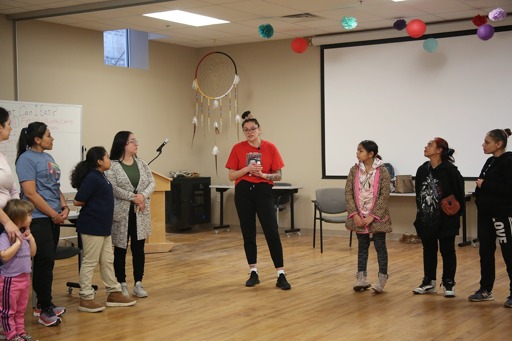
Emma Carufel demonstrates a side step for participants at the Milwaukee Indian Health Center. (Photo courtesy of Gerald L. Ignace Indian Health Center).
In the classroom, elders danced alongside children, something Carufel said creates an environment for the dance circle to feel accessible to everyone. When the faster two-step dances were becoming too fast, there was no pressure to power through the whole dance. Oftentimes, there would be a dancer or two taking a step out of the circle to regroup and drink some water. There would also be someone joining the circle in the middle of the dance after feeling rejuvenated. There were no rules about beginnings and ends.
Albright said she also recognizes the rejuvenating power of the dance class. There are particularly hard days in everyone’s daily lives, like one of Albright’s recent Wednesdays, “but as soon as I heard the music, I was up there.” Albright feels embraced by this component of the Movement is Tradition program. “Nobody’s judging each other. Nobody’s thinking, ‘Oh, they don’t belong.’ Everybody belongs. It makes me feel really good. It just does well for my soul. When I go home after that class, I really feel great. Not just physically,” she said.
In addition to class participants, thousands of people view the class on a livestream. “People in different reservations saying, ‘Oh, I wish we had this at our reservation,’ and here we’re not even on a reservation. We’re in an urban setting and we’re offering this,” Albright said. “(That) shows that this is definitely something that was needed and appreciated in this community.”
In between dances, Carufel sat down on the studio’s wood floor and recounted her mother’s story about how the healing dress came to be. It’s impossible not to feel the importance of her message. “You’re out here dancing to this music, and you’re having good vibes, and you’re bringing your own spirit here and that’s what matters.” The energy Carufel describes doesn’t end when the class does. Participants are encouraged to bring their new moves home to practice with other family members and help get them involved, Carufel said.
There’s a sense of empowerment that comes from the new series, she said, and it’s especially meaningful in this form where movement and tradition come together.
“There’s something going through all of us,” Albright said, “like an energy that we’re all feeling, that we’re all contributing to and we’re all receiving.”
The post Reconnecting with culture through innovative Indian Health Service programming appeared first on ICT.
From ICT via This RSS Feed.