

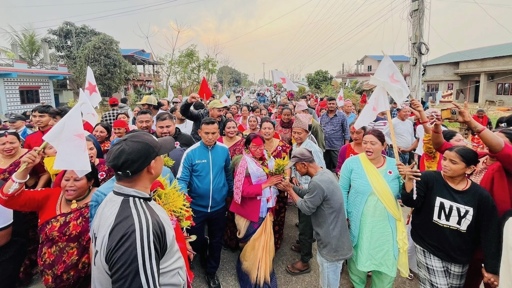
On Thursday, March 5, Nepal will hold its first national elections after last year’s violent protests which had forced the government to resign. Mass protests, largely known as the Gen Z uprising, erupted in September 2025 after the government decided to ban social media in the country due to the non-implementation of new regulations.
However, the uprising was seen largely as a reflection of a deeper anger among the youth towards the failure of the ruling classes in addressing some of the basic issues in the country, such as unemployment and poverty.
The uprising, in which around 77 people were killed across Nepal, led to the resignation of the then-prime minister K. P. Sharma Oli, who was leading a centrist-leftist alliance.
The Pratinidhi Sabha, the elected lower house of the parliament, was dissolved within three years after the elections in 2022 and an interim government, under the leadership of the former chief justice of the country, Sushila Karki, was appointed to oversee the transition.
A hung parliament
Around 19 million voters, out of a total population of around 30 million, will exercise their franchise to choose 275 members of the Pratinidhi Sabha, or the House of Representatives, from over 3,400 people contesting under different party banners or as independent candidates.
Nepal has a mixed form of electoral system with both “first past the post” and “proportional representation” being used to elect the members of the parliament. Candidates for 165 out of the total 275 seats will be elected under the first past the post system while the rest will be elected under proportional representation with the entire country converted as one constituency.
Whichever party will win a simple majority of all the seats will form the next government.
Due to the mixed electoral system, a predominantly rural electorate and a multiparty dominance it is often difficult to have a reliable poll predicting the results in Nepal.
However, it is most likely that no one single party will be able to win the majority and it will be a hung parliament as has been the case in most of the previous elections.
If the assembly is hung, the new government may be formed after a post-poll alliance is created among the leading parties.
A multi-cornered fight
According to the country’s Election Commission, there are 65 political parties contesting the elections this time. However, there are four major parties which are expected to get the maximum number of seats in the parliament:
The former prime minister K P Sharma Oli (74)-led Communist Party of Nepal (Unified Marxist-Leninist) or CPN-UML, its former coalition partner and Nepal’s largest centrist party the Nepali Congress (NC), the Nepali Communist Party (NCP), which was formed after the merger of dozens of left parties last year and the centrist Rastriya Swatantra Party (RSP).
The NC is led by Gagan Kumar Thapa (49) who has also been projected as its prime ministerial candidate.
The NCP is led by former prime minister Pushpa Kumar Dahal Prachanda (71), while the RSP is led by former mayor of Kathmandu and rapper Balen Shah (35).
Multiple polls predict a rising popularity for Balen, particularly among the young voters (around 40% of the total electorates are below the age of 35) due to his lack of a political legacy and an unconventional campaign method.
Major issues
According to different polls, major issues dominating the elections in Nepal are political and administrative corruption, unemployment among the youth, and massive poverty. The failure of the existing political class to address these issues was the central cause of last years’ uprising.
Nepal remains largely an agricultural economy with nearly 30% GDP coming from it and over 60% of the population dependent on it for sustenance. However, agriculture in the country faces several infrastructural shortcomings and frequent natural disasters intensified by climate change in recent years.
Remittances and tourism are the next two largest contributors in the Nepalese economy in terms of share in total GDP and employment generation.
Lack of enough employment opportunities at home has made a large number of Nepali citizens migrate for jobs in other countries, including neighboring India and to the Gulf.
Around 14% of the Nepalese working age population is now living abroad working in India or in the Gulf or elsewhere. The remittances they send constitute around 24% of the country’s total GDP, one of the highest in the world.
This is the reason that most of the major parties have promised to focus on economic development and create strong welfare mechanisms to tackle unemployment and poverty in the country.
Parties have promised to create millions of new jobs by modernization and expanding the tourism sector and introducing IT industries in the country in order to reduce forced migration and reduce the reliance on remittances.
Most of the parties have also promised to curb political and administrative corruption in the country once elected.
The post Nepal heads to first elections since mass protests appeared first on Peoples Dispatch.
From Peoples Dispatch via This RSS Feed.