

By Mohammed Abunahel, World BEYOND War, March 4, 2026

Naval Communications Station Harold E. Holt Links Australian Soil to U.S. Submarine Operations
On the north-western edge of Australia, near Exmouth in Western Australia, stands one of the most consequential U.S.-linked military facilities in the Southern Hemisphere: Naval Communications Station Harold E. Holt. Officially an Australian “Defence” site, it has long operated in close cooperation with the United States, particularly the U.S. Navy.
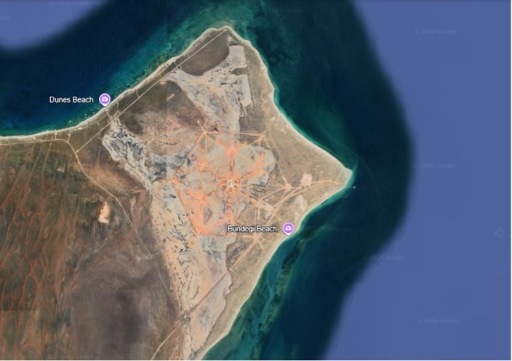
The station is best known for its vast Very Low Frequency (VLF) antenna array, an installation so large it can be seen from space. Its stated function is straightforward: to communicate with submarines operating across the Indian and Pacific Oceans. It has no strategic significance, as claimed. The base has tied Australia to U.S. nuclear and naval operations for nearly six decades, embedding the country in U.S. warfighting architecture that continues to generate political and environmental concern.
Three distinct operational areas define the station: Area A, the VLF Transmitter Antenna array; Area B, the administrative and residential complex; and Area C, the broader operational communications zone. Together, they form a critical node in U.S.-Australian military integration. Together, they also illustrate the costs, strategic, ecological, and political, of hosting foreign-aligned military infrastructure.
Historical Background
The station was established in the 1960s during the Cold War. On 9 May 1963, a formal agreement was signed between the Australian and the United States for the establishment of a communication complex at North West Cape in Western Australia. It was commissioned in 1967 as a joint U.S.–Australian project designed primarily to serve U.S. Navy submarines operating in the Pacific and Indian Oceans. On 20 September 1968, the name of the Station was officially changed from US Naval Communication Station, North West Cape, to US Naval Communication Station, Harold E. Holt.
For decades, the United States Navy operated the facility. In 1992, operational control formally transferred to Australia, but U.S. access and integration remained intact. Under long-standing defense agreements, including the Australia, New Zealand, and United States Security Treaty (ANZUS Treaty, 1951), framework and subsequent bilateral arrangements, the facility continues to support U.S. operations.
Scholars such as Desmond Ball of the Australian National University have documented the station’s integration into U.S. global communications architecture, particularly in relation to nuclear-powered and nuclear-armed submarines. The base’s endurance beyond the Cold War suggests that its relevance expanded rather than diminished after 1991.
Area A: VLF Transmitter Antenna — A Nuclear Communications Backbone
Area A, situated at the extreme northern tip of the North West Cape, is the kinetic heart of the Naval Communication Station Harold E. Holt. While the news and analysis often emphasize the engineering marvel of its construction, a critical analysis reveals a facility that functions as a high-powered conduit for global nuclear escalation, operating with significant environmental and safety externalities.

The Architecture of “Tower Zero”
The physical profile of Area A is dominated by a massive Very Low Frequency (VLF) antenna array, a sprawling web of thirteen steel towers. At the center stands Tower Zero, rising to a height of 387 meters (1,271 feet). For decades, this was the tallest structure in the Southern Hemisphere.

Naval Communication VLF Station, Australia. (Credit: Photon-Photos via Getty Images)
Electromagnetic Pollution and Biological Hazards
The environmental impact of Area A is largely invisible but no less invasive. The station operates at a staggering 1,000 kilowatts (1.0 megawatt). This level of output generates an intense electromagnetic field (EMF) that effectively sterilizes the immediate vicinity of traditional civilian utility.
A 1993 technical report documented radiation hazard (RADHAZ) conditions and assessed electromagnetic field exposure levels to evaluate potential risks to personnel at the VLF transmitter facility.
The height of the towers, combined with the “guy wires” that stabilize them, creates a massive physical hazard for migratory birds. Combined with the high-intensity strobe lighting required for aviation safety, the site acts as a fatal attractor and obstacle in a sensitive coastal ecosystem.
The scale is not merely for show; VLF waves require immense antennas to propagate signals that can penetrate seawater. This capability is the station’s sole raison d’être: maintaining constant, “belligerent” contact with submerged U.S. and Australian nuclear-powered, ballistic-missile-carrying submarines (SSBNs). By its very nature, Area A is a “first-strike” enabler, ensuring that the command to launch a nuclear volley can be received even when a vessel is hundreds of feet below the surface.
This is not routine maritime messaging. VLF systems are integral to maintaining contact with ballistic missile submarines—core components of nuclear deterrence strategy. Such transmitters enable command-and-control links essential for nuclear readiness.
The implications are significant. If the station facilitates communication with U.S. nuclear submarines, then Australia, through this facility, is structurally connected to the U.S. nuclear posture. In a crisis, such sites are not peripheral. They are priority targets.
Environmental concerns have periodically surfaced. The antenna array occupies sensitive coastal ecosystems near Exmouth Gulf and the Ningaloo region, an area internationally recognized for its biodiversity. Although the base predates Ningaloo’s UNESCO World Heritage listing (2011), conservation groups have repeatedly warned about cumulative military-industrial pressures on the region.
Area B: Base Administrative Area

Area B houses the station’s administrative headquarters, living quarters, and the high-frequency transmitter site. It is here that the everyday mechanics of joint operations take place.
Formally, the base is under Australian control. Yet U.S. military access remains embedded through bilateral agreements. It is argued that this arrangement blurs sovereignty lines. If U.S. strategic operations rely on Australian soil, how much independent oversight does Canberra exercise over operational usage?
Unlike Pine Gap, Harold E. Holt has attracted less sustained protest. That may reflect geography more than consent. Exmouth is remote. Distance reduces scrutiny. The existence of any bases distorts the area and its surrounding areas.
Area C: Operational Communications Zone

Area C is the High Frequency receiver facility. It encompasses the broader operational communications infrastructure linking the station into global military networks. Over time, the site has expanded beyond its original Cold War function.
The station supports not only submarine communications but also broader maritime surveillance and regional security coordination. This integration with U.S. Indo-Pacific Command enhances interoperability, particularly in tracking naval movements across contested sea lanes.
The problem, from a critical perspective, lies in entanglement. When Australia hosts communications nodes embedded in U.S. force architecture, it narrows its margin for strategic neutrality. In a conflict involving the United States, whether over Taiwan, the South China Sea, or elsewhere, such infrastructure would likely be considered operationally relevant.
Smaller allies’ risk being drawn into conflicts initiated by larger partners. Harold E. Holt exemplifies the material dimension of that risk: steel towers and encrypted signals binding national territory to another power’s military chain of command.
Environmental scrutiny also extends here. The North West Cape region sits adjacent to marine ecosystems of global significance. Increased militarization of Western Australia, including submarine rotations linked to AUKUS arrangements, may intensify industrial pressure on the region.
Such infrastructure rarely shrinks once built. It accumulates layers. Therefore, people have to take action to stop the extension or at least to prevent it
Overall, Naval Communications Station Harold E. Holt is often described in neutral technical terms: a communications facility, a joint defense asset, a strategic enabler. Those descriptions are operationally accurate, but incomplete in terms of their real and hidden intentions for existence.
Area A anchors nuclear-era communications. Area B embeds alliance governance in Australian territory. Area C integrates the site into expanding Indo-Pacific military networks.
The facility reflects Cold War logic persisting into a more volatile century. Its presence links Australia materially to U.S. submarine operations and, potentially, to nuclear command structures. That linkage may enhance deterrence. It may also increase vulnerability.
Military bases are not abstract symbols. They are physical commitments. Once established, they narrow options.
As geopolitical rivalry intensifies in the Indo-Pacific, sites like Harold E. Holt will attract renewed scrutiny. Whether Australia can balance alliance obligations with sovereign strategic judgment remains an open question. What is clear is that the station is not merely a communications array in a remote landscape. It is a node in a global military system, one that carries consequences far beyond Exmouth’s shoreline.
The post U.S. Submarines Prepare for Wars in Australia appeared first on World BEYOND War.
From World BEYOND War via This RSS Feed.
You must log in or # to comment.