

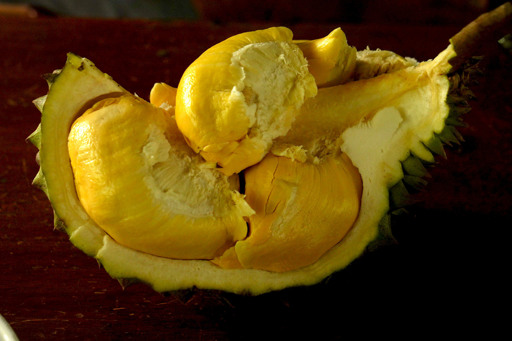
BANYUMAS, Indonesia — The first two months of the year would ordinarily see Ganjar Budi Setiaji hurrying around Plana village’s durian orchard, here in the hilly Javanese district of Banyumas. But on the last Tuesday of January, the 53-year-old father instead appeared restless. “In 2024, I harvested 3,500 durians from 300 trees,” Ganjar told Mongabay Indonesia, a little ruefully. “I’ve had only 500 this year.” The durian fruit farmed by Ganjar is a mainstay in much of Southeast Asia, where its unusual texture and intense flavor profile splits opinion. Last year, Indonesia’s food minister rushed out trade data showing the archipelago’s superior production volume after Malaysia announced the durian as the kingdom’s national fruit, the latest bout of cultural fencing between the neighbors. Here in the Banyumas hills, farmers have propagated their own durian heritage since a hajj pilgrim known locally as Mbah Kromo planted an unusual durian tree in 1985 at his home in Karangsalam village. Ganjar shows drums used in the fermentation process to produce natural fertilizer. Image by L Darmawan/Mongabay Indonesia. A few years later, Mbah Kromo began offering seeds from the parent tree to his neighbors. Appreciation for the Kromo durian grew as the trees flourished across the district. Ganjar slices through a thorny Kromo durian, revealing a sweet fruit with the texture of thick cheesecake, an acquired taste to many. The Kromo durian is also unusual for producing a heavyweight fruit than can, people here say, grow up to 10 kilograms (22 pounds), with a…This article was originally published on Mongabay
From Conservation news via This RSS Feed.