

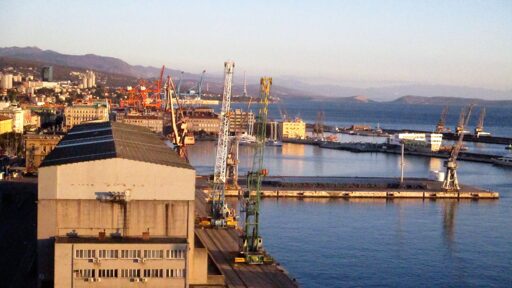
In former Yugoslav republics, EU armament plans are overlapping with the interests of local businessmen and far-right tendencies. This trend was illustrated during a public meeting in Rijeka, Croatia, on February 27, where Slovenian activists and researchers Barbara Rajgelj, Monika Weiss, and Peter Korošec reflected on the shared aspects of contemporary anti-militarist and antifascist struggles.
The meeting was part of a series of discussions contextualizing present-day antifascist initiatives in Croatia and the region, as far-right and nationalist trends claim increasingly more space.
Read more: “No room for fear”: broad antifascist front confronts far-right violence in Croatia
From the perspective of left movements in surrounding countries, Slovenia might be seen as a more progressive neighbor – yet the right has polled at around 25% support for years, warned Rajgelj, a legal expert and co-organizer of Grounded Festival in Ljubljana. This has translated into periodic attacks against specific parts of the population, with progressive civil society being the latest target, facing threats from political options represented by Janez Janša ahead of the upcoming general elections.
The steady presence of a hardline right has also meant that more liberal coalitions, like the one currently headed by Prime Minister Robert Golob, have implemented extreme policy solutions when lacking better ideas – most recently in relation to the Roma population. This tendency, Rajgelj’s intervention illustrated, gives shape to a context where extremist discourses can take deeper root just as the region prepares for war.
Danger also comes from the failure of centrist governments to build explicit and robust opposition to war in practice, as Rajgelj explained through the example of increasing militarization of education spaces. Not only did approximately 3,500 high school students attend an arms trade exhibition in Celje late last year as part of their civic education curriculum, she emphasized, but army careers are now presented as just another job option. The Legal Network for the Protection of Democracy warned against this, with Rajgelj adding that the trend stands in sharp contrast to UN guidance that classrooms should be “places of peace and learning.”
Read more: Activists urge continued mobilization to ensure Slovenia’s arms embargo on Israel
Monika Weiss, a journalist with the left-wing weekly Mladina, added another layer to the interpretation, connecting EU rearmament plans, Slovenian transition profiteers, and Rijeka’s now decrepit maritime industry. Unlike Slovenia, which abstained from joining the EU loan mechanism SAFE, Croatia secured approximately €1.7 billion to “strengthen” local “defense” initiatives.
While more details about the plan are yet to emerge, news that the Slovenian millionaire family Šešok is involved in the acquisition of “3. maj” shipyard – with plans to “take important steps forward in the military shipbuilding segment” – has raised concerns about local impacts of EU plans.
The Šešoks’ plans should be viewed in the context of other companies with strong presence in the arms industry, including Rheinmetall and Lürssen, eyeing parts of Rijeka’s port infrastructure, some of the meeting’s participants pointed out. If implemented, this would put the city squarely on the map of remilitarized Europe. The plans also play into the narrative floated by European politicians that the region’s arms supplies are depleted. “And what will happen when the weapons depots are full?” Weiss asked. “In capitalism you need supply for demand, and what is demand in this equation? Demand is war.”
Read more: “Militarization of rules and minds” in Europe threatens workers and welfare
The end result of far-right domination and wars is one and the same, Peter Korošec warned. “Every war is a war against the people and humanity, and today’s wars are capitalistically motivated by profiteering, the interests of the ruling classes, imperialism and colonization,” he pointed out during the event. “The fight against war is also a fight against the system that is reproduced by war, and it should be said that the new European arming and financing of armies has ceased to be a matter of external security and has become a reaction to the current economic crisis.”
The post Antifascism is anti-militarism: socialist industrial legacy at risk of becoming motor of EU armament appeared first on Peoples Dispatch.
From Peoples Dispatch via This RSS Feed.