

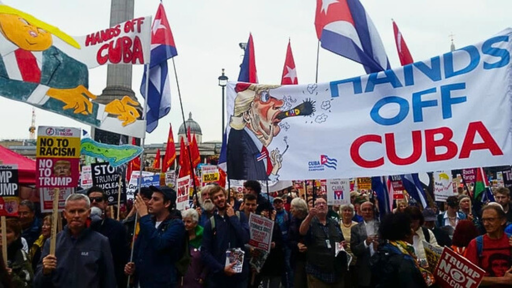
In one of his typically bombastic and provocative statements, the U.S. president said Friday, “Perhaps we will have a friendly takeover of Cuba after many years. … I’ve heard about Cuba since I was a child. Everyone wanted change, and I can see that happening.” Once again, Trump is openly stating his objectives: to take control of Cuba. But he has started more fights than he can handle, particularly in Iran. His popularity is declining in the United States, thanks to the Epstein scandal and poor economic indicators. This suggests he is not unstoppable, and class struggle can halt his agenda.
Regarding Cuba, Trump acknowledged that the fuel blockade is causing an economic and social crisis: “They have no money, no oil, no food. And right now, it’s a nation in serious trouble, and they want our help.” He made it clear that he is using economic warfare and social crisis to impose his will on a sovereign country. This is illegal and illegitimate. We condemn all forms of imperialist aggression against Cuba, whether military, economic, or diplomatic.
Trump has repeatedly insisted that bilateral negotiations between the White House and Cuba’s government are underway: “They are talking to us.” This signifies nothing more than imperialist coercion — forcing the Cuban government to concede under the pressure of the oil blockade, which adds to the historical sanctions that inflate the cost of importing goods.
Recently, news circulated that Secretary of State Marco Rubio is holding talks with senior Cuban officials, particularly one of Castro’s grandsons. Rubio himself noted his goals in an interview: “That the Cuban people have more freedom, not only political freedom, but also economic freedom. … Beginning to open up in this sense is a possible way forward.” Coming from the war hawk Rubio, this translates to regime change and capitalist restoration.
When representatives of imperialism speak of “the Cuban people,” they are referring to U.S. corporations. When they discuss “economic freedom,” they mean the freedom of these monopolies to exploit the country’s natural resources and its working class. We flatly reject any discourse of “solidarity” or “freedom” that emanates from imperialism, which is directly responsible for the current crisis.
The Cuban government continues to deny such negotiations, but a recent fact suggests that secret discussions may be taking place: almost simultaneously, both governments have allowed fuel purchases for Cuba’s private business sector, which includes medium-sized companies in public transport, food production and sales, and tourism.
Despite the confrontational statements from both governments (Cuba labeled members of the boat “terrorists,” and the U.S. announced it would launch an “independent investigation” and act “accordingly”), the truth is that the incident, serious in the current context, has not led to an escalation, not even diplomatically. On the contrary, Trump has been suggesting (in his own way) that negotiations are progressing.
Furthermore, it is clear (even to the boastful Trump) that any U.S. military action in Cuba would not be as easy as the invasion and kidnapping in Venezuela on January 3. This indicates that the incident was likely the result of a group of “rogue wolves” spurred by the rhetoric and aggressive imperial policy of the U.S. president (which he pursues not only against Cuba but globally), or that it was a provocation driven by the U.S. aimed at gauging the Cuban response or inciting unrest to create a broader image of crisis.
Under conditions of coercion, any negotiation between the restorationist, austerity-minded, and repressive bureaucracy of the Communist Party and the Trump administration can result in only one thing: an advance of imperialism over Cuba. It will be reactionary and aimed at liquidating what little remains of the revolution’s achievements, particularly state ownership of key economic resources.
We need an international campaign of solidarity with Cuba, in Latin America and in the heart of U.S. imperialism, focused on demanding that governments that call themselves “progressive” and “friends of Cuba” break Trump’s oil embargo. This is part of the struggle to defeat the blockade that has been in place since 1962, allowing food, medicine, and other basic products to enter without restrictions. This fight is fundamental to defeating the imperialist offensive throughout the continent.
In the United States, we need a mass movement on the streets, from the schools and our workplaces, to stop Trump and U.S. imperialism and to oppose working-class internationalism and solidarity to the Donroe Doctrine.
The post Trump’s Threatened “Friendly” Takeover of Cuba appeared first on Left Voice.
From Left Voice via This RSS Feed.
You must log in or # to comment.