

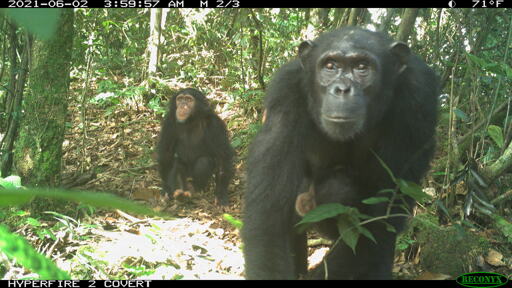
In August 2025, Louis Nkembi, founder of conservation NGO ERuDeF, was abducted by militia fighters in Cameroon’s Lebialem Highlands. He was held for two weeks, hidden in a secret location inside a forest. “It was a traumatic experience,” he recalls. “I can’t go back to that area until everything is resolved.” Though Nkembi was eventually freed, his ordeal sheds light on the risks facing scientists, researchers, eco-guards and conservation workers protecting apes in Cameroon’s conflict hotspots, including the Lebialem Highlands. Lebialem is a global biodiversity hotspot in Cameroon’s southwest, host to dozens of endemic and threatened species, including critically endangered Cross River gorillas (Gorilla gorilla diehli), Nigeria-Cameroon chimpanzees (Pan troglodytes ellioti), African forest elephants (Loxodonta cyclotis), leopards (Panthera pardus), dwarf galagos (Galagoides demidovii) and white-bellied pangolins (Phataginus tricuspis). Camera trap photo of a Cross River gorillas(Gorilla gorilla deihli). Fewer than 300 are believed to survive, making them the rarest great ape subspecies. Image by ©WCS Nigeria. This irresistible richness is the root of Nkembi’s love for Lebialem. He’s spent nearly three decades documenting, surveying and conserving the area through ERuDeF (the Environmental and Rural Development Foundation), which he founded in 1999. In late 2016, Lebialem, like dozens of other parks, reserves and sanctuaries in the region, was swept up in armed conflict that continues to wrack Cameroon’s Northwest and Southwest regions. “It was something that took all of us by surprise,” Ndimuh Bertrand, executive director of Voice of Nature (VoNat), a conservation organization based in the Southwest capital Buea, tells…This article was originally published on Mongabay
From Conservation news via This RSS Feed.