


Janine Jackson interviewed Belly of the Beast‘s Reed Lindsay about the US war on Cuba for the February 20, 2026, episode of CounterSpin*. This is a lightly edited transcript.*
https://media.blubrry.com/counterspin/content.blubrry.com/counterspin/CounterSpin260220Lindsay.mp3
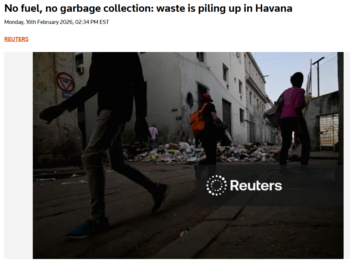
Reuters (2/16/26)
Janine Jackson: Cuba is in a humanitarian crisis that is growing worse by the day, with major blackouts, and fuel and food priced out of reach, due to the US-imposed oil blockade, and the illegal US interference in the government of longtime oil-supplier Venezuela. The latest headlines here describe garbage piling up in the street, with the potential for spreading disease, as garbage trucks lack the fuel to function.
Trump’s Cuba policy is run by Secretary of State Marco Rubio, who’s been overt in his calls for “regime change” in Cuba—an oddly passive term used to describe the effort of one country to unilaterally depose the government of another sovereign country, and impose one deemed more favorable. And, hey, a good way to do that is to use any means available to make the people of that country so miserable that they themselves bring about or welcome the change.
That sounds dramatic, because it is. But Cuba has been under economic embargo since before many CounterSpin listeners were alive, and US news media coverage still reflects a framing that hasn’t shifted much in that time.
Journalist/filmmaker Reed Lindsay has been reporting on Cuba, and making documentaries about the country, for more than a decade. He works with the project Belly of the Beast, and writes for outlets including Jacobin and CounterPunch. He joins us now by phone. Welcome to CounterSpin, Reed Lindsay.
Reed Lindsay: It’s a pleasure to be here. Thank you, Janine.
JJ: Trump said a couple days ago, “We’re talking to Cuba right now, and Marco Rubio is talking to Cuba right now, and they should absolutely make a deal, because it’s really a humanitarian threat.” Now, CNN called that “strongarming,” but in the same sentence, they said that it was an effort to achieve “reforms” in Cuba.
So at the most basic level of language, the story is muddled. How does one country strongarm another country into reform? And then again, at a fundamental level, a blockade, a belligerent act designed to cut off trade and supplies: Isn’t that an act of war? And is the US at war with Cuba?
Belly of the Beast (10/9/20)
RL: The US is at war with Cuba, and has been for a while. When we started Belly the Beast six years ago, we started it just as Trump had rolled back the opening that was happening under Obama, and he was intensifying sanctions, and we were trying to report on that, and we did a documentary series. And we’re trying to come up with a name for it, and we ended up landing on “The War on Cuba,” because, in looking into US policy and economic sanctions, and looking at the actual definition of what it is the US is doing to Cuba, it is indisputably economic warfare.
And it’s not a term that major media outlets ever use. In fact, when we started using it, some people would say, “Well, I don’t know. That’s pretty strong language. I’m not sure if you should say that.” So we say, “Well look it up in the Encyclopedia Britannica, look up the definition of what economic warfare is.” These sanctions, the embargo, the blockade, depending on how you call it, you can use a lot of different words. But in the end, what it is is economic warfare.
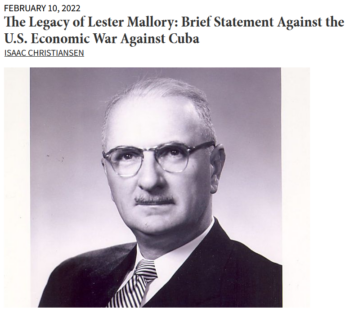
CounterPunch (2/10/22)
And it’s been around since the early ’60s. There’s a quote that we often point to from Lester Mallory, deputy assistant secretary of state for American affairs in 1960, when he was making an argument to impose embargo; it hadn’t fully been imposed yet. And he said that what we need to do, essentially, is to sabotage Cuba’s economy, to “decrease monetary and real wages,” “denying money and supplies to Cuba,” “bring about hunger, desperation and the overthrow of government.” And we have to do that “as adroitly and inconspicuous as possible.” That was the argument made at that time. And that’s basically been the playbook since then.
The objective is to make people in Cuba suffer to such a degree, and to do it in such a discreet way, where you blame the Cuban government for all the problems, that people will eventually rise up and overthrow the government. That’s still the playbook. The only difference now is the economic warfare is more intense than ever.
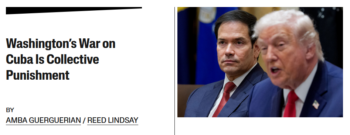
Jacobin (2/13/26)
JJ: Right. And people can see that if they choose, they can see the images of people, of garbage piled in the street, of trucks that can’t run. They can read accounts of people who are saying, “We are in fact being made miserable.” And so it would seem the simplest thing in the world to say, as the headline of your piece with Amba Guerguerian for Jacobin, “Washington’s War on Cuba Is Collective Punishment.” That seems like a simple thing to say. And yet, if we fully took that on board, it would have to change the conversation. Collective punishment is prohibited under these Geneva Conventions that we claim to care about, right? (Or some claim to care about.)
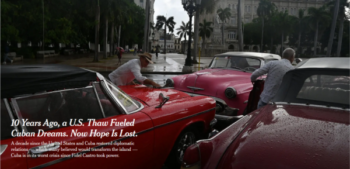
New York Times (12/27/24)
RL: Right? One line you see a lot, I mean, it’s boilerplate in mainstream media coverage—pretty much any New York Times article you’ll see on Cuba, you’ll see a line in there that says Cuba’s economy is in crisis as a result of the Cuban government’s economic mismanagement of the economy, and the embargo. So covering their bases there. And you can copy and paste that, and you’ll find it in almost every article that you see on Cuba, and that muddles things, that makes it not so clear.
What is the problem? Of course, “Cuba has this Communist system. The economy doesn’t really work. They’re mismanaging, they’re corrupt.”
The Cuban government, are they brilliant at managing the economy? No, right? Do they commit errors all the time? Surely, like every other government in the world.
But by doing this, the end result is downplaying the impact of the most powerful country in the world proactively trying to destroy the economy of a country of 10 million people, 90 miles away from their shores.
The impact, you can’t measure it. Nobody really knows the impact of the blockade, but it’s real, and I’ve seen it with my own eyes. You can see it, just in the last 10 years. Ten years ago during the opening with Obama–it’s night and day compared to how it is right now.
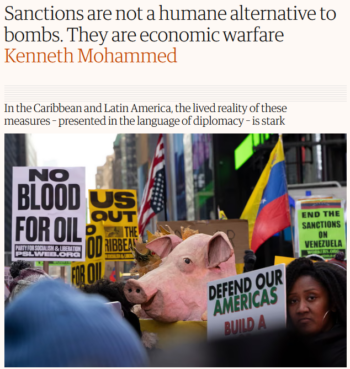
Guardian (1/28/26)
And so what’s the difference? Ten years ago, Cuba had the same Communist government, they had the same economic system. Was the economy booming? No. No, but the problem, the severe problems that are happening now, in terms of scarcities of fuel, scarcities of medicine, the degree of suffering that is occurring now, is not what was happening 10 years ago.
And what is the factor that has changed? It is the intensification of sanctions. It is the ramping up of the economic warfare. The Cuban government’s the same.
In fact, speaking of reform, and this is another thing, it’s not really well-reported: The Cuban government has been reforming in recent years. In fact, they passed a new constitution recently that allows for private companies to be formed, and many have been formed. In fact, if there wasn’t this economic warfare, the private sector would be booming. So it’s like this elephant in the room, the embargo, the economic warfare that’s going on from the US.
It’s acknowledged, you can’t completely ignore it, but it’s sort of mentioned in passing in most of the major media coverage of Cuba. And then they move on to other issues.
JJ: And I would just add to that, the way that the New York Times and other outlets do it, they’re talking about suffering and hardships, and they’ll say it’s due to their being Communists who mismanaged their economy—and the embargo. Another thing that they will do is to say, the Cuban government, or Cuban people, blame the US embargo for their hardships. They put that little caveat in there, to where the US embargo is mentioned as something that Cubans blame for their hardships. So it even adds that other degree of distance.
RL: Exactly. Yeah, you’re absolutely right. They attribute it all the time, usually attribute it to the Cuban government, as if, “well, we are not really sure. It maybe isn’t really having an impact. The Cuban government says it is. OK, now let’s move on.”
JJ: Exactly. And we can’t trust them anyway. What we know is that we can’t trust them.
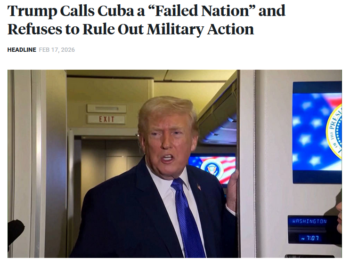
Democracy Now! (2/17/25)
Well, I have to say it is quite a feat to say that Cuba is a failed country that can’t get itself together, and it is also, simultaneously, in Trump’s words, an “unusual and extraordinary threat” to the United States. So this is by way of justifying the executive order threatening tariffs on any country that sells oil to Cuba. So how do you push the line, or how do you make a narrative, that says this “failed country” is an “extraordinary threat” to the United States?
RL: Yeah, it’s funny, because we’re actually working on a video right now, which is coming out soon, in which the journalist on our team makes that very point: So you’re saying this country, which has the oldest population in the Americas, which is going through this horrific economic crisis, poses a national security threat to the United States. Really?
They also said that Cuba was “propping up” Venezuela. Imagine, you have an oil-producing country, Venezuela, much larger than Cuba, and Cuba somehow, which is going through this devastating economic crisis where they can’t keep the lights on, is propping up Venezuela. That’s another [thing] which, again, you see repeated again and again in major media outlets.
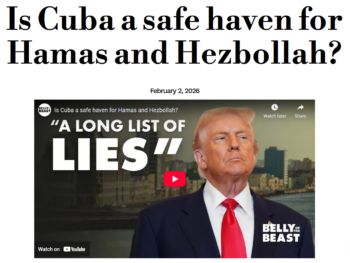
Belly of the Beast (2/2/26)
But one thing, in this executive order, they laid out the justification for this measure, and the justification was that it’s a “malign” influence in the hemisphere, and it’s a national security threat. And they specified how it’s a national security threat. They said, well, the biggest Russian spy base in the hemisphere is in Cuba. And they said that Hamas and Hezbollah were in Cuba.
There’s no evidence of this. And we’ve done extensive reporting. It’s sort of ridiculous, because we actually have gone out to report on these types of accusations, and you feel like—you know it’s false, It’s patently false, and it’s hard to disprove something. You could say there are aliens in Cuba as well.
JJ: I was going to say, it’s cartoonish. It’s cartoonish, it seems to me, like, Hamas, Hezbollah, who else can you name? And yet this is being put forward seriously, and is being, evidently, taken seriously, at least as a background, by reporters, by our First Amendment–protected press corps.
RL: Yeah. Well, there was a Russian spy base. It’s been like 25 years. It was there during the Cold War, unsurprisingly; the Soviet Union had a spy base. It eventually was shut down.
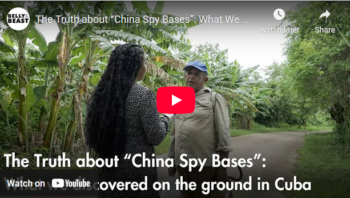
Belly of the Beast (8/1/24)
For the last 25 years, they’ve been talking about it, Rubio himself. In the primary debate with Trump in 2016, this came up, in Miami, and I think it was a CNN debate, where Rubio said there’s this China spy base in Cuba, we’ve got to get rid of it. And Rubio has been talking about that for years, “the China spy base,” “the China spy base” and so on.
And we’ve reported on it. We’ve reported on the fact that there’s no evidence that there’s a China spy base.
JJ: Well, I got to pause you there, because we went from Russia to China, and I know that the line does that, too, but there was a Russian spy base, and now there are accusations of a China spy base? Whose spy base? What’s the reality there?
RL: Well, now it’s back, it’s apparently back to Russia. You know what’s funny, though, we actually, when we were looking for the spy base, we googled, right? We looked on Google, you can see it on the map. Of course, you go there, and you talk to people, and they say, “Well, there’s no Russians here. No Chinese here.” And there’s no evidence of the spy base, right?
JJ: I know that you’ve been observing US media on Cuba for a long time, and there are people who are just learning this history and this politics now, and I think will be surprised at how dusty it is, how Cold War–framed it is.
And yet we do have outlets, we do have people, who are doing independent reporting. There are other places that people can look, if they want to move outside the rigid and cartoony presentation in so-called mainstream news. There are other places that people can look for up-to-date information about Cuba.
RL: Yeah. And I also feel like, in the United States, despite all of this fake news and misinformation, people really want to go to Cuba. You saw that during Obama, people were going in droves. And even now, people go, despite the fears and the lies about Cuba, people go.
And one thing I’ve noticed, when they go from the United States, everyone, they can’t believe it. I have not run into a single person in the United States who has visited Cuba and hasn’t said, “Wow, this is not at all what I thought it was going to be like.” And these are people who are open to Cuba. These are people who are willing to get on a plane and go to a place that a lot of people say you shouldn’t go to. And even they were like, “Wow, this is not at all what I’ve been reading about and hearing about in media.”
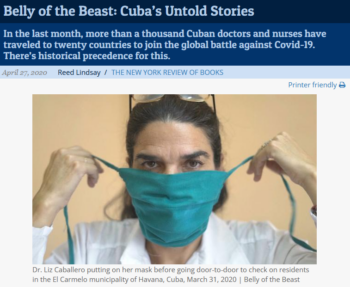
Belly of the Beast (via Portside, 4/27/20)
JJ: I think a lot of Americans are shocked when they learn, also, that people in other places in the world don’t think Cuba is a pariah, where the living envy the dead.
And then, one example that I know you’ve written about, also, when Cuba did, during Covid, as they’ve done on a number of occasions, sent doctors around the world, Belén Fernández wrote for FAIR.org about how media were saying, oh yeah, that’s cool that they’re doing that, but—and this is Bloomberg—“allowing Havana to exploit the virus for hard currency will just empower repression at home.”
So even when Cuba is presented, as it often is in international media, as doing something obviously, overtly positive, there still has to be a little note that says, “But don’t think it’s good. Don’t think it’s good, because it’s still Cuba.” It’s so simplistic and stupid, and it’s amazing that media think people will continue to fall for it forever.
RL: Yeah. An example of that, I reported for a while in Haiti, and the Cuban medical mission there was incredible. I was blown away, because the aid programs, as many people know, in Haiti—from the US and Europe and so on—have been a total disaster. And with not only no positive impact to show for all the money they spend, but in many cases have a destructive impact. And the Cuban medical mission, quietly in Haiti, amazing, amazing public healthcare system. It saved so many lives, changed so many lives.
I was reporting in Haiti for five years. I never saw a single major media outlet cover that.
And the Cubans have missions all over the world. And not only have I not seen any positive coverage of these missions, but it’s all negative. It’s all negative. “Well, Cuba’s only doing this for these nefarious reasons.” One is they make money. Well, they’re not making money in Haiti. So what’s the reason there? The reason given in Haiti, when it’s ever even mentioned at all, is that it’s basically PR. They’re trying to look good. OK, well, that might make sense if the media outlets actually reported on what they were doing. Because nobody knows about what they’re doing, it doesn’t really add up.
And this is part of the war in Cuba, because Cuba does make money; so, not all of the missions, but many of the missions, that money goes back to Cuba. It helps sustain their own free healthcare system. The doctors go on these missions voluntarily. They’re actually eager to go on missions, because they get salaries that are much higher than what they earn in Cuba. And the missions now are being attacked left and right, because the US government knows this is a source of foreign currency for Cuba.
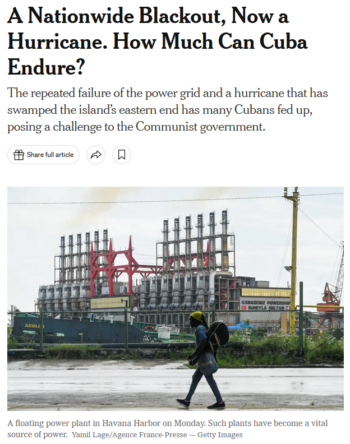
New York Times (10/21/24)
And, again, it’s part of the bigger plan of depriving Cuba of resources, and essentially trying to make Cuba become a failed state. Cuba’s not a failed state. It hasn’t been, but that’s the objective.
JJ: Let me just ask you, finally, for thoughts for folks—and as I do understand, because the coverage of Cuba is kind of preserved in aspic, and hasn’t changed very much—there are folks who will be confused by the stories, by the media that they’re reading. One story, this is from a couple of years ago, but still it’s tossed off, a story about a blackout in Cuba: Cuba is “a Communist country long accustomed to shortages of all kinds and spotty electrical service.”
So it’s almost as if there’s nothing to see here; the hardship and the suffering, there’s nothing to see, and certainly nothing that you, as a US observer, need to think about your own involvement in that situation. What do you say to folks as they are reading this news coming out of Cuba right now?
RL: On the one hand, I feel like people are suffering. The situation is bad, it’s getting worse. And you want to show that, right? Because the US is causing it. And it’s important to show that people are suffering, but major media outlets love to do that. But in our case, we like to show, what is the cause? It’s essential for people in the US to know, OK, well, things are really bad in Cuba, why? We have to do with this. We are the biggest reasons that this situation is bad like this.
On the other hand, there’s also this sort of, I can’t tell you the number of times I’ve seen this headline recently: “Cuba’s on the Brink of Collapse.” It’s again and again on the brink, on the brink, about to collapse, and so on.
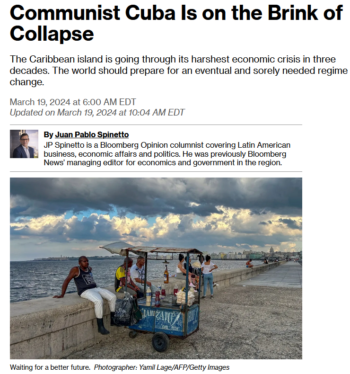
Bloomberg (3/19/24)
And then, when I’ve seen Rubio interviewed by journalists, it’s the same question: “When is Cuba going to collapse? When is the government going to go down? When is this going to happen?” Almost as if it is this inevitable thing, because now Trump has decided to do this, and this is a good thing. It’s just sort of implicit that this is a good thing, and we just want to know when; hopefully it’s soon. That’s the context behind it.
And we’ll see. We’ll see. Nobody knows, right? It’s the future, and you can’t predict it. But I’ll tell you, I just spoke with someone—I’m not in Cuba at the moment—I just spoke with someone who was visiting, and her first reaction was like, “This is not on the brink of collapse.” I didn’t mention those words. She did. She said, “This is not at all what I’ve been hearing in the media.”
Things are bad. They’re going to get worse. Not denying that, but Cubans have had a long time dealing with sanctions. They’ve found ways to become self-sufficient. They are very used to rationing, and they’re trying to hold out and maintain their sovereignty.
And, frankly, that’s one thing as well, there’s a long list of them, which I think is really an important word, “sovereignty,” because our whole international system is based on the principle of sovereignty. And yet, again, in the way the US views Cuba, and has acted toward Cuba, and major media outlets have, it’s almost taken for granted that Cuban sovereignty has no value, that it doesn’t matter.

Reed Lindsay: “It’s our government, with our resources, that is essentially playing a huge role in causing the suffering in Cuba.”
I feel like that’s one thing that I’ve come to appreciate, as spending time in Cuba and reporting in Cuba, is that they’re fiercely proud of their sovereignty. It’s one line they’re not going to cross.
And I think that’s a good thing. I think that’s a good thing when countries are sovereign. And I think it’s a good thing when sovereignty is respected.
So we’ll see what happens. I think that the best thing people in the US can do who are following Cuba is to speak out and say something about our policy there, because it’s our government, with our resources, that is essentially playing a huge role in causing the suffering in Cuba.
JJ: All right, then. Thank you so much. I’ll end on that note.
We’ve been speaking with journalist and filmmaker Reed Lindsay. You can read his recent piece with Amba Guerguerian at Jacobin.com on collective punishment in Cuba. Reed Lindsay, thank you so much for joining us this week on CounterSpin.
RL: Thank you, Janine.
From FAIR via This RSS Feed.