

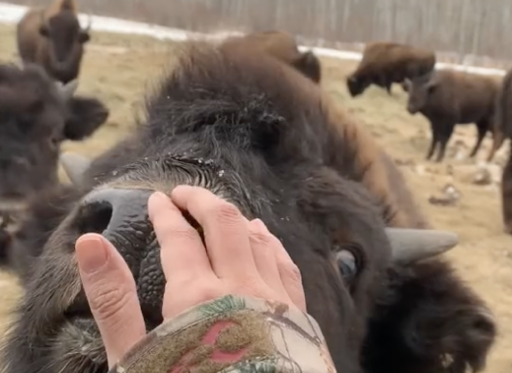

A wood bison approaches Skownan First Nation operations director Rychelle Catcheway in Chitek Lake Anishinaabe Provincial Park. Screengrab courtesy Rychelle Catcheway
A large herd of bagwaji-bizhikiwag (wood bison) call Chitek Lake Anishinaabe Provincial Park in Manitoba home — and their community recently grew even larger.
On Feb. 18, the herd welcomed ten new bulls and cows to their territory nestled between Lake Winnipegosis and Lake Winnipeg — more than 300 kilometres northwest of the City of Winnipeg.
They’d traveled 12 hours in a massive cattle trailer across provinces, from Elk Island National Park in “Alberta.”
Wood bison, once on the brink of extinction, have seen their populations climb thanks to conservation efforts. And even though historically the species wasn’t known to live in this herd’s area, the vast isolation of the park’s boreal forest, fields and lakes helps keep them safe from disease as their numbers come back.
Skownan First Nation serves as stewards of the free-ranging herd, which is currently at nearly 200 animals, said Rychelle Catcheway.
“It’s a very proud and meaningful [and] fulfilling role to know that our bison were nearly extinct or on the endangered species list and now to see their numbers come rise back up,” said Catcheway, who is Skownan First Nation’s operations director.
“This was years in the making.”
Catcheway said several years ago, the First Nation submitted a request to the Elk Island bison transfer program. Last fall, she said, they began a series of meetings “to discuss how many animals they were able to give us … and to see if we had the capacity to take them in.”
Moving wood bison, which can each weigh up to a tonne, between herds is not an easy task.
It required many steps, starting with Skownan and Elk Island National Park signing a Memorandum of Understanding outlining who bore responsibility for sorting, tagging, handling, loading, and transporting the animals.
But it also required helping the newest members of the herd integrate. As the ten transferred bison were unloaded in Manitoba, at first one of the cows refused to leave the transport trailer.
So Catcheway stepped in. She made eye contact with the scared animal through a hole in the trailer’s side. And then she told the bison that she’d arrived in her new home.
Finally, Catcheway’s spouse Paul Marion — who serves as their First Nation’s herd manager — lured the timid mammal out using a bell and hay.
Now, the bison are able to recognize the couple’s truck. But if it’s driven by someone unfamiliar, they can get “spooked,” Catcheway noted.
She said she’s become closer with the new buffalo, remembering moments where a calf and a bull walked right up to her window as the couple were stopped in the middle of the herd.
Wood bison approach the vehicle of Skownan First Nation’s operations director, Rychelle Catcheway. Video courtesy Rychelle Catcheway
‘Small but very tangible act of reconciliation’
The move wasn’t the first one between the animals’ original national park in “Alberta” and their new home on Skownan First Nation’s bison ranch.
In fact, about 40 years ago, Elk Island National Park sent Skownan several of its initial herd when the Manitoba program first started.
At that time, the federal government had declared the large bovine species as officially “endangered”; by 1988, wood bison were downgraded to “threatened” status.
Today, the species is still listed as of “special concern,” with between 5,000 and 7,000 mature individuals spread between nine wild subpopulations.
Without many natural predators to hunt bison, their populations have been able to slowly bounce back, explained David Bruinsma, a Parks Canada resource management officer at Elk Island National Park.
But six years ago, Environment and Climate Change Canada issued a warning that wood bison face “imminent threats to their recovery,” particularly from domestic cattle-borne diseases, “oil sands mining” and hydroelectric dams, and vehicle strikes.
“The effect of threats make achieving the recovery objectives of the species highly unlikely or impossible,” the department’s report concluded, “such that immediate intervention is required.”
Without many natural predators to hunt bison, their populations have been able to bounce back, explained David Bruinsma, a Parks Canada resource management officer at Elk Island National Park.
The “Alberta” park hosts two distinct herds — one wood bison, the other plains bison.
“There’s limited amount of grass and other forage in the park for them,” Bruinsma said.
“Every so often, we have to remove surplus bison from the park to prevent overgrazing … and then transfer them to conservation projects and Indigenous communities.”
Such transfers usually occur in wintertime because it’s easier to lure the bison with feed when the ground is covered with snow. Additionally, the calves will have been weaned by that time.
Bruinsma said Parks Canada is trying to increase how many bison it transfers to Indigenous communities, calling it a “small but very tangible act of reconciliation” that “supports ecological and cultural restoration” of the species considered sacred to many First Nations in the region.

Wood bison graze in the snow in Elk Island National Park in ‘Alberta.’ The park sent ten herd members to join another herd in Chitek Lake Anishinaabe Provincial Park. Photo courtesy Stephen G. Edgerton/Parks Canada
The wood bison sent to Skownan came fitted with coloured ear tags to differentiate them from the rest of the herd, Catcheway said.
The five males, known as bulls, are old enough to breed at three years old and up, and have green ear tags.
Meanwhile the five females, or cows, range from yearlings to roughly four years old, and wear yellow tags.
The ten were introduced to add genetic diversity to the local breeding population, Catcheway explained.
“There’s a possibility that the females might be bred already, so we’ll be looking forward to seeing if they have any calves this May,” she said.
Their new provincial park home sits on the traditional lands of the Skownan Anishinaabe.
In 2014, it became the first area the provincial government designated as a Traditional Indigenous Use Park.
The 1,000-square-kilometre protected area draws hunters, fishers and gatherers from local Indigenous communities and beyond.
“That took years making it into a provincial park,” Catcheway said, “to prevent logging and to keep the land for generations to come.”
The bison roam within a 50-square-kilometre enclosure of the park.
But being free to wander, some have left the area, often northbound within the province. It’s estimated that there are about 300 wild buffalo whose lineage originated from Skownan’s bison ranch.
“Last year, we had one of the wild bison actually come right into Skownan,” she recalled. “A lot of people were in awe.”
Wood bison from ‘Alberta’ are unloaded from a giant trailer on Feb. 18, after being moved to another herd two provinces to the east by members of Skownan First Nation. Video courtesy Rychelle Catcheway
Catcheway and Marion drive 40 minutes each way to feed the bison during winter months.
“It’s a pretty big area for them to roam,” she said.
“Free grazing during the summer — wintertime is when we feed them and they stay in the feedlot.”
Marion prepares the hay and salt blocks for the animals.
“They like alfalfa,” she noted. “We gave them barley last year, and they were pretty excited to have that — different hays, grasses.”
She told IndigiNews they start to feed the herd as soon as “the snow first starts flying.”
By the time the snows melt, they’ll have consumed “about 500 bales” before they can graze freely in springtime.
Marion’s late father, Raymond, passed on the responsibilities to care for the herd to the couple.
“On warmer days when Paul goes to feed up, it’s nice to see the calves running around and jumping,” Catcheway said.
“Sometimes, there’s some older females that are stubborn, give us a hard time, say if we’re having a round up or anything, I find they have their own personalities.”

The wood bison herd cared for by Skownan First Nation, at Chitek Lake Anishinaabe Provincial Park. Photo courtesy Skownan First Nation
First Nations ‘are reclaiming their role’
Bison are an important food source for many Indigenous communities, and are also used in Sundance ceremonies, such as the dragging of buffalo skulls after dancers are pierced, she said.
Recently, Skownan hosted Manitoba Keewatin Okimakanak, a northern chiefs organization, to a bison harvest.
After being shown ways of using all parts of the harvested animal, the guests and hosts then held a feast. “Taking care of the land and conserving endangered species is our responsibility,” said Skownan band councillor Nelson Nepinak in a press release. “Our priority is herd health.”
The First Nation added that, as Indigenous people are increasingly recognized internationally as environmental stewards, the Skownan Wood Bison program “demonstrates how nations are reclaiming their role as caretakers of the land,” the press release stated, “while building resilient futures for generations to come.”
The small community of nearly 1,800 people has “learned a lot of lessons from the bison,” Catcheway said proudly — for instance, how to protect fellow community members like bison do in a herd.
“They learned how they function in their community,” she explained.
“They’re really protective of each other — just like how community members are here in Skownan, they’re there for each other.”
The post In Manitoba, a growing herd of bagwaji-bizhikiwag offers lessons in community appeared first on Indiginews.
From Indiginews via This RSS Feed.