

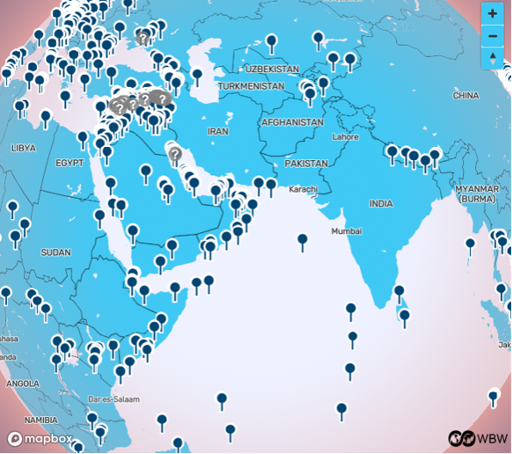
Iran has retaliated against the U.S.-Israeli-launched war by attacking Israel, Saudi Arabia, Bahrain, Qatar, UAE, Kuwait, Lebanon, Iraq, and Jordan. With the exception of Lebanon, those nations had pinned bullseyes on themselves by hosting U.S. bases. Those U.S. bases are not simply targets for wars, and launching points for wars, but also a means for the U.S. government to control brutal dictatorships and to help those brutal dictatorships in controling their populations.
In the following video from Tuesday, Rami Khouri, Palestinian American journalist and distinguished public policy fellow at the American University of Beirut, speaks with Democracy Now! about how nations in Western Asia are not actual soveriegn nations:
Here is a comment from Monday by Jeffrey Sachs and Sybil Fares: “At the Security Council on February 28, 2026, the US and its allies directed their condemnation not at the American and Israeli aggression, but at Iran. . . . It is easy to understand why the US allies behave in the embarrassing and self-abasing way they did at the UN Security Council. In addition to the United States, eight of the other fourteen Council members host US military bases or grant the US military access to local bases: Bahrain, Colombia, Denmark, France, Greece, Latvia, Panama, and the United Kingdom. These countries are not fully sovereign. They are partially governed by the US. The US military bases house CIA operations, and the host countries constantly look over their shoulder to try to avoid US subversion in their own countries.”
And yet, nations with U.S. bases in them can in fact find the decency to deny the U.S. the ability to use those bases for a particular murder spree, because Spain just did.
Below is a new report from World BEYOND War’s Mohammed Abunahel on the U.S. bases in the nations just west of Iran.
— David Swanson

What We Know So Far About the U.S. Bases in the Gulf Countries
By Mohammed Abunahel, World BEYOND War, March 3, 2026
The initiation of the U.S.-Israeli attack on Iran in the early hours of Friday, June 13, 2025, has given rise to several potential scenarios about the war’s progression, notably the prospect of Iran striking U.S. military installations in the region. This occurred when Iran struck the Al Udeid Air Base in Qatar on June 23, 2025, subsequent to the U.S. attack on Iranian nuclear facilities in the early hours of June 22. This is a situation that the United States had long cautioned against if it were to become directly engaged in any war with Tehran. It is noteworthy that Iran earlier attacked the Ain al-Asad Air Base in Iraq, which the U.S. officially withdrew from in January 2026, in revenge for the killing of Qassem Soleimani, commander of the Quds Force of the Iranian Revolutionary Guard, by a U.S. bombing on January 3, 2020.
In the days following these developments, the U.S. and Israel attacked Iran again on 28 February 2026. These attacks mark a significant escalation in U.S.–Israel military action against Iran. Iran responded against U.S. and allied positions in the region, highlighting an ongoing cycle of escalation since the strikes began.
Reports indicated heightened alert levels at several U.S. installations in Qatar and other countries, amid fears of further missile and drone strikes. These developments reinforced concerns that this direct confrontation between Washington and Tehran could rapidly transform the region into an active arena of proxy and direct military confrontation.
U.S. Bases in the Gulf
This information below is based on research conducted by World BEYOND War, available on an interactive map showing over 850 bases spanning the world.
The United States operates a complex military infrastructure in the region, distributed across a number of air, naval, and land bases, which together constitute a vital strategic foundation for any potential American military action in a regional or global context.
Estimates indicate that the United States deploys roughly 46,000 troops in the Middle East, accompanied by a varied fleet of warships and fighter jets, some newly commissioned and others with prior operational experience in regional conflicts. The White House alleges that the U.S. military presence in the region is “defensive,” yet the deployment evidences a significant augmentation of military assets, as seen in the following chart counting the number of U.S. bases in each country:

A brief history of the United States in the Middle East
The Eisenhower Doctrine, instituted in 1956 and named after Dwight Eisenhower, the President of the United States, was the spark that ignited the first wave of U.S. military intervention in the Middle East. This doctrine enabled the United States to use military force in situations deemed essential to safeguard regional security and to protect the sovereignty of any alliance or state that requested support against aggression in the region. Its primary objective was to limit the Soviet Union’s expansion into the region. The Eisenhower Doctrine was cited in 1958, when the President of Lebanon, Camille Chamoun, requested assistance from the United States to “restore legitimacy” and end the opposition. Marines from the United States arrived in Beirut via the port on June 15 of that year as part of an operation codenamed “Operation Blue Bat.”
From Facilities to Permanent Presence
U.S. military influence in the Middle East has escalated at a pace that varies according to demand. After initially establishing a presence for joint military exercises, the U.S. gained access to extensive facilities, including airspace, ports, airports, and bases, as well as refueling, maintenance, and weapons storage in most countries of the region. The 1991 Gulf War then paved the way for a permanent US military presence based on fixed bases. The United States deployed over 500,000 troops to Saudi Arabia as part of the Gulf War, which involved 697,000 US soldiers and culminated in the establishment of a network of bases enabling Washington to conduct large-scale land, sea, and air operations.
Military Deployment Locations
- Qatar
Al-Udeid Air Base, Qatar
The US maintains only one base in Qatar, named Al-Udeid Air Base. This is the largest facility maintained by the US in the Middle East, established at the conclusion of the Gulf War and covering over 12 square kilometres. It accommodates over 11,000 soldiers and houses over 100 fighter jets, strategic bombers, tankers, and surveillance equipment. Since the Iraq invasion, this base has functioned as a primary operational base for American and British forces in the Persian Gulf. Furthermore, the US declared that the majority of actions targeting ISIS have emanated from this base.

Al-Udeid Air Base
The base features two exceptionally long runways, approximately 3,750 meters in length, allowing use by any aircraft in the US Air Force. The base houses B-52 bombers, KC-135 tankers, F-15 and F-35 aircraft, along with MQ-9 attack drones. The Hill reports that Qatar has spent more than $8 billion upgrading infrastructure, including $1.4 billion on troop housing and airfield improvements.
Qatar has ostensibly prohibited the utilization of its air force base for operations against Iran, which has threatened to target American installations in the region; however, Al-Udeid may still function as a key site for any actions the US chooses to undertake against the Islamic Republic.
Satellite images released on 25 February 2026 indicate that the United States continues to prepare for escalation with Iran, and that it continues to evacuate its bases in the region, including Al-Udeid Air Base. In recent days, Iran has launched a series of missile and drone strikes against different US bases in the region, including this base.
- Oman
The United States and Oman signed a 10-year renewable military agreement, which is know as the “Access to Omani Facilities” agreement in 1980, granting the US military. The agreement, renewed in 1985, 1990, 2000, and 2010, allowed American access to Omani facilities, including airports, seaports, and several military bases. The most prominent of these include:
- Masirah Air Base: Used for operating reconnaissance aircraft and housing a monitoring station for the region’s waterways.
- Al-Musannah Air Base: Used for airlift operations and containing large US ammunition depots.
- Thumrait Air Base: Contains US weapons and equipment depots.
- United Arab Emirates
The UAE is a crucial ally of the United States, providing essential support to its military forces, aircraft, and ships in the Middle East. It hosts US military personnel in four military bases:
- Al Dhafra Air Base: The Al Dhafra Air Base is a U.S. Air Force Central Command state that is located south of the UAE capital Abu Dhabi and is shared with the UAE Air Force. It is a vital U.S. Air Force hub that supports air operations and surveillance missions.
- Fujairah Naval Base: Fujairah Naval Base is located on the Gulf of Oman. Fujairah Naval Base serves as a logistical hub for U.S. Navy operations, particularly for maritime prepositioning and joint exercises like Native Fury. The base enables rapid deployment of equipment. Its strategic position allows U.S. forces to operate outside the Strait of Hormuz.
- Al Minhad Air Base: Al Minhad Air Base, operated by the UAE Air Force, has hosted various coalition forces, including the Australian Defence Force’s Joint Task Force 633. While primarily supporting Australian operations, the base has been utilized by U.S. forces for logistical and operational purposes. Its facilities have been expanded to accommodate multinational missions.
- NSA Bahrain – Jebel Ali: The Jebel Ali port is the U Navy’s busiest port in the Middle East, which facilitates the aircraft carriers and warships. The port is the U.S. Navy’s most frequently visited port outside the United States. The U.S. Navy’s Fifth Fleet relies on the port for some operations in the Arabian Gulf.
It was reported that Al Dhafra Air Base and Jebel Ali, were among the bass that Iraq attached in the last two days
- Kuwait
The United States operates multiple military installations in Kuwait under bilateral arrangements established after the 1991 Gulf War. Major sites include Camp Arifjan and Camp Buehring, along with associated training areas and logistical facilities. Since 2003, these bases have been used to stage troops, coordinate supply networks, and conduct exercises linked to U.S. military operations in the Gulf region. Their continued presence forms part of the broader U.S. force posture in the Middle East and remains subject to strategic and political debate.
Camp Arifjan

Ain al-Asad Air Base (Photo: AP)
Camp Arifjan is located south of Kuwait City near the port facilities that support U.S. logistics into the Gulf region. Established after the 1991 Gulf War and significantly expanded following the 2003 invasion of Iraq, Camp Arifjan has been widely described in U.S. military reporting as a central logistics and command hub for American operations in Southwest Asia.
The base supports rotational deployments and pre-positioned equipment, enabling rapid force projection into Iraq, Syria, and other theaters in the region. While Kuwait hosts several U.S. facilities, Camp Arifjan is primarily an Army installation focused on logistics, sustainment, and command rather than combat aviation.
Udairi Range
The Udairi Range, located in the desert of northwestern Kuwait near Camp Buehring, is a primary training complex for U.S. Army, coalition, and Kuwaiti forces. It features live-fire, maneuver, and testing facilities for various weapon systems, including armored vehicles, helicopters, and infantry, often used for combat simulations and validating military capabilities.
Camp Buehring

Camp Buehring
Camp Buehring is a U.S. Army installation in northwestern Kuwait, located in the Udairi desert roughly 25 miles south of the Iraqi border. It was established in January 2003 as Camp Udairi during the buildup to the Iraq War and was later renamed Camp Buehring.
The installation functions as a forward staging and training site for units deploying into the U.S. Central Command area. During peak Iraq operations, the camp processed large troop rotations and expanded infrastructure to handle brigade-sized elements. As of recent reporting, Camp Buehring remains part of the U.S. military bases in Kuwait under bilateral agreements.
Ali al-Salem Air Base
This base hosts the 386th Air Expeditionary Wing, which the military describes as the “primary airlift hub and gateway for delivering combat power to joint and coalition forces” in the region. Additionally, the United States has drones, including MQ-9 Reapers, in Kuwait.

Ali al-Salem Air Base
In recent days, Iran has launched a new wave of missile and drone strikes targeting U.S. military bases and installations across the Gulf, including Ali al-Salem Air Base.
Other remaining US bases in Kuwait are Ahmed Al Jaber Air Base, Al Mubarak Air Base located within the Kuwait International Airport complex, Camp Patriot, located within the Mohammed Al-Ahmad Kuwait Naval Base, and Camp Spearhead.
- Iraq
Iraq hosts several U.S. military bases, including Harir Air Base in the Kurdistan Region and Balad Air Base in central Iraq. These facilities have been used for military operations and logistical activities since the Iraq War. Their continued presence remains controversial within Iraq, as many political groups and segments of the public view foreign military bases as a challenge to national sovereignty and independent decision-making.
Additional bases such as Al-Habbaniyah, Al-Taji, Camp Speicher, and areas near Altun Kupri have also hosted U.S. forces at different times. These bases have frequently been targeted in rocket and drone attacks, reflecting ongoing regional tensions and domestic opposition to foreign military deployment. The debate over U.S. bases in Iraq remains closely tied to issues of sovereignty, regional power competition, and internal political divisions.
Harir Air Base

Harir Air Base
Harir Air Base, located near Erbil in the Kurdistan Region of northern Iraq, is a military airfield that hosts a contingent of U.S. forces and serves as a logistical and operational hub. U.S. troops have been present at the base since 2003, and it remains one of the facilities in Iraq where American forces are still stationed following broader drawdowns from other bases across the country.
In early March 2026, Harir Air Base came under multiple attacks, with at least two strikes targeting the facility in rapid succession. Local reports indicate the strikes occurred in the early morning hours, with explosions widely heard and smoke seen rising near the base. These incidents are part of a broader pattern of regional escalation involving U.S. forces in Iraq amid heightened tensions in the Middle East.
- Saudi Arabia
The United States maintains a military presence in Saudi Arabia, primarily concentrated at Prince Sultan Air Base near Riyadh. This presence was reestablished in 2019 amid rising regional tensions, particularly following attacks on Saudi oil infrastructure. Furthermore, the US has the right to access and to use different bases such as the Unnamed site in the Ta’if Airport, the Unnamed site in the Jeddah Airport, Logistical Support Area Jenkins, Eskan Village, King Abdulaziz Air Base in Dammam, King Khalid Air Base, King Fahad Air Base, Riyadh Air Base, and Umm Al-Sahek military city.
Prince Sultan Air Base
Saudi Arabia hosts U.S. military personnel at Prince Sultan Air Base, located near Al Kharj, southeast of Riyadh. The base has been used for air operations, regional surveillance, and logistical coordination, particularly since the reintroduction of U.S. forces in 2019 following heightened tensions with Iran. Saudi authorities frame the presence as part of a defensive security partnership.
The base has also been referenced in regional threat calculations, particularly amid periods of confrontation between the United States and Iran. Following the U.S.–Israeli strikes on Iran, Tehran responded with a series of ballistic and drone attacks aimed at American military bases in the region, including Prince Sultan Air Base. This base is often viewed as part of the broader U.S. military infrastructure in the Gulf, and its presence reflects the larger geopolitical contest in the region**.**

Prince Sultan Air Base
- Jordan
Following the recent US withdrawal from Afghanistan and Iraq, the United States has acquired 12 military bases in Jordan through a 15-year “Jordanian-American Cooperation Agreement.” The agreement grants the United States comprehensive control and freedom to operate these bases as it sees fit, just like any other US military base on American soil, without Jordan having the right to object or inquire about what happens within them.
These 12 US military bases house approximately 6,000 American troops, distributed across the Jordanian capital and several other Jordanian governorates.
Muwaffaq Salti Air Base is considered the main base in the region for US drones, with a newly established operations room that handles all command-and-control functions. Other bases, including Joint Training Center – JTC, Tower 22, Training Base- Al-Quwayrah, H-4 Air Base, King Abdullah II Air Base, Royal Jordanian Navy Forces, The King Abdullah II Special Operations Training Center, Prince Hussein Air Base, King Faisal Air Base, and Titin Training Camp
Muwaffaq Salti Air Base

Muwaffaq Salti Air Base
Muwaffaq Salti Air Base, located in Azraq in eastern Jordan, is one of the main air installations used by the Jordanian Armed Forces and also hosts U.S. military personnel under defense agreements. The base has been expanded significantly in recent years, including runway upgrades, hardened shelters, and infrastructure improvements to support fighter aircraft, surveillance platforms, and logistical operations. It plays a role in regional military operations linked to developments in Syria and Iraq, and it has been used for air missions, intelligence activities, and joint exercises.
Because of Jordan’s geographic position near active conflict zones, the base has become strategically exposed during periods of regional escalation. In recent confrontations between the United States, Israel and Iran, reports indicated attempts to target military sites in Jordan, including bases associated with a U.S. presence. These developments have drawn attention in Jordan to the security risks associated with hosting foreign forces, particularly as regional tensions rise and neighbouring states become arenas for indirect confrontation.
- Bahrain
The Fifth Fleet of the United States Navy is currently stationed in the royal kingdom’s Naval Support Activity site. This fleet’s area of duty includes the Persian Gulf, the Red Sea, the Arabian Sea, and certain portions of the Indian Ocean. According to the Congressional Research Service report, this link dates back to 1948, when the installation was under the administration of the British Royal Navy.
According to the report, the deep-water port of Bahrain is one of the few sites in the Middle East that can accommodate aircraft carriers and amphibious assault ships of the United States. Among the Navy vessels are four mine countermeasures ships (MCMs), one ship serving as an Expeditionary assistance Base (ESB), and two ships providing logistical assistance. These ships are operated by the Military Sealift Command (MSC). In addition, the location is home to the American Marine Patrol and Reconnaissance aircraft known as the P-8 Poseidon, the EP-3E Aries II reconnaissance aircraft, and the Patriot missile defence systems.
According to the report, the United States Coast Guard also keeps a fleet of ships in Bahrain, which includes six specialized cutters that are designed for rapid response. Furthermore, approximately 9,000 civilians and service members are present at the facility.
In the context of the recent U.S.–Israeli military campaign against Iran, Iranian forces launched missile strikes that impacted areas around the U.S. Fifth Fleet base in Bahrain’s Juffair district, contributing to heightened regional tensions and underscoring the risks associated with hosting foreign military installations amid escalating conflict dynamics.
The post Hosting a U.S. Military Base Near Iran Is Bad for Your Health and Your Government appeared first on World BEYOND War.
From World BEYOND War via This RSS Feed.