

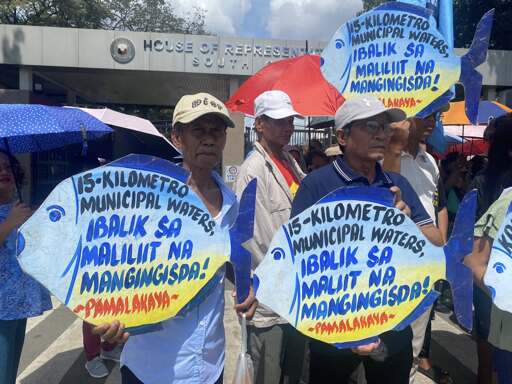
CEBU CITY – Students from the Center of Excellence in Fisheries at the University of the Philippines Visayas (UPV) are intensifying calls for the passage of House Bill No. 5606, or the “Atin ang Kinse Kilometro” bill.
This seeks to grant small-scale fisherfolk dedicated and protected access to municipal waters within 15 kilometers from shore.
For Fisheries majors, the study of aquatic resources cannot be divorced from the communities whose survival depends on them.
They stressed that fisheries education must be people-centered and sustainability-driven, not reduced to a system of export-oriented and profit growth.
The campaign gained ground during the 60th Convention of the General Assembly of Student Councils (GASC) held at University of the Philippines Diliman on February 6.
The bi-annual assembly, where student councils across the UP system consolidate systemwide campaigns, the UPV University Student Council (USC) and the UPV College of Fisheries and Ocean Sciences Student Council (CFOS SC) authored a resolution urging students to stand with fisherfolk organizations nationwide.
The resolution explained the worsening threats to municipal fishing grounds following the Supreme Court ruling on August 24, 2025, that opened these waters to large commercial operators, a move fisherfolk groups said would further marginalize small producers struggling with dwindling catch and climate-related disruptions.
Fernando Hicap, chairperson of the progressive fisherfolk alliance Pamalakaya, welcomed the solidarity extended by students.
He said that the youth’s involvement shows that fisherfolk are not alone in confronting policies that restrict their access to traditional fishing grounds and undermine their capacity to sustain their livelihoods.

Members of Pamalakaya held a coastal protest in Manila Bay against the fuel price increase on February 17 (Photo courtesy of PAMALAKAYA-Pilipinas)
The resolution stems from a December 2023 ruling of the Malabon Regional Trial Court (RTC) allowing Mercidar Fishing Corporation to operate within the 15-kilometer municipal waters, an area legally intended for small-scale fisherfolk.
The decision was later affirmed by the Supreme Court of the Philippines, not on substantive grounds, but due to the failure of the Department of Agriculture (DA) and the Bureau of Fisheries and Aquatic Resources (BFAR) to file an appeal within the prescribed period.
Fisherfolk groups decried the lapse as state inaction that paved the way for commercial encroachment into municipal waters.
In response, House Bill No. 5606 was filed on October 20, 2025 by the Kabataan, ACT Teachers, and Gabriela partylist groups. The bill seeks to restore and safeguard the exclusivity of the 15-kilometer zone for small-scale fisherfolk, closing legal loopholes that have enabled corporate intrusion.

Hicap, together with members of Pamalakaya, joined Kabataan Partylist Representative Renee Co in forwarding the bill to the House of Representatives (Photo courtesy of Kabataan Partylist)
Hicap reiterated calls to junk the Fisheries Code of 1998 which fisherfolk organizations have long criticized for privileging private commercial interests over municipal fishers.
He described the law as the “main culprit” behind decades of displacement, resource depletion, and deepening poverty in coastal communities.
He said that the encroachment of commercial vessels into municipal waters intensified during the presidency of then dictator Marcos Sr. “Many small-scale fisherfolk were once able to make a decent living from municipal waters. But during the Marcos dictatorship, he enacted the Fisheries Decree of 1975, or Presidential Decree No. 704, under martial law. That policy limited small fishers to just seven kilometers from the shoreline.”
He stressed that restricting municipal fishers to a narrower zone while expanding access for commercial operators institutionalized competition in favor of large fishing corporations, a system that fisherfolk groups say continues to shape present-day inequities in the sector.
The decades-long marginalization of small-scale fisherfolk triggered waves of mobilization across coastal communities. In the 1980s, there were nationwide fisherfolk movements in response to worsening privatization in municipal waters.
These efforts intensified during Pamalakaya’s establishment in 1987, forging a national alliance to advance the rights and welfare of small fishers.
During the same period, vast fishing grounds were converted into private concessions controlled by corporations.
Hicap said that small fishers who merely passed through these restricted areas were harassed and in some cases shot, including the reported cases in Samar.
He shared that corporate aquaculture operations likewise intensified ecological damage. Large operators used chemical inputs, including pesticides, in fishpond production.
When ponds were flushed during tidal shifts, contaminated water flowed back into open seas, affecting surrounding ecosystems and threatening the livelihood of coastal communities.
As early as 1998, sectoral advocates also pushed for reforms to counter Presidential Decree No. 704 by proposing limits on aquaculture expansion. Pamalakaya sought to cap fishpond operations to 10 percent of the total surface area of fishing grounds, while recognizing that responsible aquaculture can support livelihoods when regulated alongside the 15-kilometer provision.
Sean Buenavista, a second-year Bachelor of Science in Fisheries student at UPV CFOS and one of the presenters of the GASC resolution, said that Fisheries majors must place themselves at the forefront of the struggle to defend fisherfolk communities.

Buenavista, on the right, holding the UPV CFOS SC nameplate, presents the resolution at the 60th GASC alongside the UPV USC representative (Photo courtesy of Nixie Peptio/Lanog)
He said that Fisheries students carry a responsibility that goes beyond laboratory work and aquatic resource assessment.
He said that their scientific knowledge should serve marginalized sectors rather than corporate interests.
Having grown up in a coastal community in Bayawan City in Negros, Buenavista said that pursuing a career in fisheries was not merely a professional choice but a responsibility he recognized from an early age.
“In an archipelagic country like ours, coastal communities are at the center of survival. In my hometown, the number of fisherfolk is already declining because fishing can no longer sustain their families,” Buenavista said.
He said that passage of the 15-kilometer bill is urgent for ecological protection and social justice. He said that the first 15 kilometers from the shoreline are among the most biologically productive zones that serve as breeding and nursery grounds for fish and must be sustainably utilized, not for intensified commercial extraction.
“Small-scale municipal fisherfolk do not have the capacity to exploit these waters on a massive scale, nor can they even venture far beyond the said zone because of their limited boats and gear,” Buenavista said.
Amid this disadvantage, Hicap saidthat through the years, commercial fishing vessels continue to operate within the six-kilometer zone, waters that should be reserved for small-scale fisherfolk.
Mangrove forests, critical breeding grounds for marine life and natural buffers against storm surges, have also been cleared for reclamation projects or repurposed as dumping sites, further degrading coastal habitats.
Fisherfolk communities are also experiencing militarization due to the presence of state forces, in terms of their livelihood. Hicap said that impoverished fishers were pushed toward dynamite fishing because of its low cost and the intensifying competition with commercial ones.
The suppliers of explosives included local power holders and local state forces, who profit from the trade. Their current struggles drove some to resort to such destructive methods in an attempt to compete.
Aljo Benedicto, chairperson of the UPV USC and main author of the resolution, said that fisherfolk are compelled to resort to such measures because they are not provided with adequate and protected fishing grounds consistent with the traditional reach of their small boats and equipment.

UP students, together with members of Pamalakaya, staged a coastal protest in Navotas City on February 3 in response to ongoing reclamation activities (Photo courtesy of PAMALAKAYA-Pilipinas)
Hicap said that the house bill highlights the need to maintain communal fishing grounds, as devolving regulation to individual municipalities has created further complications.
Municipal fisherfolk who are not registered in a particular locality risk being labeled “illegal” when crossing invisible boundaries, even within the broader 15-kilometer zone. This has contributed to the rising number of so-called illegal fishing cases, disproportionately affecting small producers.
Benedicto added that the fisherfolk’s situation is a form of state neglect. He said that the current DA Secretary, Francisco Tiu Laurel Jr., worked as president of Frabelle Fishing Corporation, one of the country’s major commercial fishing firms, casting doubt on the government’s commitment to prioritizing small-scale fisherfolk over large commercial interests.
Following the General Assembly of Student Councils (GASC), Buenavista said that student organizers stepped up campus-based campaigns. During their college’s Fisheries Week, they conducted educational discussions on the proposed measure and distributed a primer outlining the bill’s history and rationale.
They are also building alliances with other colleges and student organizations through petition-signing drives. To broaden accessibility, the group is translating their existing primer, originally written in Karay-a, into Filipino so that more campus units across the university system can engage with and support the campaign.
Benedicto said that the council’s work regarding the campaign is rooted in the direct conversations with fisherfolk communities surrounding the Miagao campus.
Beyond petitions, he said that the council urges local student councils to build alliances with progressive fisherfolk organizations in their regions.
“Our government system shows that the rules implemented for fisherfolk communities are detached from on-the-ground realities,” Benedicto said.
He criticized the DA for failing to protect small-scale fishers, noting that fines and restrictions disproportionately burden municipal fisherfolk while commercial operators face minimal oversight.
Buenavista echoed the same calls by agreeing that there must be substantial revisions to the Fisheries Code, which he described as “not pro-people.” This “disproportion” is fails to account for stark socioeconomic disparities
For Hicap, there is a rampant marine resource depletion because the total commercial and inland marine fish catch has declined over decades, with roughly 70 percent of the country’s fishing grounds now overfished.
The Nationwide Assessment of Coral Reef Environment showed that about 90 percent of coral reefs are in ‘poor’ to ‘fair’ condition.
“We are one of the poorest sectors, and commercial fishing is driving the worsening conditions,” Hicap said.
He said that average fisherfolk income ranges between P5,000 and P7,000 per month, barely enough to sustain families, leaving many vulnerable to malnutrition, while basic services for fisherfolk remain inadequate despite the country’s rich natural resources.
Students said that halting projects such as reclamation, sand mining, and coastal roads, must be done immediately due to the environmental crises caused by commercialization.
Hicap said that while the current administration under Marcos Jr. oversees many of these projects, it appears supportive of initiatives that continue to threaten fisherfolk livelihoods. “Advocating for the passage of this bill is about protecting the welfare of future generations. We need to preserve municipal fishing grounds, make them sustainable, curb importation, and safeguard marine ecosystems for those who will come after us.” (DAA)
The post UP fisheries students push for exclusive waters for small-scale fishers appeared first on Bulatlat.
From Bulatlat via This RSS Feed.