

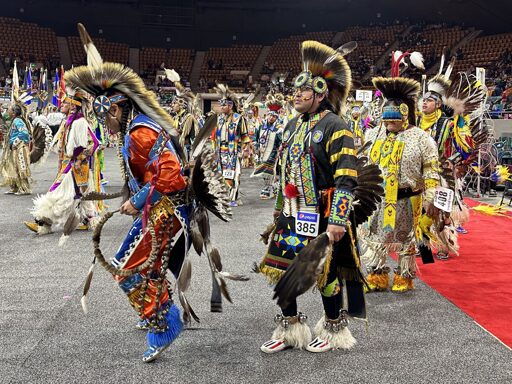

This story is part of ICT’s 2026 Powwow Newsletter. You can sign up here for the newsletter.
Stewart Huntington
ICT
If the Denver March Powwow has a central message it might be: We’re still here … and we’re coming back!
The powwow turns 50 years old this year and has grown from a small youth enrichment program in the 1970s into a sturdy institution that celebrates Indigenous cultures and anchors family, business and arts calendars across the country.
“When you hear those drums they draw you in no matter who you are,” said Doug Good Feather, the Standing Rock citizen and executive director of Denver’s Lakota Way Healing Center who opens the powwow each year with a prayer for the land and safety of all who attend. “It just tells everybody how far we came and tells people that we’re still here and we are even getting stronger.”
Year after year.
“We start getting ready for Denver the day after the powwow ends,” said jewelry vendor and Kewa Pueblo citizen Bill Coriz who’s been plying his trade at the powwow for more than a decade. “We’re going to keep sending in our application [for vendor space] every year. It’s just such a great event.”

Child-sized moccasins are displayed on a counter at a vendor booth at the 2024 Denver March Powwow. Vendors from the Great Plains, the Southwest, Oklahoma and beyond flock to the powwow to sell their wares. Credit: Photo by Stewart Huntington
The Denver March Powwow, or Denver March, or just Denver or March, is one of the big early events of powwow season every year that kicks off the “powwow trail,” the string of events that winds its way across the continent and is followed by drummers, dancers and vendors for months. The Denver kickoff has moved from various locations around its host city but has called the Denver Coliseum home since 1990.
And thrived there.
Last year, 31 drum groups and more than 1,200 dancers participated in the powwow that drew vendors and celebrants from all over. A survey of attendees last year found that people came from 49 states and 25 countries, according to powwow officials, and total attendance topped 55,000.
But at its heart, it is a family event.
“A lot of families look at it as like a reunion,” said Denver March Powwow Executive Director Grace Gillette. “People just really enjoy themselves when they come here.”
Gillette, a Mandan, Hidatsa and Arikara Nation citizen, speaks from first-hand experience when she says the powwow is rooted in family. She has led the organization since 1990 and five years ago her granddaughter, Larissa No Braid, was named as the powwow coordinator. No Braid grew up immersed in powwow culture and was 2010 Denver March Powwow Princess.

Two young dancers share a laugh just before going out on the floor at the 2024 Denver March Powwow. The event turns 50-years-old this year and has grown into one of the powwow season’d largest gatherings. Last year 31 drum groups and more than 1,200 dancers participated in the powwow that drew vendors and celebrants from all over. A survey of attendees last year found that people came from 49 states and 25 countries, according to powwow officials, and total attendance topped 55,000.
Credit: Photo by Stewart Huntington/ICT
The event’s family foundation is strong but it’s also a beacon for urban Natives disconnected from their roots.
“It’s really important because we’re … finally bringing back our culture,” said Good Feather, whose organization taps traditional Lakota culture and philosophies to help individuals find a way to heal and live a good productive life. “It’s important for the people to learn about themselves because we have always been America’s step children.

Lavor Thomas plays a flute in front of his vendor booth at the 2024 Denver March Powwow. The Navajo Nation citizen makes his flutes by hand and calls the Denver event one of his favorite places to sell his wares. Credit: Photo by Stewart Huntington/ICT
“So we have to kind of take that power back by decolonizing the minds of people. Sometimes people don’t even know their culture. So coming to the powwow gives them new ideas when they meet people from their tribe.”
The powwow is also a way for the broader community to see, hear and feel the deep current of Indigenous lifeways and values that remain strong despite centuries of deprivation and suppression.
Coriz, who when not on the powwow trail is educator at the Santa Fe Indian School, said he sees the power of the March gathering in the eyes of Denver school children.
“On Friday mornings [of powwow week] the public schools bring in their students to witness what’s happening at the gathering,” he said. “And I think it’s really an opportunity for them to firsthand learn about who we are as Indigenous people. They witness the dancing, the singing, the stories that are being told. It gets the point out that we’re still here. We’re still doing this. We’re still here in our culture.”
A culture the powwow is dedicated to. Indeed, the primary mission of the powwow, as outlined in the organization’s Articles of Incorporation, is to “preserve and protect the traditional performing arts of American Indian people.”
And grow them.
Gillette has watched for more than three decades as the powwow has grown into the cultural institution that it has become – for a variety of reasons.
Partly it is geography.
Denver is a natural meeting place for tribes from the southwest and the Great Plains. And Oklahoma’s within a long day’s drive.
Partly it’s the calendar.
The powwow arrives with the beginning of spring each year. “It’s the time we all come together to celebrate the renewal of life,” Gillette said. “We’re just all happy we made it through the winter months.”

Neesah Kanip from the Ute Indian Tribe stands just off the dance floor at the 2024 Denver March Powwow. The powwow is celebrating its 50th year in 2026.
And partly it’s because of a commitment to traditions.
“I’ve been doing this for many years, and a few years ago, I realized the hardest part of my job was to keep it as a powwow should be,” Gillette said. And that means dancers. And drums. And storytelling rooms. And arts and craft shows. And maybe even some jokes from the emcees.
But not too many extras.
“So many of the urban powwows add different things, to make it more into a show with the smoke, flashing lights, and, you know, that type of thing,” said Gillette. “We don’t do that here.”
And what about for the 50th anniversary? Are any special changes on tap to mark the milestone?
“You know, we will have some souvenir type things,” said Gillette. “But we don’t have anything different on the agenda that won’t normally happen next year or that happened last year.”
And that consistency is part of what makes Denver March, well, Denver March.
The post Denver March taps the power of powwows appeared first on ICT.
From ICT via This RSS Feed.