

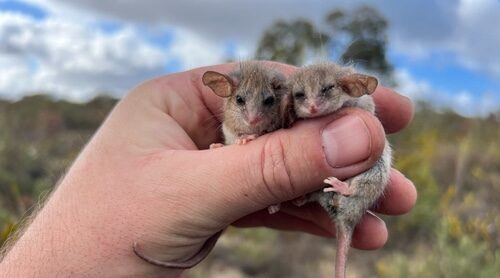
New evidence of the world’s smallest possum has emerged hundreds of kilometers from where it’s known to occur in southern Australia — a finding that potentially extends the range of this locally threatened species. Pygmy possums are a group of tiny, mouse-sized marsupials that live in open woodlands, heathlands and scrub. They feed on nectar, pollen and insects, and play a crucial ecological role as pollinators. Yorke Peninsula in the state of South Australia is the traditional land of the Narungga people and was a known habitat for the western pygmy possum (Cercartetus concinnus). Now, a new study published in the journal Australian Zoologist suggests the rare and cryptic little pygmy possum (Cercartetus lepidus) may live there too. Researchers revisited photographic data from wildlife surveys conducted between 2004 and 2011 in Dhilba Guuranda–Innes National Park, an important remnant patch of native vegetation at the tip of the peninsula. Among observations of more than 250 pygmy possums, two photographed in 2006 stood out: these possums were smaller, with distinctive gray belly fur. They were initially labeled as juvenile western pygmy possums because there were no existing records of other pygmy possum species in the area; the closest known population of little pygmy possums is on Kangaroo Island, which has been isolated from the Yorke Peninsula for 10,000 years. However, the researchers hypothesized that the two observations were misidentified, so they compared the photos with specimens kept at the South Australian Museum. They concluded that these were indeed little pygmy possums. “About…This article was originally published on Mongabay
From Conservation news via This RSS Feed.