

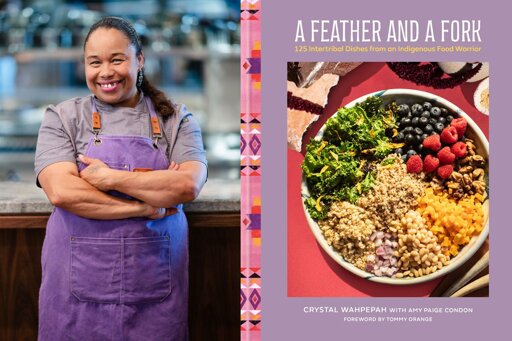
Chef Crystal Wahpepah’s story is one of intertwining threads, as is her cuisine. The food she serves at her eponymous Oakland restaurant, Wahpepah’s Kitchen, reflects her mixed-raced Kickapoo, Sac and Fox, and African-American heritage. Dishes like wild rice fritters, three-bean bison chili, and blue corn mush take their influences from the two places she calls home: her San Francisco Bay Area hometown of Oakland, and Shawnee, Oklahoma, where her Indigenous ancestors were relocated in the 1800s and where she spent childhood summers with extended family.
It’s fitting, then, that Wahpepah’s first cookbook, A Feather and a Fork, publishing on March 17, centers on intertribal foods. While the 125 recipes are largely informed by her Kickapoo heritage, there are also clear nods to other Indigenous communities, including the Ohlone people, who stewarded the place now known as Oakland for millennia before European arrival and are increasingly reclaiming their relationship to the land.
Beyond her restaurant, the self-proclaimed Indigenous food warrior is deeply involved with Oakland’s often overlooked yet vibrant Native community as well as food sovereignty efforts in the Bay Area.
Those recipes—titled in both English and Kickapoo—are accompanied by pointers on ingredient sourcing and rich storytelling about Wahpepah’s life, her tribe’s history, and cultural context about the featured foods. A James Beard Foundation Emerging Chef Award finalist, she was the first Indigenous chef to compete on Food Network’s Chopped and was inducted into the Native American Almanac for her professional achievements.
Beyond her restaurant, the self-proclaimed Indigenous food warrior is deeply involved with Oakland’s often overlooked yet vibrant Native community as well as food sovereignty efforts in the Bay Area. Known for her effervescent personality and big auntie energy, Wahpepah collaborates closely with the Culture Conservancy, a Native-led nonprofit aimed at preserving and empowering Indigenous cultures, as well as the Intertribal Friendship House, one of the nation’s oldest urban Indian centers.
Civil Eats recently spoke to Wahpepah about A Feather and a Fork, the concept of food as medicine, and fry bread as a symbol of Native resilience.
What does it mean to you to be an Indigenous food warrior?
My interpretation of an Indigenous food warrior is anyone who is participating in the food sovereignty movement and keeping our ancestral knowledge alive—from farmers and seed keepers to hunters and gatherers to those who serve and eat our foods. I first started using the term back when I was doing catering work. My niece and I would be driving between Oakland and Los Angeles [for catering jobs], and we were like, “We’re Indigenous food warriors.”
It became part of our culinary journey and shaped who we are, and we really embraced it as the years went on. When we go to the farm, when we plant the seeds, when we harvest the foods—that’s all being an Indigenous food warrior. It’s so beautiful to see the important work that Indigenous food warriors are doing all across Indian Country.

Bison roast with chokecherry rub (Misiikwaa Katoowakimina). Chokecherries, Wahpepah says, are a powerful medicine rich in antioxidants and anti-inflammatory properties. (Photo credit: Clay Williams)
Why is it important to you to get involved in food sovereignty initiatives in the Oakland community?
I wouldn’t be a chef without my community. My community has played a huge role in what I do and what I advocate for. A lot of my food sovereignty work is done in collaboration with the Culture Conservancy.
I met the team maybe 12 years ago when I was cooking a dinner at the Intertribal Friendship House here in Oakland, and the relationship built out from there.
At [the conservancy’s] Sonoma farm, Heron Shadow, we grow all sorts of vegetables, like Hopi black beans, Quapaw red corn, Buffalo Creek squash, chilies, tomatoes, and amaranth. I use some of that produce at the restaurant, but most of it gets distributed to community members.
All of this work is about quite literally providing food access to Native people. It’s also about educating the next generation, because our youth are watching us and want to get involved. Oakland is so rich and multicultural, and we have a huge Native community, especially in the Fruitvale area, where my restaurant is.
If you live here, you already know that, but it’s easy to overlook if you’re not from here. Anyone can get involved in supporting the community by volunteering with the Culture Conservancy, the Intertribal Friendship House, or the Sogorea Te’ Land Trust, which is a Native-led nonprofit that helps return Indigenous land to Indigenous people.
I also teach a class at Cal Poly Humboldt’s Food Sovereignty Lab, where I’ve been chef-in-residence since last October. I’m having a lot of fun helping students from all different backgrounds learn about the benefits of Indigenous foods and the importance of sovereignty work. There happen to be a lot of Native students in that class, but it’s made for everyone.

Blue corn mush with mixed berries (Peeskipaateeki Methiikwaki Meekateethichik Miinaki) is a staple on the Wahpepah’s Kitchen menu. It can be served for breakfast or as a dessert. (Photo credit: Clay Williams)
How does the concept of food as medicine factor into your work?
When I was growing up and I was at that period when intergenerational trauma can really take hold, I found myself gravitating toward certain healing foods. For example, I loved picking berries, and that’s still my happiest place to this day.
I believe our ancestors are really calling us to connect with these tribal foods and heal not only for ourselves but for future generations.
A lot of people are feeling lost and disconnected right now, and that’s because they’re not connected with the land. It’s very important to understand whose land you’re on and where your food comes from.
Food as medicine is about approaching things with an open mind and an open heart. It’s about talking to Mother Earth, feeling her, tasting her. For instance, spring is my favorite time of year to pick the miner’s lettuce—we call it Indian lettuce—that grows among the redwoods.
It has a lot of healing properties; it can help if you are feeling fatigued, get headaches, or aren’t sleeping well. Or bay laurel can help lower blood pressure. It’s important that we become fully aware of what these foods have to offer.
The first expansive section of your book focuses on the Three Sisters: corn, beans, and squash. Why was it important to dedicate so much attention to this Native culinary tradition?
The Three Sisters—what we call neowi ototeemetiaki in Kickapoo—are our pillars of strength. Corn, beans, and squash have fed our Native communities for centuries and are what feeds us to this day. I utilize the Three Sisters not just in the restaurant but also at home, at tribal events, everywhere.
Because so many communities across Turtle Island (North America) have grown the Three Sisters for so long, everyone has their own story. But our shared story is that this is the foundation that we built our Indigenous agriculture upon. At the restaurant, my first menu started off with the Three Sisters, so it made sense to start the book that way, too. Then when you dive deeper into these foods’ healing properties, you can really see the enduring strength of the Three Sisters.
Is there a dish that feels most closely connected to home for you?
That’s easy: dried sweet corn. It brings up so many childhood memories of spending time in Oklahoma with my grandmother and aunties. In the summertime, we celebrate the green corn, then the hot heat of August is the best time to preserve the corn. So I get to bring it from my home in Oklahoma to my home here in Oakland, where we use it for family dinners, birthdays, and other special moments. It’s a food that helps me feel connected to the land and to my identity, no matter where I am.
Let’s talk about fry bread. It’s widely considered a quintessential Native American dish, but in reality, it’s a relatively unhealthy survival food. What made you decide to include it in the book?
We didn’t serve fry bread at the restaurant for the first three years, then eventually we added it to pair with our dried corn soup and other stews. Now it’s one of our staples. When it came to including it in the book, it really took me a while to decide, because I feel like fry bread can overshadow what the story is really about, which is all these beautiful foods from this land. At the same time, fry bread is a big part of our story and reflects who we are as resilient Native people, so I realized if I left it out, I wouldn’t be telling a complete story.
“When you dive deeper into these foods’ healing properties, you can really see the enduring strength of the Three Sisters.”
I grew up very, very poor, and fry bread always kept my family fed. For us, it truly was a generational survival food. It’s what my mom, as a single mother of three kids, fed us. It’s what my grandmother fed her six kids. It’s what the aunties have always fed our community. Of course, fry bread should be eaten in moderation, but during my childhood, we had it every day. For me, it’s a reminder to never forget where you come from.
What do you hope readers take away from A Feather and a Fork?
First and foremost, I want readers to know that Native people are still here. Beyond that, I want them to know we have so many beautiful stories that have been handed down from generation to generation. I come from a really strong family of women, and I feel like it’s my duty to continue to pass along that wisdom. So much of it comes through these foods, which I hope readers can embrace in a respectful way. At the end of the day, we’re all human, and we’re all trying to be healthy. When it comes to health and wellness, why not eat the foods from this land?
This interview has been edited for length and clarity.
The post Kickapoo Chef Crystal Wahpepah Showcases Oakland’s Native American Side appeared first on Civil Eats.
From Civil Eats via This RSS Feed.