

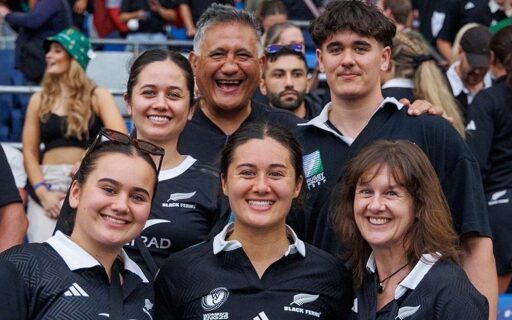

Black Fern Maia Joseph (front, centre) with her parents Jamie and Mandy, and her siblings Lydia, Ben and Lula. (Photo supplied)
When Maia Joseph debuted as a Black Fern at 18, she was achieving a childhood dream — one that likely owed something to having a former All Black and international coach for a dad. (That’s Jamie Joseph, who may be the next All Blacks coach.)
But rugby isn’t Maia’s only love — she also wants to be a doctor. After putting her medical studies on hold for two years to play for the Black Ferns and become one of the stars of last year’s Women’s Rugby World Cup, she’s now returning to med school at Otago University. Here she is talking to Dale about doing what she loves.
Tēnā koe, Maia. Rugby is what you do, and what you’ve grown up with, too, as the daughter of a high-profile rugby coach. But I guess there’s a lot that makes up your life and personality, and I’m particularly interested in your medical ambitions as well as your life on the field.
Would you be kind enough to start us off by telling us a little bit about the Joseph clan and some of your whakapapa lines, Maia?
I whakapapa Māori on my dad’s side. My mum’s Pākehā. My dad’s mum comes from the top of the South Island, so we whakapapa to Rāngitane, Ngāti Rarua on her side. And then Ngāti Maniapoto on my grandfather’s side. But I’ve spent most of my time with my nan’s side of the family in Blenheim. We spend every Christmas there, so that feels like home to me.
Beautiful. So we assume your sporting prowess comes from your dad, but sometimes there are curveballs. Was there some sporting prowess that came through your mum’s line?
No. I think I get my brains from my mum (Mandy). She’s an artist as well. So, yes, a bit of a creative side from Mum’s side of the family, but not many athletes.
The creative side is important too. What sort of work does she do? And how inspirational have her efforts been for you?
Well, Mum was a full-time mum for me and my three siblings, which was pretty full-on, especially with Dad being away so much with rugby. Then, when we got a bit older, she was able to go back to art school, and over the past few years, she’s become really successful with her painting. She has her work in galleries in the South Island now, which is amazing.
Both of my parents have had a big influence on me. I guess the thing I’ve learned from them is to do what you love. Mum’s an artist because she loves painting, and Dad’s a rugby coach because he loves rugby.
So that’s a huge reason why I want to pursue what I love, not just find a job.

“Mum’s an artist because she loves painting, and Dad’s a rugby coach because he loves rugby. So, that’s a huge reason why I want to pursue what I love, not just find a job.” Maia with her parents, Jamie and Mandy. (Photo supplied)
That’s cool, āe. With all your old man’s travelling, I sort of assumed the family would’ve been taken into various parts of the world, including Japan. But have you guys been mostly at home? And dad was away doing the coaching?
I grew up in Wellington, and then we moved down to Dunedin for Dad’s job. Then when he was coaching in Japan, my mum and younger siblings went with him, and they went to school there. But my older sister Lydia and I were heading into high school at that time, and we really wanted to stay in New Zealand. We were at that age where school seemed like the most important thing in the world.
So we boarded in New Zealand for a couple of years, at Columba College in Dunedin. And then Mum decided to come back with my younger siblings, Ben and Lula, because they were getting older and school was getting a bit difficult over there.
It was definitely tough, but my parents have always just wanted to do what’s best for us. And sometimes that meant spending time apart, but I think it’s all worked out in the end.
When you were in high school, did you want to be a professional athlete? I wonder where your interest in medical studies was piqued. Was it in high school, when you thought: “I think I’d like to study to be a doctor?”
It probably wasn’t until the end of high school that I realised I wanted to do both medicine and rugby. I always loved rugby and sport, but I didn’t realise it could be a full-time job for me. Especially as, 10 years ago, women’s sport and women’s rugby weren’t where they are today.
Rugby didn’t come till the end of high school, and the same with medicine. I was lucky to enjoy lots of different subjects in high school, and I never really knew what I wanted to do until probably year 12. It was actually my mum who suggested going into medicine. I don’t have anyone in my family who’s in health, so I hadn’t been around it, but as soon as my mum suggested it to me, something sort of clicked in me.
At the same time, my nan was really unwell. And seeing the trouble she had with the health care system, particularly because she was Māori, I guess inspired me to go into medicine to help my Māori whānau. Also, I really enjoyed science in high school, especially studying the human body, probably because I loved sport as well. It aligned well. And I was fortunate enough to get into medical school in my first year at uni.
Tēnā koe. And you’ve done three years of your medical studies? Have you given much thought to what you’ll specialise in, or will you work that out as you get closer to the end?
Yeah, probably work it out as I get close to the end. In the three years of placement at medical school, you get to try each rotation. So I won’t know until the end.
I work in Māori media, and we’re aware of the challenges we face across different areas, including health care. We know we need more Māori medical staff, GPs, surgeons, and others across the board, because our people feel more comfortable when they’re cared for by someone they can see themselves in.
I don’t know if you’ve delved into the inequities that exist in the health sector in your studies thus far, but they’re pretty stark, and nobody has a silver bullet to fix it on their own. How important were those issues to you in your decision to embark on a medical studies line?
I think it helps that I really enjoy the topic and I’m passionate about it. I love to work hard, and this aligns with all my values. But I guess the deeper reason is seeing firsthand the experiences of my whānau and what that meant for their health.
And then learning about public health and the inequities that exist at medical school strengthened that point.

Before the Black Ferns’ quarter-final match against South Africa at the Women’s Rugby World Cup 2025 in England. (Photo New Zealand Rugby)
Let’s talk a bit more about your love of sport and athleticism. Could you name-drop a couple of sportspeople that you admired when you were growing up, because of the qualities they carry, not necessarily the sport they played?
Well, of course, there was my dad, and with him working as a coach when I was growing up, I obviously looked up to lots of rugby players. It was my predominant sport and the sport I was around the most with Dad.
But honestly, the lack of female rugby players and athlete role models shown to me when I was younger meant that I didn’t have a hero to look up to. It’s hard to look up to a male athlete when you can’t see yourself in that role.
There were obviously amazing women in rugby and other sports in New Zealand that I would have looked up to — I just didn’t see them.
And I guess that’s the real reason I want to be a Black Fern as well. I want to be that for a little girl, because I didn’t have that growing up. And that’s no fault of the Black Ferns of that era — it was the fact that they weren’t really shown.
There’s certainly a lot more interest and respect for women’s sport across the board now that it’s getting the attention and coverage it deserves. Women’s basketball, certainly rugby, and rugby league are getting much more prominent and attracting big crowds. I mean, there were phenomenal crowds at the World Cup.
So, you know, it’s come a long way from when you were a young teen with few role models. And, as you say, it’s no disrespect to previous generations of players. How encouraged are you by that change across this last decade?
One hundred percent. It’s exciting to see it grow, and I’m just really grateful to have entered the game at this time.
Tēnā koe. Māori have always loved rugby, and I know it’s a generalisation, but it would seem to be that it’s because rugby is a contact sport. What is it about the game you like the most, Maia?
Probably not the contact! I love the strategy and game plans involved in rugby. Especially being a halfback, that’s a big part of my role.
I also loved touch growing up — it was my favourite sport. There’s lots of similar skills and qualities that you can transfer between touch and rugby. My favourite part of the game is attacking and having the ball in my hands, and trying to put people into space. So, yeah, that’s why I love rugby.
The halfbacks and first fives obviously have the ball in their hands more than most.
It’s a pressure cooker situation, and the best players thrive under pressure, Maia. What sort of mental approaches do you rely on to help you make appropriate decisions when you’re right under the pump?
That’s something I’ve been working on over the last couple of years. I’m obviously still quite a young player, and I’ve learned some key things in the mental space over the last couple of years.
Personally, I play my best when I’m not thinking. It’s what some people call a flow state. So, it’s important for me, in a test week, to have processes throughout the week that help me get to that state.
That’s been a huge priority for me in my game, the mental side of things.
There are so many things that a halfback has to consider before making the decision — it’s a really important position to occupy. Who would you describe as your most important mentor?
My dad. He’s definitely my main mentor in rugby. We don’t just talk rugby all the time, but the advice he’s given me around the off-field side of things and the mental side of things has been a huge part of why I am where I am today.
And there are a whole lot of players that I’ve been grateful to play beside over the years. Without them knowing, they’ve had a huge influence on my game and how I play, and how I am off the field.
Black Ferns captain Ruahei Demant is up there for me. And Les Elder, who captained me when I was at the Chiefs for one year. She had a huge impact — and honestly, just the rest of the Black Ferns squad. I’ve learned a lot from everyone in the Black Ferns.

Maia during the match against Ireland at the Women’s Rugby World Cup in England, September 2025. (Photo New Zealand Rugby)
Well, you hit the stage at 18, so you made your mark early, which is remarkable. How different a player are you, five years on?
Oh, I think my strengths are still my strengths. But, of course, across the whole game, I’ve improved in all areas. Physically, I’m a lot more developed than I was at 18. Which makes a huge difference on the field.
Mentally, too, my mindset, through experience and the hard times and good times, has made me a much more well-rounded player, more equipped to deal with those high-pressure situations.
But yeah, like I said, I think the things that were strengths back then are still strengths now. So a bit of both, I guess.
Resilience and the ability to stay focused are two really important traits for a professional athlete. And you were tested, weren’t you, with the reality of a knee injury a couple of years ago.
Yeah.
A lot of people plummet into a bit of a hole when that reality bites. How did you handle that? And were you always confident in a return?
I didn’t see myself going backwards or not rehabbing from it — that wasn’t an option for me. It didn’t even really cross my mind. I was lucky to have good support around me, and I was still studying medicine too, so I had something to distract me.
I guess for some professional athletes who get injured, it’s a huge blow because that’s their job and their passion, all gone in an instant. Whereas I had my other passion to keep me motivated.
Tēnā koe, Maia. Could you touch on one of the most memorable moments in your career? It might not have been in the black jersey — it might be playing in a club team, or a university or school team.
It’s pretty hard to look past my debut for the Black Ferns. That was obviously a huge moment for me personally. I was achieving a dream that I’d had forever.
And the game itself, despite being my first game and not knowing what to expect, was one of the most fun. It’s one of the games I’m most proud of. I felt free. It’s a bit of a blur now, but I think the pride and joy that I had after that game is second to none.

Maia celebrating with her teammates after scoring a try against Ireland at the Women’s Rugby World Cup in England, September 2025. The try was later named the International Rugby Players Association Women’s 15s Try of the Year. (Photo: New Zealand Rugby)
People have high expectations of our national teams, both men’s and women’s. And sometimes we get the wins, and sometimes we don’t. I know you wanted to bring the World Cup home last year, but it didn’t happen this time. They say that you can learn more from losses than wins. How do you react to losses, bearing in mind the high expectations our national teams carry?
Yeah, it was really tough losing. We’re clear about legacy in the Black Ferns, because we’ve been the best women’s team in the world for tens of years. And, I mean, we definitely went with the expectation of winning and bringing the World Cup back to New Zealand again.
Not just losing games, but selection and injury are a hard part of sport. And I’m quite big on trying to respond well to hard times and learning as much as I can from them.
But I won’t lie. That loss in the semifinal of the World Cup was tough for me and the whole team and management. I think it helps that I don’t watch the news or go on social media, so I didn’t feel the weight that maybe some of the other girls did.
As you said, you learn the most about yourself, and we all learned from it. And, hopefully, the next World Cup will end differently.
That’s the hope. Everyone needs time away from their principal endeavour to strengthen themselves in some way, so what do you do, Maia, to keep yourself fresh for your studies and your footy career?
My relationships are really important to me, so spending time with my family and friends, who I don’t get to spend heaps of time with.
I’m also the kind of person who enjoys spending time by myself, so I try to plan for that as well. I love going to the beach, swimming, and the ocean. Those are all things that fill my cup and are important for me to schedule in, so I can stay happy and make sure I can give everything else I have to rugby and school.
(This interview has been edited for length and clarity.)
The post Maia Joseph: Doing what I love appeared first on E-Tangata.
From E-Tangata via This RSS Feed.