

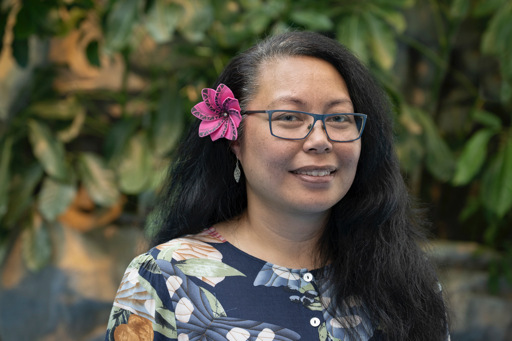

Dr Safua Akeli is the first person of Pacific heritage to take on the role of curator of an Oceania collection and head the Department of Ethnology at a European museum. (Image supplied)
Historian Tanja Rother visits a German museum that’s trying to decolonise its own Pacific narrative.
When you step out of the train station onto the big square in the centre of Bremen, a large city in the northwest of Germany, it feels a world away from the Pacific.
Yet the Übersee (“overseas”) Museum, a monumental building dominating the busy square, houses a large collection of Sāmoan measina, Māori taonga, and many other “objects” from Oceania.
It’s here that I meet Dr Safua Akeli, the first person of Pacific heritage to take on the role of curator of an Oceania collection and head the Department of Ethnology at a European museum.
More than 30 years after Mina McKenzie urged European museum professionals to “keep the taonga warm”, I’m interested to find out from Safua if she thinks progress has been made towards rebuilding relationships between artefacts and their communities of origin, and towards decolonising museum narratives more broadly.

The Übersee Museum in Bremen, advertising its Blue Continent exhibition of Pacific taonga. (Photo supplied)
Togialelei Safua Akeli Amaama was born in Sāmoa, and, from the age of five, grew up in Aotearoa New Zealand and Australia. She also lived in Sāmoa from 2015 to 2020. Safua is one of the Pacific’s leading Sāmoan studies scholars. She previously led Te Papa Tongarewa’s History and Pacific Cultures department and was the director of the Centre for Sāmoan Studies at the National University of Sāmoa.
In Bremen, Safua is tasked with implementing the museum’s process of re-examining, reorganising, and reconnecting its Pacific, and particularly Sāmoan, collections, in partnership with the National University of Sāmoa.
Her job is part of a wider push from European museums to address their own institutional histories, which are often deeply embedded in colonialism.
The Übersee Museum opened in Bremen in 1896, a few years before Germany’s annexation of Western Sāmoa. As a major port, Bremen’s wealth was built by the merchants and explorers who drove German colonisation of the South Pacific. In addition to importing copra, cocoa, and rubber from Sāmoa, which was under German rule from 1900 to 1914, large quantities of cultural artefacts, then often known as “curios”, were also shipped to Bremen.
Today, there are 20,000 “objects” from the Pacific housed at the Übersee Museum — more than there are at Te Papa.
The museum’s new permanent exhibition, The Blue Continent — Islands of the Pacific, opened in 2025. It takes a fresh look at life and cultures in the Pacific, biodiversity, cultural identity, resource use, climate change, and the region’s colonial past.
The exhibition reflects the growing willingness of museums to question their Eurocentric origins and to research the origins of their collections, with particular questions asked about whether objects were gifted, legitimately acquired, or looted.
Safua’s role reflects a new openness to involve people from the communities of origin in this process. The new exhibition was co-designed by museum staff, academics and artists from Bremen, Sāmoa, Aotearoa New Zealand, and elsewhere in the Pacific over several years.
One display includes a traditional kava ceremony bowl. The display shows Ta‘iao Dr Matiu Matavai Tautunu in the museum’s storage space holding the bowl. Exhibition visitors can listen to a recording of Dr Tautunu explaining his connection to this Sāmoan measina.
In another section of the exhibition space, poets Hinemoana Baker and Dr Emelither Kihleng speak about objects in the collections that they’ve been involved with.
For example, to express her connection to a dohr, a belt for men of high status, Emelither, who is from the island of Pohnpei in Micronesia, writes: “You need our eyes to see us”, referring to the “locked up, caged” artefacts “behind glass, for decades”, which, she warns, are “not asleep . . . never asleep”.
Since Safua arrived at the Übersee Museum in early 2025, she’s had many colleagues from Oceania get in touch to request lists of the taonga held at the museum. “This is an important part of the work we have to do, to be transparent and share information,” she says.
The job has given her front-row access to conversations about how museums understand themselves.
“There’s a sense from the ‘Global South’ that Germany is at the forefront of discussions around repatriation, restitution and return,” she says. “Now that I’m inside the belly of the beast, I can see that there’s a lot of goodwill, but there’s also a lot of anxiety.”
She says the work focuses on “finding out how these taonga, our collections, came to be here. What are the entanglements, what are the mobilities that have enabled this?”
Provenance research is critical to this process, and Safua hopes to go beyond sourcing the standard documentary evidence. “We do need to have the communities engaged to help us understand how some of these taonga may have been used, how they were stored. Were there gender rituals around these? Were they secret, or sacred? And what sort of protocols do we have now? Do we need a place to make sure that we’re keeping things warm?”
None of that is easy, she admits, given there are so few Pacific people in Europe.
Safua also advocates for the repatriation of taonga. She recalls that in 2024, the Übersee Museum repatriated a canoe prow to Sāmoa.
The prow had been kept in storage for 136 years, bearing only a label with the inventory number D04870. The museum worked with Dr Brian Alofaituli in Apia to research the small wooden sculpture. It quickly became clear that a German naval officer, Wilhelm Souchon, had taken it by force, and he had meticulously documented the theft in his diary.
The prow is now part of an exhibition at the National University in Apia, where it is named “taumua”, short for taumualua, an iconic war canoe artefact.

Some of the taonga housed at the musuem. (Photo supplied)
Fortunately, museums such as the Übersee are becoming places where multiple layers of stories connected to a taonga are allowed to flow together. The new Oceania exhibition has encouraged people from Bremen and the surrounding areas to come forward and bring their own Pacific taonga to the museum.
Safua has been very surprised at what she’s seen: “High quality material that I haven’t seen in the Pacific. To hear the stories of how these individuals came to have these, it’s been quite amazing,” she says.
“The majority of donors really feel a connection, and they feel honoured to have some of these pieces. They want to donate them to where they will be cared for, and their stories remembered.”
Dr Tanja Rother is an independent researcher, historian and writer based in the Eastern Bay of Plenty. She has written historical reports for the Waitangi Tribunal, the Office of Treaty Settlements and Takutai Moana — Te Tari Whakatau, a unit in the Ministry of Justice, and the Crown Forestry Rental Trust. She dedicates her spare time to researching the decolonisation of museum practices, both in Aotearoa New Zealand and overseas.
The post Reckoning with a German museum’s Pacific past appeared first on E-Tangata.
From E-Tangata via This RSS Feed.