

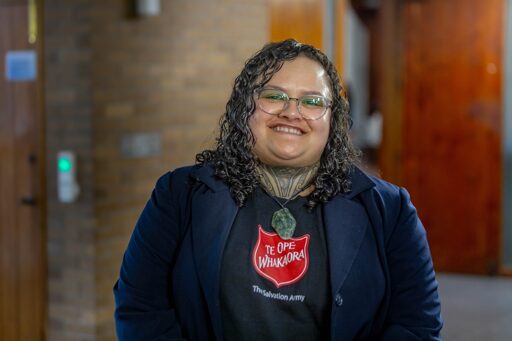

Charm Skinner, te ao Māori policy analyst for the Salvation Army. (Photo supplied)
The Salvation Army’s annual State of the Nation report is a snapshot of the health of the nation. It seldom delivers good news. This year, for the first time, it applied a Māori lens to the data, with the help of te ao Māori policy analyst, Charm Skinner.
Here’s Charm talking to Tracey Cooper about what that means.
When I was first asked to incorporate a Māori framework into the Salvation Army’s signature State of the Nation report, I cried a little bit.
Not from the joy of seeing the Salvation Army honouring its commitment to Te Tiriti o Waitangi and embracing an ao Māori worldview, but from the sheer scale of the task ahead.
For 19 years, the Salvation Army has presented its State of the Nation report, assessing the country’s wellbeing by looking at outcomes across five key areas: children and youth, work and incomes, housing, crime and punishment, and social hazards.
The report is intended to promote discussion about our progress towards wellbeing for everyone in Aotearoa New Zealand.
It’s important to understand that every piece of data reported across those five areas represents a key foundation for what sets whānau up to truly thrive and flourish.
So, when children and young people are thriving, when people have jobs that pay a living wage, when welfare systems provide adequate support, when there’s healthy kai on the table and a stable home, and when communities are protected from social hazards, we have a sound basis for community and whānau wellbeing.
The report has, for some years, included a section focusing specifically on how the statistics relate to Māori — but this year, for the first time, the report includes an assessment of Māori wellbeing using a te ao Māori framework, Te Whānau o te Ora.
As the Salvation Army’s te ao Māori policy analyst, my role was to bring together the data in the report and apply the layers of Te Whānau o te Ora — kawa, tikanga, ritenga and āhuatanga — to make it all make sense.
This was hard because, on the one hand, you’ve got this stats monster, which is like the paipera or bible of stats and data that everyone looks to — and which is really important and has its own mana. And then you’re trying to merge that with Te Whānau o te Ora. It was incredibly difficult because we didn’t want to be mixing our evidence-based research and data with what some people call “airy-fairy” stuff, like wellbeing.
We know that the State of the Nation really does highlight some damning statistics — and that’s its purpose. It’s supposed to put on the record what’s not working.
But we wanted to try to include another way of looking at wellbeing — and the Whānau o te Ora framework enables that.
It’s not our framework. It builds on the mahi of the late Professor Manuka Henare and Professor Piri Sciascia, and more recently, Sacha McMeeking, working alongside the National Iwi Chairs Forum.
The framework uses the four interconnected layers of kawa, tikanga, ritenga, and āhuatanga to show how upstream influences shape downstream outcomes.
Using it helps my team and me explain the deeper story behind the statistics.
For instance, if we start with kawa — the intrinsic quality of life, which includes our identity, belonging and sense of who we are — we can see how the child data we report on brings this into sharp focus.
If tamariki aren’t raised with the things that are integral to Māori identity, such as our culture, language and whakapapa, then their sense of identity can be weakened from the very beginning. Over time, that loss can manifest in many ways throughout their lives.
We can clearly see this in the data showing that rangatahi who learn predominantly in te reo Māori achieve at least as well as non-Māori students and significantly better than Māori students who learn only in English.
When we look to tikanga — the structural and societal factors that shape whānau realities — we ask which system settings are contributing to the outcomes we’re seeing. It’s here that colonisation emerges as the root cause, made visible by the ongoing breaches of Te Tiriti o Waitangi and embedded in the systems and structures that shape the day-to-day lives of some of our most vulnerable people.
I see this play out in the everyday realities that many of our whānau face — the continuing cost-of-living crisis, cuts to social supports, and the barriers that make life harder.
These aren’t abstract forces. They have real, daily impacts on the wellbeing of some of our whānau.
Then there’s ritenga — the behaviours and choices whānau make within the constraints they face. This is where we see how people navigate life with limited options. It might mean choosing between paying the power bill and kai, moving to find work, or taking on extra mahi whenever it’s available. These decisions aren’t failures — they’re responses to pressure points created by the systems around them.
And finally, āhuatanga — the visible outcomes, the things we can measure and observe. The symptoms are homelessness, no kai on the table, child poverty, housing stress, over-representation in state care or justice, and distress among rangatahi. They flow from one another, each layer building on the last, the natural result of what happens when identity is weakened, and systems don’t work for whānau.
Āhuatanga shows us the end of the pipeline, but the framework breaks down the things we need to focus on to change those outcomes.
When we combine all those factors, it shows us that we need to look at the systems — and that’s what this is trying to do. What we report on isn’t new, but the urgency of the need is only increasing.
As Bonnie Robinson, the director of the Salvation Army, writes in this year’s report: “The statistics tell us that we cannot solve social wellbeing deficits one person at a time. As a nation, without change to the underlying drivers of the statistics in this report, we simply farm these issues, helping some, while at the same time, more people come through the funnel of need.”
I think of Matua Moana Jackson in this mahi, of his legacy and the very real need to carry that work forward, striving towards the fruition of Matike Mai and a future where Te Tiriti is truly honoured.
Understanding these principles of kawa, tikanga, ritenga, and āhuatanga has been a lifelong journey for me. I wasn’t brought up around that way of life, but my aunties and cousins in my hapū humble me and continue to teach me through their actions. When I look at kawa, there are just certain ways you’re taught to do things. It’s as simple as, “Don’t sit on the table.”
Plus, I’ve been privileged to have awesome guides and mentors around me — people like Whaea Margaret Mutu, Matua Bill Hamilton, Matua Moana Jackson, and Dr Claire Charters.
We also included whānau stories in the report, and I think that lifts it to another level. It honours the data by grounding it in lived experience through showing what those numbers actually mean in real lives.
A chief executive or senior leader may not read much beyond the summary, so you have to capture them quickly — the data has to land, resonate, and spark something. Ideally, someone sitting in a meeting thinks: “That story stayed with me. We need to focus on this, direct more funding here, or hear more from that organisation.”
That’s the power of pairing evidence with real voices. It brings truth to power, it opens the door for the harder conversations, and it’s often in that space where the story meets the system that change begins.
I hear stories from our frontline kaimahi about kaumātua or nannies caring for six or more mokopuna who have no kai. The food bank does its best to help, and they leave with a parcel. On paper, that looks good — a 65-year-old nanny received a food parcel. But that doesn’t show the real picture*,* or the mahi that social workers and others put in behind the scenes.
Growing up in Fairfield in Kirikiriroa, I grew up in struggle, and I saw many other whānau around us struggling. A lot of the whānau who come through our doors at the Salvation Army are like my whānau that I grew up with.
That’s why I went to uni, to be able to help our people with the tools that I’ve gained. I care about justice and good outcomes, and I see the Salvation Army as making a difference for people on the ground and for many of our whānau Māori.
I said at the start that this mahi made me cry — and we could all get a bit tearful when we look at some of the Māori statistics.
Nearly a quarter of our tamariki are living in material hardship, more of our rangatahi are experiencing psychological distress, and we continue to be over-represented in state care and the criminal justice system.
The Whānau o te Ora framework shows us exactly where we need to put our efforts to improve wellbeing. It’s the systems we need to fix, not our people.
You can read the full 2026 State of the Nation report here.
As told to Tracey Cooper.
Charm Skinner (Ngāti Wairere), te ao Māori policy analyst at Te Ope Whakaora (the Salvation Army), has a Bachelor of Arts and a Bachelor of Laws from the University of Auckland. Before joining the Salvation Army, she was a former fellow of the United Nations Office of the High Commissioner for Human Rights Indigenous Fellowship Programme, worked at Te Kāhui Tika Tangata (the Human Rights Commission), and served as a senior advisor at the Ministry of Justice.
*Tracey Cooper (*Tainui me Ngāti Ranginui) is a former Waikato Times chief reporter, award-winning writer, and communications specialist.
The post It’s the systems we need to fix, not our people appeared first on E-Tangata.
From E-Tangata via This RSS Feed.