

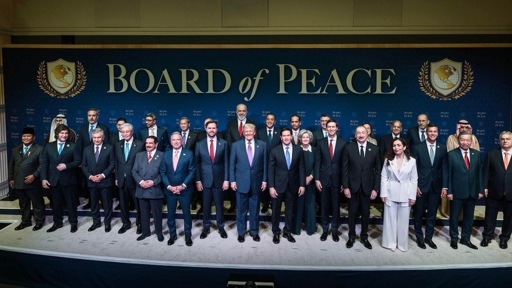
One month after Washington had announced the launch of phase two of the US-brokered Gaza ceasefire deal, developments regarding Trump’s “Board of Peace”, which is supposed to administer the besieged enclave in the post-war era, are still unfolding.
The new developments revolve around three major pivots, including a pledge of USD 17 billion for rebuilding the war-ravaged territory, exploring the creation of a new digital currency to boost its economy, and the commitment of five countries to join the so-called International Stabilization Force (ISF).
Trump announces USD 17 billion pledge towards Gaza “relief package”
US President Donald Trump announced on Thursday, February 19, during the inaugural meeting of his Board of Peace (BoP) in Washington that nine of the countries that joined the US-led multi-tier body, have pledged a total of USD 7 billion to support relief efforts in Gaza.
These countries include Kazakhstan, Azerbaijan, The United Arab Emirates, Morocco, Bahrain, Qatar, Saudi Arabia, Uzbekistan, and Kuwait.
Trump also said that the US vowed USD 10 billion, emphasizing that the sum is very small when compared to the cost of war, during which his administration provided unwavering support to Israel.
“It’s two weeks of fighting,” Trump noted. “Sounds like a lot, but it’s a very small number,” he asserted.
It is worth noting that 50 countries were invited to join the inaugural meeting, 27 out of which attended, while the rest took part as observers.
Besides the countries that pledged the donation, the following countries attended the first meeting: Albania, Argentina, Armenia, Belarus, Bulgaria, Cambodia, Egypt, El Salvador, Hungary, Indonesia, Israel, Jordan, Kosovo, Mongolia, Pakistan, Paraguay, Türkiye, Vietnam.
Meanwhile, countries that sent their delegates to the meeting as observers were: Austria, Croatia, Cyprus, Czech Republic, European Union, Finland, Germany, Greece, India, Italy, Japan, Mexico, Netherlands, Norway, Oman, Poland, South Korea, Romania, Slovakia, Switzerland, Thailand, and the United Kingdom.
Notably, the list of observers contains key US allies, the UK, Italy, and Norway, who, alongside France and Sweden, had declined to join the board over concerns apparently related to its charter.
It is said that these countries objected to not mentioning Gaza in the charter directly. On the other hand, they are concerned that the board’s mandate may undermine the United Nations’ role in peacekeeping efforts.
The Vatican had also declined to join the BoP, as it believes that the crisis situations in Gaza should be handled by the UN.
According to the Holy See secretary of state, Cardinal Pietro Parolin, the Vatican will not accept the invitation as it was left “perplexed” by some points of the board’s plan, pointing out that “critical issues” needed to be resolved.
Moreover, Trump had already revoked his invitation to Canada to become a member of the board last month, after its Prime Minister warned of a “rupture” in the US-led world order during the World Economic Forum in Davos.
The invitation of Israeli Prime Minister Benjamin Netanyahu has provoked significant controversy too, given the Israeli leader’s key role in driving the genocide in Gaza and the existence of a warrant for his arrest from the International Criminal Court (ICC).
Read more: ICC issues arrest warrants for Netanyahu and Gallant as the genocide continues in Gaza
The BoP is reportedly exploring the creation of a US dollar-pegged cryptocurrency
The Financial Times said in a report on Monday, February 23, that it was told by sources familiar with the discussions that the “Board of Peace” is exploring the creation of a US dollar-pegged stablecoin in the form of a cryptocurrency, to restructure the devastated enclave’s economy.
The Euro-Med Human Rights Monitor slammed the proposal, warning that “introducing digital wallets as a technical solution for reconstruction functions as a cover for a new phase of engineering control over the population and increasing economic reliance on Israel.”
The Geneva-based human rights organization further cautioned that “any digital infrastructure established under occupation or international tutelage without full Palestinian sovereignty over data and financial systems risks becoming a tool for collective control and subjugation.”
“Israel has frequently enforced arbitrary movement restrictions based on vague and non-appealable security reasons, raising fears that similar restrictions could extend to access to financial resources,” the organization maintained.
Five countries vowed to join the ISF
With regard to efforts aiming to maintain “stability and security” in Gaza, US Army Major General Jasper Jeffers, declared during Thursday’s meeting that five countries agreed to send their troops to serve in the International Stabilization Force (ISF) in the war-torn territory.
These countries include: Indonesia, Morocco, Kazakhstan, Kosovo, and Albania.
The High Representative of the BoP, Nickolay Mladenov, also announced the launch of the recruitment process for a transitional Palestinian police force, which Egypt and Jordan have already begun to train on Egyptian soil. Mladenov added that 2,000 individuals had applied to join the police force within hours.
EU signals cautious willingness to join BoP, while waiting for Israel’s approval to train Gaza police
In what appears to be an effort to bridge the gaps between European nations over Trump’s BoP, the foreign ministers of the European Union (EU) convened with Mladenov in Brussels on Monday.
The EU’s foreign policy chief, Kaja Kallas, stated ahead of the meeting that the bloc wants to be part of the peace process in the Gaza strip and contribute with what it has.
In addition, Kallas suggested the European Union Mission for the Support of Palestinian Police and Rule of Law (known as EUPOL COPPS) assist Jordan and Egypt in training the new police force in Gaza. However, she said that the EU needs Israel’s approval to do so.
“We have agreements with the Jordanian and Egyptian sides, but we also need Israel’s approval,” Kallas affirmed.
Israel’s genocidal aggression continues in Gaza despite the BoP’s discussions
While the Trump administration has been promoting the BoP and trying to push forward the transitional period in Gaza, Israel has not stopped its genocidal aggression on the besieged strip.
Not 48 hours after the Board of Peace inaugural meeting, on Saturday, February 21, Israeli warplanes launched airstrikes in different parts of Gaza, killing at least two people. The assault raised the death toll of Palestinians killed since the US-sponsored truce took effect in October 2025 to 614.
This in turn takes the tally of Palestinian people who were killed in Israel’s genocidal aggression on Gaza since October 7, 2023, to 72,072. A huge number of victims, which does not seem to be a factor in the economic and political calculations of world leaders, who are eagerly waiting to divide the Gaza pie amongst themselves through Trump’s BoP.
The post Cryptocurrency, billions of dollars, and five countries to send troops: what’s new in Trump’s “Board of Peace” for Gaza appeared first on Peoples Dispatch.
From Peoples Dispatch via This RSS Feed.