

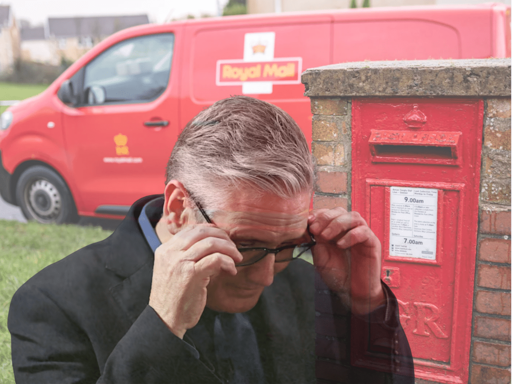

Royal Mail bosses are being called to Parliament to answer for the company’s current failures. The news comes after hundreds of people contacted BBC Your Voiceto complain about late deliveries.
Of course, the news follows less than one year after the company was bought out by Czech billionaire Daniel Kretinsky. The move is the latest nail in the coffin of a decade-long push to privatise the once-national delivery service.
Repeated failures
In particular, disgruntled customers complained about the Royal Mail’s prioritisation of parcels over letters. This led to crucial communications – e.g. hospital appointments – being missed. Likewise, some people also highlighted that important documents, such as school certificates and bank statements, had also been lost.
Royal Mail staff told the BBCthat they were stretched beyond capacity. This meant that some delivery offices were missing rounds, in turn leading to difficult decisions about prioritising some mail over others.
Back in October 2025, communications watchdog Ofcom issued a £21 million fine to Royal Mail for failing to meet delivery targets in the 2024/25 financial year. The company only delivered 92.5% of second-class and 77% of first-class mail on time. The target levels were 98.5% and 93%, respectively.
It was the third time in as many years that Ofcom found Royal Mail to be in breach of its obligations.
‘Significant concerns’
Regarding the fresh wave of complaints, the Business and Trade Committee originally gave Royal Mail two weeks to answer for itself. In a 16 February letter to interim CEO Alistair Cochrane, committee chair Liam Byrne raised:
significant concerns about the quality of postal service being provided by Royal Mail.
You will be well aware of the recent failures in service that have been reported to the press and to Members of Parliament. In recent days, the Royal Mail website has listed well over 100 postcodes across the UK at risk of service disruption due to “local issues such as high levels of sick absence, resourcing, or other local factors”.1 This chaos has continued into mid-February, well beyond the predictable pressures of the Christmas period.
He also asked a series of seven questions on the failures. The deadline for the Royal Mail’s response would have fallen on 2 March.
However, Byrne has reportedly decided that the allegations against the company are so severe that representatives should attend parliament to explain themselves.
On 26 February, Byrne said:
The Committee is very concerned by consistent and growing reports, and now many direct representations, about significant failures in Royal Mail’s letter delivery service.
In reply to the summons, a Royal Mail spokesperson stated that:
Attending the Business and Trade Committee will give us the opportunity to discuss the work we are doing to transform Royal Mail and the urgent need to implement changes to the Universal Service to deliver the services our customers want and ensure we are financially sustainable for the long term.
Bled dry by private profit
The Royal Mail has suffered a slow death to privatisation over the last thirteen years. Back in 2013, Lib Dem business secretary Vince Cable floated Royal Mail shares on the London Stock Exchange. At the time, 96% of Royal Mail staff were against the sale.
The last of the public shares were bought up in 2015. Since then, private shareholders have run, and profited from our postal service. And, almost like magic, postage costs have more than doubled in the last decade.
Nationalisation campaign group We Own It stated that:
Royal Mail is failing its customers. In line with the familiar pattern of privatisation, service standards have fallen while prices have risen, for the public and business customers alike. In 2023 the deteriorating service resulted in Royal Mail losing its monopoly on delivering from Post Office sites, it had to pay out £26 million in compensation, and was fined a paltry £5.6 million by its regulator, Ofcom.
Czech billionaire Daniel Kretinsky’s EP Group bought the company in April 2025. The effect on deliveries was immediate and catastrophic. On the subject of the takeover, Byrne said:
EP Group’s takeover was approved on a legal undertaking that it would maintain the Universal Service Obligation that is the bedrock of the UK’s postal service. But one year in, even first-class deliveries are way off track.
Privatisation IS the problem
This is an inevitable consequence of the privatisation of our public institutions. For-profit companies, by their nature, will try to extract as much money as possible. Simultaneously, they strip services back to the bare minimum and below.
We’ve seen it with our polluted waterways, we’ve seen it with our healthcare system, and we’ve seen it with the Royal Mail. Big businesses profit and gut services to breaking point, the government bails them out, and the public suffers.
Without addressing the root problem – privatisation – our public services will never recover. It’s time to end this failed experiment, once and for all.
Featured image via the Canary
From Canary via This RSS Feed.