


Sandra Hale Schulman
ICT
The latest: ‘A painting tells a story if you listen closely,’ future fabrics in New York City, woven tales and baseball poetry
ART: Fire, bulls and ravens
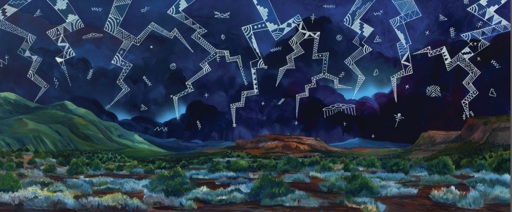
With Indigenous roots and artistic wings, Jesse Raine Littlebird, Laguna/Kewa Pueblo, is a multi-disciplinary artist, filmmaker, and storyteller. He even paints hotel rooms, such as the floor to ceiling freeform graphic murals at the Nativo Lodge in Albuquerque. Born in Santa Fe, New Mexico, Littlebird’s childhood was enriched by artisan parents.
A new series of paintings will be on display Feb. 27 – March 12, at Blue Rain Gallery in Santa Fe, New Mexico, with an artist’s reception set for Friday, Feb. 27, from 5-7 p.m.
His hybrid work marries Western and Indigenous elements, pulling iconography from Southwestern landscapes — lightning, rivers, mountains, and Indigenous culture, along with historical perspectives. He has exhibited throughout the Southwest art scene and has collectors across the globe.

Jesse Raine Littlebird, Laguna/Kewa Pueblo, is a multi-disciplinary artist, filmmaker, and storyteller whose works will be display through March 12, 2026, at the Blue Rain Gallery in Santa Fe, New Mexico. Credit: Photo courtesy of Blue Rain Gallery
“My work is inspired by teachings, prophecies, and stories common among Earthly rooted people,” Littlebird said. “I delve into the inner workings of what makes up thoughts, choices and actions of humankind, past, present and future.”
He said he considers himself “a sampler of art history” to examine modern life.
“For example,” he said, “applying a quote by Vine Deloria Jr., ‘An Indian never questions whether or not he is an Indian. The query he faces is what kind of Indian,’ and juxtaposing that thought with a figure or a mass amount of figures in a landscape of energy and color.”
He concludes, “A painting tells a story if you listen closely.”
Littlebird is a Sundance Institute Full Circle Fellow and Andy Warhol Foundation recipient.
FASHION: Adornment as tools for resistance
A new exhibition from the Fashion Institute of Technology catwalks fashion and adornment as tools for resistance while passing down cultural knowledge during environmental and social change.
The exhibition, “Adorned Futures: Fabric, Form, and Indigenous Resistance,” in the institute’s Art & Design Gallery in New York City, explores textile, fiber, and wearable art as places of cultural resilience, Indigenous futurism, and environmental storytelling.
It features hand-dyed textiles, beadwork, wearable works, photographic documentation, and collaborative fashion design projects created by Ma’s House artists and institute students.

Shinnecock artist and fine arts photographer Jeremy Dennis is the founder and lead artist of Ma’s House & BIPOC Art Studio residency program and studio on the Shinnecock reservation in Southhampton, New York. Credit: Photo courtesy of Fashion Institute of Technology
The works honor ancestral knowledge that imagine Indigenous futures grounded in sovereignty, sustainability and care for the land and sea.
The exhibition opened Wednesday, Feb. 25, and continues through Sunday, March 29, at Ma’s House & BIPOC Art Studio, Inc., a Shinnecock-led artist residency and studio located on the Shinnecock Indian Reservation in Southampton, New York.
Shinnecock artist and fine arts photographer Jeremy Dennis is the founder and lead artist of Ma’s House. His work centers Indigenous identity, culture and the legacies of colonial assimilation.
BASKETRY: ‘Thousands of years in the making’
Seventh-generation Passamaquoddy basket-weaver Jeremy Frey is set to open his major solo exhibition March 26 at the Cantor Arts Center at Stanford University.

Woven baskets such as this one are part of a solo exhibition by seventh-generation Passamaquoddy basket-weaver Jeremy Frey that runs March 26-July 20, 2026 at the Cantor Arts Center at Stanford University. Credit: Photo courtesy of Jeremy Frey
The exhibit, which runs through July 20, 2026, marks the final stop and only West Coast venue for the show, which has been shown at the Portland Museum of Art in Maine), the Art Institute of Chicago and the Bruce Museum in Greenwich, CT.
The exhibit, “Jeremy Frey: Woven,” spans works from the past 25 years, including 30 baskets, prints, a new video, and a large-scale woven sculpture. Frey describes the show as “thousands of years in the making.”
Frey learned from his maternal ancestry and parents, but the artistic craft is also a core cultural language for the Passamaquoddy, who are part of the Wabanaki Confederacy.

Seventh-generation Passamaquoddy basket-weaver Jeremy Frey will be featured in a major solo exhibition starting March 26, 2026, at the Cantor Arts Center at Stanford University.The exhibit, which runs through July 20, 2026, includes 30 baskets, prints and a large-scale woven sculpture. Credit: Photo courtesy of Jeremy Frey
Frey uses traditional black ash, sweetgrass, cedar, and porcupine quills to honor traditions while creating his own complex, double-wall basket construction with color and graphic elements that push the medium into ambitious realms.
The 2025 MacArthur Fellow took instruction and guidance from The Maine Indian Basketmakers Alliance in the early 2000s, and ended up winning Best of Show at the Santa Fe Indian Market. He was the first basket-maker to receive the award in nearly 100 years.
His journey — from chef to master weaver, from endangered weaving tradition to major arts exhibit — helps secure a future for the fragile practice while radically expanding its possibilities.
AUTHORS: Festival seeks Native poets who love baseball
The National Baseball Poetry Festival is seeking Native poets for its annual contest celebrating the game known as America’s pastime.
The poetry festival, now in its 4th year, will be held May 7-10 in Worcester, Massachusetts, the home of the Worcester Red Sox and hometown of Ernest Thayer, author of perhaps the most famous baseball poem ever written, “Casey at the Bat.”
The festival organizers want to recognize the key role Native athletes have played in the game, from early Native athletes like Louis Sockalexis and the legendary Jim Thorpe to modern players such as Joba Chamberlain and Jacobi Elsbury.
The poetry contest features two categories — one for adults, and another for youths in grades 4-12. Entries must be submitted by April 17 in the body of an email (not as an attachment) sent to baseballpoetryfest@gmail.com. The entry must include the poet’s name, category (adult or youth) and email address. Youth entries must also include the school, grade, and guardian name and email address.
The post INDIGENOUS A&E: Prophetic art, textiles as identity, baskets through the ages and poetry appeared first on ICT.
From ICT via This RSS Feed.