

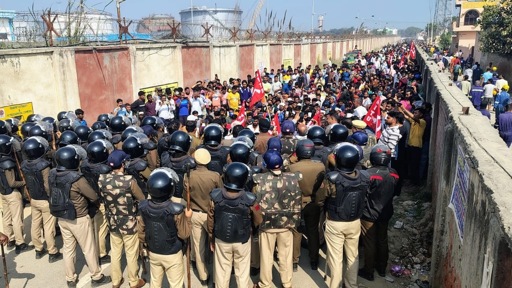
Thousands of workers at the public sector refinery and petrochemical complex in Panipat, Haryana, are on strike in opposition to an extension in working hours at the complex. Beginning on Monday, February 23, the strike was joined by thousands of contractual workers who have complained they are being forced to work 12 hours instead of the stipulated 8-hour days, without being paid overtime wages.
The workers are also demanding the regular and timely payment of their wages, weekly holidays, and the overall improvement in working conditions, among several other demands.
Several workers have also complained that they are not even allowed access to basic amenities and are mostly deprived by contractors of basic legal protections, such as their provident funds (mandatory, government-backed retirement savings).
Though the talks are ongoing, workers have refused to be intimidated by the management and local administration’s rumors and repeated attempts to use force.
They continue to stage a sit-in, blocking the main entrance of the facility located just 100 km’s from the national capital, New Delhi.
The majority of the striking workers are employed at an extension project of the refinery and petrochemical compound owned by public sector giant Indian Oil Corporation (IOC). It is one of the largest such refineries in all of South Asia.
Threats and intimidation by the management
Workers began the sit-in protest on Monday, immediately after declaring the strike, and blocked the entrance of the facility in support of their demands.
The management has repeatedly used the security personnel deployed in the facility to threaten and intimidate the striking workers, trying to demand they to return to work, which has led to almost daily clashes and scores of workers and security personnel being injured.
However, the workers have refused to end the strike or the sit-in protests. Meanwhile, various rounds of talks have been conducted between the management and representatives of the workers.
The management and administration claimed on Wednesday that they had agreed to all the demands raised by the workers, however, workers refused to continue work until the management gave them written assurances.
A fresh round of talks began on Thursday with several major trade unions, such as the Centre for Indian Trade Union (CITU), the All India Trade Union Congress (AITUC) and the All India Central Council of Trade Unions (AICCTU), extending their support to the striking workers.
CITU, in a press release on Thursday, claimed that “powerful images and videos coming from Panipat have rekindled the determination and hope of the working class across the country.”
It acknowledged the role of the contractual working in the struggle at Panipat refinery, saying it “has again established the leading role of the non-permanent workers in India’s militant class oriented movement.”
A larger fight
Addressing the sit-in on Thursday, CITU Haryana state leader Jai Bhagwan claimed that the attack on workers rights is part of the larger project of the pro-corporate government in the country.
CITU claimed the Panipat struggle should not be seen as an “isolated” incident but it is “rather part of the annoying nationwide workers combative resistance.”
Bhagwan mentioned how the four new labor codes normalize the extended working hours and contractualization, in complete violation of the basic rights of the workers and threatens their right to form unions and go on strike.
All major trade unions in the country, under the banner of the Central Trade Unions (CTUs), had called for a national strike on February 12, demanding the withdrawal of the four labor codes and other regressive anti-worker laws and policies of the union government.
Read more: 300 million on the streets in a historic national strike in India
Over 300 million workers and farmers in India participated in the nationwide strike, which the CTUs claimed was part of the larger movement against the anti-people policies of the current government.
The post Thousands of refinery workers in India strike against 12-hour workday appeared first on Peoples Dispatch.
From Peoples Dispatch via This RSS Feed.